Showing posts with label BCP. Show all posts

2017-02-23

Historical and True Anglicanism

The Rev'd Dr. Percy Dearmer
“The English Church happens to base herself in a special manner upon history–she appeals to the Scriptures and primitive antiquity for her theology, [* Articles VI., VIII., etc.] to the ancient Fathers for her ritual, [* The Preface Concerning the Service of the Church, Article XXIV., etc.] to Catholic tradition for her ceremonial; [* The Preface Of Ceremonies, Canon 30 (1603), Canon & (1640), etc.] she refers us to the second year of Edward VI for her ornaments, [* The Ornaments Rubric] and to the later middle ages for the arrangement of her chancels. [* "And the chancels shall remain as they have done in times past." (First inserted in 1552.)] [24/25] Her formularies, therefore, cannot be understood without a good deal of historical knowledge. Some people may object to this, and may ask–Why should they be bound by documents that are two or three hundred years old? But the fact remains that they are so bound, whether they like it or not; and that the whole intention of the Reformers, as shown from end to end of the Prayer Book, Articles, and Canons, was to bind them to principles that are nearer two thousand than two hundred years of age. Nor will they be released from this bondage to historic continuity till the same authority that imposed it shall have removed it,–which will not be for a long time to come. The attempts that have been hitherto made at throwing off this light yoke have not been so conspicuously successful in their results as to encourage us to proceed. Therefore I ask Churchmen to renounce those futile experiments of private judgment, and to throw themselves into the task of realising in its entirety that sound Catholic ideal which the defenders of the English Church preserved for us through the most troublous period of her history."
– The Rev'd Dr. Percy Dearmer
Loyalty to the Prayer Book

2015-03-31

Why Anglican? By J I Packer

J.I. Packer:
I identify myself as a heritage Anglican, or a main stream Anglican, on the basis of that view of things. I adapt to state my Anglican identity, words from the great Pastor Duncan of the Free Church of Scotland, who something like 150 years ago, said in answer to a question about his identity as a minister of the church, “I’m first a Christian, second a Protestant, third a Calvinist, fourth a Paedo-baptist, and fifth a Presbyterian”. Well, I go with the first four; and then “fifth I’m an Anglican”. And if I’m asked to explain further what is the Anglicanism that I stand for, I reel off eight defining characteristics of my Anglicanism like this.
Anglicanism is first biblical and protestant in its stance, and second, evangelical and reformed in its doctrine. That’s a particular nuance within the Protestant constituency to which the Anglican church is committed – the 39 Articles show that. Ten, thirdly, Anglicanism is liturgical and traditional in its worship.
I go on to say, fourthly, Anglicanism is a form of Christianity that is pastoral and evangelistic in its style. I quote the ordinal for that and I point out that ever since the ordinal and the prayer book required the clergy to catechize the children, Anglicanism has been evangelistic, though the form of the evangelism has not been that of the travelling big tent – the form of the evangelism has been rather institutional and settled; the evangelism was part of the regular work of the parish clergyman and the community around him. But let nobody say that institutional parochial Anglicanism is not evangelistic and, today, I know the wisest folk here in England are recovering parochial evangelism in a significant way. Thank God they are.
And then I say, fifthly, that Anglicanism is a form of Christianity that is episcopal and parochial in its organization and, sixthly, it is rational and reflective in its temper. I make a point of that. I say that, in Anglican circles, any question can be asked and the Anglican ethic is to take the question seriously and discuss it responsibly. There are, of course, Protestant churches which, I think you have to say, are always running scared and as soon as a question of this kind – a real puzzle of our Christian truth, of the ways of God – is raised in their circles, they bring out the big stick. “Now you mustn’t talk like that, you shouldn’t be concerning yourself about that. Just stay with the ABC of the Gospel and Bible truth”. Theological reflection is discouraged rather than helped on its way. That makes, I believe, for real immaturity. So I celebrate the fact that Anglicanism, characteristically is rational and reflective and believes in the discipline of debate and sustained discussion, believing, you see, that like panning for gold, the gold of truth will be distilled out through the discussion and the dross of error will be panned away.
Seventhly, I tell people that Anglicanism as a form of Christianity is ecumenical and humble in spirit. Unlike some denominations, we do not claim that Anglicanism is self-sufficient. What we say, rather, is that the Anglican way is the way of a person with an unlimited charge card going through a large department store and being free to say of every valuable thing you see and would like to make your own: “That’s for me. Put it on charge”. Anglicans have always rejoiced to receive wisdom from outside their own circles. They have a vision of Christendom as a fragmented reality with flashes of truth and wisdom scattered all across the board. Our business as Anglicans, seeking the glory of God, is to pick up as much truth and wisdom (get as much help, I mean, from these scattered shards of truth and wisdom) as we possibly can. I am comfortable with that. I would be uncomfortable with anything else.
Then, eighthly, I tell people that Anglicanism characteristically is national and transformist in its outlook. By `national’ I mean that the Anglican way is to accept concern for the spiritual condition of the national group within which the gospel is being preached. By `transformist’ I mean that Anglicans seek, under Christ, to see the culture changed into a Christian mould as far as maybe. So Anglicans have always been concerned about education and educational institutions, and about a Christian voice being raised in Government and things of that kind. Please God, it will always be that way wherever Anglicans go.
All this sounds, I suppose, very triumphalist; but I do believe that Anglicanism embodies the richest, truest, wisest heritage in all Christendom. When people say “Those are fine words but everywhere in the west Anglicanism is sinking”, I have to admit – in Canada, yes, and in Britain, yes, and in the States, yes, and in Australasia, sure. It is true; but still, I think, we may stay our hearts by reminding ourselves what is going on under Anglican auspices in black Africa. There the church grows and the gospel advances by leaps and bounds.

2010-09-11

Commination for 9-11

A Commination,

or Denouncing of God's Anger and Judgements against Sinners,

With certain Prayers, to be used on the first Day of Lent, and at other times, as the Ordinary shall appoint.
After Morning Prayer, the Litany ended according to the accustomed manner, the Priest shall, in the reading Pew or Pulpit, say,
BRETHREN, in the Primitive Church there was a godly discipline, that, at the beginning of Lent, such persons as stood convicted of notorious sin were put to open penance, and punished in this world, that their souls might be saved in the day of the Lord; and that others, admonished by their example, might be the more afraid to offend.
Instead whereof, until the said discipline may be restored again, (which is much to be wished,) it is thought good, that at this time (in the presence of you all) should be read the general sentences of God's cursing against impenitent sinners, gathered out of the seven and twentieth Chapter of Deuteronomy, and other places of Scripture; and that ye should answer to every Sentence, Amen: To the intent that, being admonished of the great indignation of God against sinners, ye may the rather be moved to earnest and true repentance; and may walk more warily in these dangerous days; fleeing from such vices, for which ye affirm with your own mouths the curse of God to be due.

CURSED is the man that maketh any carved or molten image, to worship it.

And the people shall answer and say,
Amen.
Minister. Cursed is he that curseth his father or mother.
Answer. Amen.
Minister. Cursed is he that removeth his neighbour's landmark.
Answer. Amen.
Minister. Cursed is he that maketh the blind to go out of his way.
Answer. Amen.
Minister. Cursed is he that perverteth the judgement of the stranger, the fatherless, and widow.
Answer. Amen.
Minister. Cursed is he that smiteth his neighbour secretly.
Answer. Amen.
Minister. Cursed is he that lieth with his neighbour's wife.
Answer. Amen.
Minister. Cursed is he that taketh reward to slay the innocent.
Answer. Amen.
Minister. Cursed is he that putteth his trust in man, and taketh man for his defence, and in his heart goeth from the Lord.
Answer. Amen.
Minister. Cursed are the unmerciful, fornicators, and adulterers, covetous persons, idolaters, slanderers, drunkards, and extortioners.
Answer. Amen.

Minister.
NOW seeing that all they are accursed (as the prophet David beareth witness) who do err and go astray from the commandments of God; let us (remembering the dreadful judgement hanging over our heads, and always ready to fall upon us) return unto our Lord God, with all contrition and meekness of heart; bewailing and lamenting our sinful life, acknowledging and confessing our offences, and seeking to bring forth worthy fruits of penance. For now is the axe put unto the root of the trees, so that every tree that bringeth not forth good fruit is hewn down, and cast into the fire. It is a fearful thing to fall into the hands of the living God: he shall pour down rain upon the sinners, snares, fire and brimstone, storm and tempest; this shall be their portion to drink. For lo, the Lord is come out of his place to visit the wickedness of such as dwell upon the earth. But who may abide the day of his coming? Who shall be able to endure when he appeareth? His fan is in his hand, and he will purge his floor, and gather his wheat into the bam; but he will burn the chaff with unquenchable fire. The day of the Lord cometh as a thief in the night: and when men shall say, Peace, and all things are safe, then shall sudden destruction come upon them, as sorrow cometh upon a woman travailing with child, and they shall not escape. Then shall appear the wrath of God in the day of vengeance, which obstinate sinners, through the stubbornness of their heart, have heaped unto them, selves; which despised the goodness, patience, and long, sufferance of God, when he calleth them continually to repentance. Then shall they call upon me, (saith the Lord,) but I will not hear; they shall seek me early, but they shall not find me; and that, because they hated knowledge, and received not the fear of the Lord, but abhorred my counsel, and despised my correction. Then shall it be too late to knock when the door shall be shut; and too late to cry for mercy when it is the time of justice. O terrible voice of most just judgement, which shall be pronounced upon them, when it shall be said unto them, Go, ye cursed, into the fire everlasting, which is prepared for the devil and his angels. Therefore, brethren, take we heed betime, while the day of salvation lasteth; for the night cometh, when none can work. But let us, while we have the light, believe in the light, and walk as children of the light; that we be not cast into utter darkness, where is weeping and gnashing of teeth. Let us not abuse the goodness of God, who calleth us mercifully to amendment, and of his endless pity promiseth us forgiveness of that which is past, if with a perfect and true heart we return unto him. For though our sins be as red as scarlet, they shall be made white as snow; and though they be like purple, yet they shall be made white as wool. Turn ye (saith the Lord) from all your wickedness, and your sin shall not be your destruction: Cast away from you all your ungodliness that ye have done: Make you new hearts, and a new spirit: Wherefore will ye die, O ye house of Israel, seeing that I have no pleasure in the death of him that dieth, saith the Lord God? Tom ye then, and ye shall live. Although we have sinned, yet have we an Advocate with the Father, Jesus Christ the righteous; and he is the propitiation for our sins. For he was wounded for our offences, and smitten for our wickedness. Let us therefore return unto him, who is the merciful receiver of all true penitent sinners; assuring ourselves that he is ready to receive us, and most willing to pardon us, if we come unto him with faithful repentance; if we submit ourselves unto him, and from henceforth walk in his ways; if we will take his easy yoke, and light burden upon us, to follow him in lowliness, patience, and charity, and be ordered by the governance of his Holy Spirit; seeking always his glory, and serving him duly in our vocation with thanksgiving: This if we do, Christ will deliver us from the curse of the law, and from the extreme malediction which shall light upon them that shall be set on the left hand; and he will set us on his right hand, and give us the gracious benediction of his Father, commanding us to take possession of his glorious kingdom: Unto which he vouchsafe to bring us all, for his infinite mercy. Amen.

Then shall they all kneel upon their knees, and the Priest and Clerks kneeling (in the place where they are accustomed to say the Litany) shall say this Psalm.

Miserere mei, deus. Psalm 51
HAVE mercy upon me, O God, after thy great goodness: according to the multitude of thy mercies do away mine offences.
Wash me thoroughly from my wickedness: and cleanse me from my sin.
For I acknowledge my faults: and my sin is ever before me.
Against thee only have I sinned, and done this evil in thy sight: that thou mightest be justified in thy saying, and clear when thou art judged.
Behold, I was shapen in wickedness: and in sin hath my mother conceived me.
But lo, thou requirest truth in the inward parts: and shalt make me to understand wisdom secretly.
Thou shalt purge me with hyssop, and I shall be clean: thou shalt wash me, and I shall be whiter than snow.
Thou shalt make me hear of joy and gladness: that the bones which thou hast broken may rejoice.
Turn thy face away from my sins: and put out all my misdeeds.
Make me a clean heart, O God: and renew a right spirit within me.
Cast me not away from thy presence: and take not thy Holy Spirit from me.
O give me the comfort of thy help again: and stablish me with thy free Spirit.
Then shall I teach thy ways unto the wicked: and sinners shall be converted unto thee.
Deliver me from blood guiltiness, O God, thou that art the God of my health: and my tongue shall sing of thy righteousness.
Thou shalt open my lips, O Lord: and my mouth shall shew thy praise.
For thou desirest no sacrifice, else would I give it thee: but thou delightest not in burnt-offerings.
The sacrifice of God is a troubled spirit: a broken and contrite heart, O God, shalt thou not despise.
O be favourable and gracious unto Sion: build thou the walls of Jerusalem.
Then shalt thou be pleased with the sacrifice of righteousness, with the burnt-offerings and ablations: then shall they offer young bullocks upon thine attar.
Glory be to the Father, and to the Son: and to the Holy Ghost;
Answer. As it was in the beginning, is now, and ever shall be: world without end. Amen.

Lord, have mercy upon us.
Christ, have mercy upon us.
Lord, have mercy upon us.

OUR Father, which art in heaven, Hallowed be thy Name. Thy kingdom come. Thy will be done in earth, as it is in heaven. Give us this day our daily bread. And forgive us our trespasses, As we forgive them that trespass against us. And lead us not into temptation; But deliver us from evil. Amen.

Minister. O Lord, save thy servants;
Answer. That put their trust in thee.
Minister. Send unto them help from above.
Answer. And evermore mightily defend them.
Minister. Help us, O God our Saviour.
Answer. And for the glory of thy Name deliver us; be merciful to us sinners, for thy Name's sake.
Minister. O Lord, hear our prayer.
Answer. And let our cry come unto thee.

Minister. Let us pray.
O LORD, we beseech thee, mercifully hear our prayers, and spare all those who confess their sins unto thee; that they, whose consciences by sin are accused, by thy merciful pardon may be absolved; through Christ our Lord. Amen.

O MOST mighty God, and merciful Father, who hast compassion upon all men, and hatest nothing that thou hast made; who wouldest not the death of a sinner, but that he should rather turn from his sin, and be saved: Mercifully forgive us our trespasses; receive and comfort us, who are grieved and wearied with the burden of our sins. Thy property is always to have mercy; to thee only it appertaineth to forgive sins. Spare us therefore, good Lord, spare thy people, whom thou hast redeemed; enter not into judgement with thy servants, who are vile earth, and miserable sinners; but so turn thine anger from us, who meekly acknowledge our vileness, and truly repent us of our faults, and so make haste to help us in this world, that we may ever live with thee in the world to come; through Jesus Christ our Lord. Amen.

Then shall the people say this that followeth, after the Minister.
TURN thou us, O good Lord, and so shall we be turned. Be favourable, O Lord, Be favourable to thy people, Who turn to thee in weeping, fasting, and praying. For thou art a merciful God, Full of compassion. Longsuffering, and of great pity. Thou sparest when we deserve punishment, And in thy wrath thinkest upon mercy. Spare thy people, good Lord, spare them, And let not thine heritage be brought to confusion. Hear us, O Lord, for thy mercy is great, And after the multitude of thy mercies look upon us; Through the merits and mediation of thy blessed Son, Jesus Christ our Lord. Amen.

Then the Minister alone shall say,
THE Lord bless us, and keep us; the Lord lift up the light of his countenance upon us, and give us peace, now and for evermore. Amen.

2010-08-23

A New Prayer Book


I have a feeling that some of the AC-NA folks are going to be really upset no matter what form the prayer book revision takes. Let's hope it's received better than the BCP was received in Scotland!

2010-05-12

Wednesday of Rogationtide

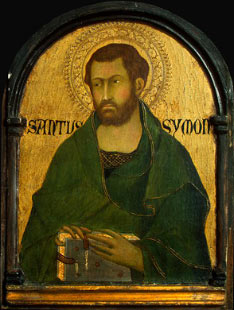
Today continues Rogationtide. We also commemorate Simon of Cyrene.

Here's the Morning Prayer service.


The (Traditional) Collect.

ALMIGHTY God, Lord of heaven and earth; We beseech thee to pour forth thy blessing upon this land, and to give us a fruitful season; that we, constantly receiving thy bounty, may evermore give thanks unto thee in thy holy Church; through Jesus Christ our Lord. Amen.

And if you haven't already taken a trip to the bounds of the parish...


2010-05-10

Rogationtide


The minor Rogation Days are the Monday, Tuesday, and Wednesday before we commemorate our Lord’s Ascension to the Father in Heaven on Ascension Day. “Rogation” comes from the Latin “rogare”, meaning “to beseech.” Although the term “beseech” could be taken as a call for penitence, this is not the intention of the Easter season. Rather it is one of asking for God’s blessing on the works of our hands—industry and agriculture—the means of our livelihoods. A singularly Anglican holiday, it’s no longer observed in the Church of Rome, but, since the reign of Elizabeth I, it has been a decided observance of the English church.

While we no longer “beat the bounds of the parish,” there are ways to adapt this tradition to meet today's need for thankfulness. Rogation Days are an ideal time to remember—and rededicate our jobs, investments, and other economic activities to our Lord, in Whom we live and move and have our being, while invoking His Presence in all we do, committing our ways to Him, so that He, as promised in Scripture, guides our paths.

2010-05-06

For the National Day of Prayer

For Our Country.

ALMIGHTY God, who hast given us this good land for our heritage; We humbly beseech thee that we may always prove ourselves a people mindful of thy favour and glad to do thy will. Bless our land with honourable industry, sound learning, and pure manners. Save us from violence, discord, and confusion; from pride and arrogancy, and from every evil way. Defend our liberties, and fashion into one united people the multitudes brought hither out of many kindreds and tongues. Endue with the spirit of wisdom those to whom in thy Name we entrust the authority of government, that there may be justice and peace at home, and that, through obedience to thy law, we may show forth thy praise among the nations of the earth. In the time of prosperity, fill our hearts with thankfulness, and in the day of trouble, suffer not our trust in thee to fail; all which we ask through Jesus Christ our Lord. Amen.

1928 Book of Common Prayer

2010-03-24

Feast of the Annunciation

This Wednesday, at 7PM, we will hold an anticipatory / vigil Eucharist in commemoration of the Annunciation of our Lord to the Blessed Virgin Mary. You're probably familiar with the Annunciation from the famous Fra Angelico painting (and his imitators). Bring your rosary if you'd like to pray that as a special devotion after the communion.

In the first chapter of Luke we read how the angel Gabriel announced to Mary that she had been chosen to be the mother of the Christ, and how Mary answered, "Here I am, the handmaid of the Lord. Let it be to me as you have said." It is reasonable to suppose that Our Lord was conceived immediately after this. Accordingly, since we celebrate His birth on 25 December, we celebrate the Annunciation nine months earlier, on 25 March.

For many centuries most European countries took 25 March, not 1 January, as the day when the number of the year changed, so that 24 March 1201 was followed by 25 March 1202. If you had asked a Christian of that time why the calendar year changed so awkwardly partway through a month, he would have answered: "Today we begin a new year of the Christian era, the era which began X years ago today when God was made man, when He took upon Himself a fleshly body and human nature in the womb of the Virgin."

The following paragraph is from Chapter 14 of the book Miracles, by C S Lewis.

...one of those features of the Christian story which is repulsive to the modern mind. To be quite frank, we do not at all like the idea of a "chosen people". Democrats by birth and education, we should prefer to think that all nations and individuals start level in the search for God, or even that all religions are equally true. It must be admitted at once that Christianity makes no concessions to this point of view. It does not tell of a human search for God at all, but of something done by God for, to, and about Man. And the way in which it is done is selective, undemocratic, to the highest degree. After the knowledge of God had been universally lost or obscured, one man from the whole earth (Abraham) is picked out. He is separated (miserably enough, we may suppose) from his natural surroundings, sent into a strange country, and made the ancestor of a nation who are to carry the knowledge of the true God. Within this nation there is further selection: some die in the desert, some remain behind in Babylon. There is further selection still. The process grows narrower and narrower, sharpens at last into one small bright point like the head of a spear. It is a Jewish girl at her prayers. All humanity (so far as concerns its redemption) has narrowed to that.

The following quotation is from Martin Luther's sermon "On the MAGNIFICAT" (the Song of Mary, Luke 1:46-55).

"For He that is mighty hath done great things for me, and Holy is His Name." (Luke 1:49)

The "great things" are nothing less than that she became the Mother of God, in which work so many and such great good things are bestowed upon her as pass man's understanding. For on this there follows all honor, all blessedness, and her unique place in the whole of mankind, among whom she has no equal, namely, that she had a child by the Father in Heaven, and such a child.
She herself is unable to find a name for this work, it is too exceedingly great; all she can do is break out in the fervent cry: "They are great things," impossible to describe or define. Hence men have crowded all her glory into a single word, calling her the Mother of God.
No one can say anything greater of her or to her, though he had as many tongues as there are leaves on the trees, or grass in the fields, or stars in the sky, or sand by the sea. It needs to be pondered in the heart, what it means to be the Mother of God.

Luther's Works, Vol. 21, p. 326, ed. Jaroslav Pelikan, Concordia Publishing House, 1956.


Annunciation

Salvation to all that will is nigh;
That All, which always is all everywhere,
Which cannot sin, and yet all sins must bear,
Which cannot die, yet cannot choose but die,
Lo! faithful Virgin, yields Himself to lie
In prison, in thy womb; and though He there
Can take no sin, nor thou give, yet He’ll wear,
Taken from thence, flesh, which death’s force may try.
Ere by the spheres time was created thou
Wast in His mind, who is thy Son, and Brother;
Whom thou conceivest, conceived; yea, thou art now
Thy Maker’s maker, and thy Father’s mother,
Thou hast light in dark, and shutt’st in little room
Immensity, cloister’d in thy dear womb.

—John Donne

Somewhat related, it is encouraging to read N. T. Wright on the Conception, on our Lord’s being “born of the Virgin Mary.”

I leave you with this incredible modern day painting by John Collier!


2010-03-11

South Carolina leads another Reformation?

Proposed Resolution R-2 2010 Convention

Offered by: The Standing Committee


Subject: Response to Ecclesiastical Intrusions by the Presiding Bishop


R
ESOLVED, That this 219th Convention of the Diocese of South Carolina affirms its legal and ecclesiastical authority as a sovereign diocese within the Episcopal Church, and be it further

RESOLVED, That this Convention declares the Presiding Bishop has no authority to retain attorneys in this Diocese that present themselves as the legal counsel for the Episcopal Church in South Carolina, and be it finally

RESOLVED, That the Diocese of South Carolina demands that the Presiding Bishop drop the retainer of all such legal counsel in South Carolina as has been obtained contrary to the express will of this Diocese, which is The Episcopal Church within its borders.
This sounds curiously familiar. Wait...let me check my "historical documents."

Oh...there it is:

Article xxxviii.—"The Bishop of Rome hath no jurisdiction in this realm of England."

Something even an AngloCatholic can agree with!


Reply to KJS


2010-01-21

461 Years of Biblical Beautiful Worship

What Began in 1549 with an Act Of Parliament Endures Today!

Archbishop Thomas Cranmer’s words of worship (and Merbecke’s chant settings of those words) will resonate Sunday in Anglican churches that value scripture and tradition — and are reasonable enough to practice “inclusion” regarding conservative Anglicans. “Conservative” in this sense means “conserving and practicing that which is good.”

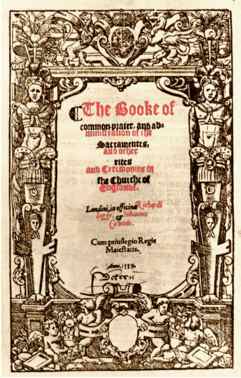
Cranmer’s Prayer Book was proclaimed the official liturgy of England by Parliament on January 21, 1549. The Act of Uniformity (text here), as the measure was called, addressed “The Book of the Common Prayer and Administration of the Sacraments and other Rites and Ceremonies of the Church after the use of the Church of England.”
Several minor changes have been made over the centuries, but the towering language — great language for great things — and, more important, the core faith expressed by that language, remain the same in the 1928 BCP. This magnificent book is the keystone of our faith today in the Anglican Church as well as other churches that have adopted it or portions of it (normally through the 1662 version in legal at the time of the great missionary movement during the 18 & 19th centuries). Moreover, the classic Prayer Book is treasured as a jewel in the crown of the entire Western Canon by readers and scholars who appreciate the English language.
It wasn’t until 1979 that the first major revisions appeared in the language and, consequently, in the meaning of the religion itself, chiefly in the secular “Baptismal Covenant.” This sociopolitical phrase is regarded by many revisionists, according to their own words, as the most important declaration in the liturgy. Another revision is a slight manipulation of language in the Creeds that denies the divine nature of Christ. If you haven’t noticed this sly edit hidden in plain sight, read it carefully and you’ll see.

No small changes, these, and vexatious to the vast majority of Episcopalians, who will be happy to learn that, to paraphrase Mark Twain, reports of the death of the 1662 & 1928 BCP have been greatly exaggerated by liberal bishops and clergy. Although the 1979 book was adopted by General Convention as the official liturgy — and, as we learned at last summer’s General Convention, is now considered in revisionist circles terribly old-hat – the 1928 BCP is still in use throughout the Church wherever Episcopalians discern the difference. How quickly the 1979 went out of fashion! Yet the classic, scripture-based 1662 & 1928 BCP endures.

If you are clergy, consider observing this pivotal day in Church history by conducting services this Sunday and next from the 1662 or 1928 BCP. You’ll leave church refreshed, renewed, and ready to take on whatever the coming week has in store.

Cranmer Lives
Cranmer Lives.

2009-12-09

Canticles

Have you ever noticed that the Book of Common Prayer provides texts for a number of poems that don't look like hymns, and yet they also aren't psalms? These are called canticles. A canticle is a biblical song other than the psalms. The term also sometimes refers to a well known hymns of the early church. Here are the biblical references for the BCP canticles:
Canticles mandated for Daily Prayer
Canticle of Zechariah or Benedictus (Luke 1.68-79): Morning Prayer
Canticle of Mary or Magnificat (Luke 1.46-55): Evening Prayer
Canticle of Simeon or Nunc Dimittis (Luke 2.29-32): Close of Day

Other Canticles / Biblical Songs
Glory to God or Gloria in Excelsis (Luke 2.14, with additional material)
Canticle of Miriam and Moses (Exod. 15.1-2, 11, 13, 17-18)
God’s Chosen One (Isa. 1.1-4, 6, 9)
The Desert Shall Blossom (Isa. 35.1-2, 5-6, 10)
Canticle of Thanksgiving or First Song of Isaiah (Isa. 12.2-6)
Seek the Lord or Second Song of Isaiah (Isa. 55.6-11)
The New Jerusalem or Third Song of Isaiah (Isa. 60.1-3, 18-19)
The Spirit of the Lord (Isa. 61.1-3, 10-11)
Canticle of Hannah (1 Sam. 2.1-4, 7-8; cf. Magnificat)
Canticle of David (1 Chr. 29.10-13)
The Steadfast Love of the Lord (Lam. 3.22-26)
A Canticle to the Lamb (Rev. 4.11, 5.9-10, 12-13)
Canticle of the Redeemed (Rev. 15.3-4)
A Canticle for Pentecost (John 14.16, 16.13a, 14.26; Acts 2.2, 4a; Rom. 8.26; Joel 2.28)
A Canticle of Love (1 John 4.7, 8; 1 Cor. 13.4-10, 12-13)
Christ, the Head of Creation (Col. 1.15-20)
Jesus Christ is Lord (Phil. 2.5c-11)

Deuterocanonical Songs from Scripture
Canticle of Judith (Judith 16.13-15)
A Canticle of Creation (Song of Three Young Men 35-65, 34)
A Canticle of Penitence (Manasseh 1-2, 4, 6-7a, 11, 13c-15)

Other Ancient Hymns, Not From Scripture
Hymn to Christ the Light or Phos Hilaron: Evening Prayer
We Praise You, O God or Te Deum Laudamus

2009-09-10

WCF XX.4 and the BCP

My brother presbyter asks an interesting question:


Westminster Confession of Faith

Chapter 20: Of Christian Liberty, and Liberty of Conscience

4: And because the powers which God has ordained, and the liberty which Christ has purchased are not intended by God to destroy, but mutually to uphold and preserve one another, they who, upon pretence of Christian liberty, shall oppose any lawful power, or the lawful exercise of it, whether it be civil or ecclesiastical, resist the ordinance of God.[401] And, for their publishing of such opinions, or maintaining of such practices, as are contrary to the light of nature, or to the known principles of Christianity (whether concerning faith, worship, or conversation), or to the power of godliness; or, such erroneous opinions or practices, as either in their own nature, or in the manner of publishing or maintaining them, are destructive to the external peace and order which Christ has established in the Church,[402] they may lawfully be called to account, and proceeded against, by the censures of the Church.[403]

Did the Westminster Assembly violates it's own guidance when they tossed The Book of Common Prayer out the window (a form of thoroughly biblical form of worship established under legitimate ecclesiastical and civil authority)? Where was the "Christian liberty?" Was it done to build up the people?

2009-08-05

The Gospel in the Prayer Book

THE GOSPEL IN THE PRAYER BOOK

by David N. Samuel

When we consider this subject, we must remember the circumstances in which the Book of Common Prayer was compiled. It took shape in the crucible of the Reformation. A new light had dawned from the Scriptures. That light was the message of salvation which had lain hidden for centuries previously in the dark ages of the Church in Europe.

It is difficult for us today to appreciate what really happened, and how new this all seemed to the Reformers, both on the Continent and here in England. The way of salvation in the Church of the Middle Ages was that of good works. Good works, it was taught, made a good man, made a righteous man. Good works made it possible for you to stand before God and to be accepted by Him. However, in order to do those good works you had to receive grace to strengthen you. Grace, at that time, was thought of as a sort of thing or substance that you received automatically, (ex opere operato), through the sacraments, through baptism, through the mass, through penance, and through the prayers of the saints. It was unlikely that anyone would go directly to heaven because he would not be good enough (only a few, exceptional 'saints', might do that), and therefore every baptized Christian would have to spend time, a very considerable time, thousands of years, in purgatory after this life, where his sins would be purged out by fire.

That was broadly the scheme of salvation taught by the medieval Church. Then came the dawn of the Reformation. That dawn came from the great light that shone from the Bible. It was as if a bright light suddenly illuminated a room that had formerly been in darkness. The central message of the Scriptures, which the Reformers discovered, was this: that we are justified by grace, that is, the free mercy of God, and not by our works, not by our merits. We are justified, that is, declared righteous before God, by grace through faith alone, not by works, lest any man should boast.

This is the great emphasis of the New Testament. The Reformers rediscovered it. They found, by reading the New Testament in Greek, that "to be justified" does not mean "to be made righteous in ourselves", which is what the Latin translations seemed to imply, but rather "to be counted righteous" before God, for the merits of our Lord and Saviour Jesus Christ. That put an entirely different complexion on things. "He [that is Christ] is made unto us wisdom, and righteousness, and sanctification, and redemption" (1 Corinthians 1:30). At the heart of the Gospel message is the concept of "the great exchange". Christ, as the innocent and righteous One, came into the world to take our place as the guilty, condemned sinner and we, by the mercy and free grace of God, take His place, and are seen in the eyes of God as justified and righteous.

Let me quote from a passage by Martin Luther in his Commentary on the Epistle to the Galatians which, I think, sets this forth so vividly:

"The doctrine of the Gospel speaketh nothing of our works or of the works of the Law, but of the inestimable mercy and love of God towards most wretched and miserable sinners; that our most merciful Father sent His only Son into the world and laid upon Him all the sins of all men, saying, 'Be Thou Peter that denier, Paul that persecutor, blasphemer and cruel oppressor, that sinner which did eat the apple in Paradise, that thief hanged upon the cross; briefly be Thou the person which hath committed the sins of all men. See, therefore, that Thou pay and satisfy for them.' Now cometh the Law and saith: I find Him a sinner, One that hath taken upon Him the sins of all men, and I see no sins but in Him, therefore let Him die upon the cross; and so it setteth upon Him and killeth Him. By this means the whole world is purged. God would see nothing else in the whole world, if it did believe, but a mere cleansing and righteousness."

Now that is the Gospel as set forth in the Scriptures, especially in the Epistles to the Romans and Galatians. That is the Gospel that our Reformers, Cranmer, Ridley, and Latimer, also rediscovered in the Bible: "The Lord our Righteousness", for we have no righteousness of our own. "He hath clothed me with the garments of salvation, he hath covered me with the robe of righteousness" (Isaiah 61:10). This is the robe of Christ's imputed righteousness, counted to us who are sinners. We are still sinners even when we are saved, we are still sinners in ourselves, but we are righteous in the sight of God, because Christ's righteousness is credited or imputed to us by faith.

Now that is the teaching of the Thirty-Nine Articles, and of the Book of Common Prayer. When Cranmer and the other Reformers found afresh this teaching in the Bible, they incorporated it into the official teaching of the Church of England. Article 11 Of the Justification of Man, which is one of the fundamental articles, on which hinges the doctrine of the Church of England, as reformed and catholic, states,

"We are accounted righteous before God, only for the merit of our Lord and Saviour Jesus Christ by Faith, and not for our own works or deservings: Wherefore, that we are justified by Faith only is a most wholesome Doctrine and very full of comfort, as more largely is expressed in the Homily of Justification."

If you refer to the Book of Homilies, you will find that the title is in fact not the Homily of Justification, but the Homily of Salvation. Did Cranmer make a mistake in calling it the Homily of Justification? No, but by so naming it he intended to show that salvation is justification by faith, and justification by faith is salvation. They are one and the same thing. Justification by faith is not a part of what it means to be saved, but the whole thing. Justification by faith is not just the entrance or beginning of the Christian's life, it is the whole of it from beginning to end.

Iain Murray, in his biography of Dr Martyn Lloyd-Jones, writes that on one of the last occasions he saw Dr Lloyd-Jones, when he was dying, he said to Mr Murray: "I am nothing but an old sinner saved by grace." He was quoting the words of Daniel Rowlands, which underline this experience of the saints, that salvation is of grace, through faith, from beginning to end....

So you see, the Book of Common Prayer is full of the grace and salvation of God. It expresses clearly the Biblical Gospel, the Gospel of justification by grace through faith alone. The Book of Common Prayer is no random sequence of prayers and devotions, but through it all, undergirding it, informing it, and structuring it, is the Gospel of the free grace of God to us, in Jesus Christ. As a body is supported by its frame, by the bones, by the skeleton, which give it shape, beauty and strength; so it is with the Book of Common Prayer and its Biblical doctrines. It is the doctrines of grace that give it its real beauty, strength, and power. I am fully aware that it is composed in very beautiful language, and this has a special appeal, but its real strength and beauty, its lasting power, reside in the doctrine that informs and shapes it. The Book of Common Prayer and the true message of God's salvation in Jesus Christ are closely and inseparably conjoined.

Read the whole thing...