

Church lights (candles) symbolize God’s Presence in the sanctuary and the spiritual enlightenment His Gospel brings our lives. Roman practice differs slightly, but in the main carries the same symbolism. Looking at the chancel (by the communion rails) in most churches, we see two major lights. First on the Gospel (left side) we see a small red light mounted on the wall.  This is the Altar Lamp that burns in honor of the constant Real Presence in the reserve Sacrament (consecrated wine and host) kept in the tabernacle / aumbry - a small, ornate box centered on the back portion of the Holy Table. or on a wall nearby.
 The other major lights are the candles on the Holy Table, divided into two groups, signifying Jesus in both His divine and human natures. At many parishes, you’ll see two groups of three each on the back of the Table, called “Office Lights,” lit when conducting the offices of the Church, such as Morning/Evening Prayer, Holy Matrimony, or Funeral services. In other parishes, there will simply be two larger pillar candles beside the Holy Table which are lit for the same purpose.
 The two lights in front of these - or directly on the table - are the Communion Lights, used during the Eucharist. All the lights echo Christ’s words, when He said, “I am the Light of the World” (St. John 8:12) and other passages referring to God’s light, such as St. Matt. 4:16 and St. Luke 2:32.
 This is the Altar Lamp that burns in honor of the constant Real Presence in the reserve Sacrament (consecrated wine and host) kept in the tabernacle / aumbry - a small, ornate box centered on the back portion of the Holy Table. or on a wall nearby.
 The other major lights are the candles on the Holy Table, divided into two groups, signifying Jesus in both His divine and human natures. At many parishes, you’ll see two groups of three each on the back of the Table, called “Office Lights,” lit when conducting the offices of the Church, such as Morning/Evening Prayer, Holy Matrimony, or Funeral services. In other parishes, there will simply be two larger pillar candles beside the Holy Table which are lit for the same purpose.
 The two lights in front of these - or directly on the table - are the Communion Lights, used during the Eucharist. All the lights echo Christ’s words, when He said, “I am the Light of the World” (St. John 8:12) and other passages referring to God’s light, such as St. Matt. 4:16 and St. Luke 2:32.
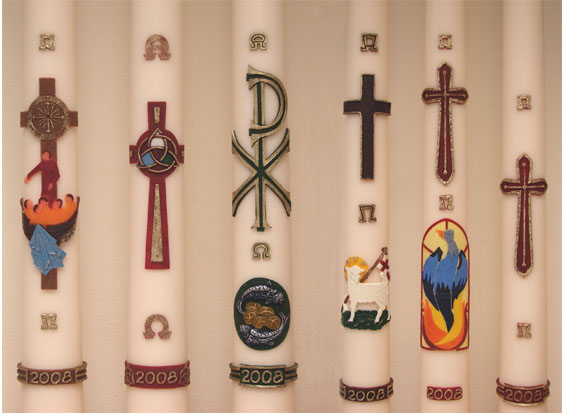 The last light in many churches is the Paschal Candle. This is a large white candle normally kept our of sight, or next to the baptismal font. The candle is blessed every year at the Easter Vigil service, having the year inscribed on it and (traditionally) five grains of incense inserted into in in the shape of a cross. It is often decorated with other signs of the resurrection as well. Some parishes - especially those with elaborate Holy Saturday / Easter Vigil services - have special rituals surrounding the entrance of the Paschal candle. These rituals can include chanting the Exultet (normally done by a deacon), dipping the base of the candle in the baptismal font, and using this candle to light the tapers that will ignite the rest of the office and communion lights. (This practice is especially important in parishes that light a Paschal fire near the entrance of the church door for the vigil.) The candle is brought to the front of the church from Easter until the Ascension (when its removal visually symbolizes Christ's immediate light being taken from our presence). Then the candle is either stored or kept near the font. However, for baptisms and funerals (which, for Christians, is the completion of our baptismal death into Christ), the candle returns to a prominent place. I should also note that this is a Western / Latin Rite practice. The East uses a different type of candle. However, this practice antedates Jerome - and was clearly a common practice long before the Council of Nicea.
The candles recall times when ancient Christians met at night to avoid discovery and needed the lights to worship, but are retained to remind us of those days and to focus us on our Heavenly Father of Lights. Scriptural authority is solid for their use—found in Ex 25:31 & 40:25, Lev 24:2 & II Chron 13:11— and reminds us—we carry the Light of Christ!


