Showing posts with label apostles. Show all posts

2010-11-30

Happy St. Andrews Day!

Readings:

Psalm 19 or 19:1-6
Deuteronomy 30:11-14
Romans 10:8b-18
Matthew 4:18-22

Preface of Apostles

Collect: Almighty God, who gave such grace to your apostle Andrew that he readily obeyed the call of your Son Jesus Christ, and brought his brother with him: Give unto us, who are called by your Word, grace to follow him without delay, and to bring those near to us into his gracious presence; who lives and reigns with you and the Holy Spirit, one God, now and for ever.

Icon of St. AndrewMost references to Andrew in the New Testament simply include him on a list of the Twelve Apostles, or group him with his brother, Simon Peter. But he appears acting as an individual three times in the Gospel of John. When a number of Greeks (perhaps simply Greek-speaking Jews) wish to speak with Jesus, they approach Philip, who tells Andrew, and the two of them tell Jesus (Jn 12:20-22). (It may be relevant here that both "Philip" and "Andrew" are Greek names.) Before Jesus feeds the Five Thousand, it is Andrew who says, "Here is a lad with five barley loaves and two fish." (Jn 6:8f) And the first two disciples whom John reports as attaching themselves to Jesus (Jn 1:35-42) are Andrew and another disciple (whom John does not name, but who is commonly supposed to be John himself -- John never mentions himself by name, a widespread literary convention). Having met Jesus, Andrew then finds his brother Simon and brings him to Jesus. Thus, on each occasion when he is mentioned as an individual, it is because he is instrumental in bringing others to meet the Saviour. In the Episcopal Church, the Fellowship of Saint Andrew is devoted to encouraging personal evangelism, and the bringing of one's friends and colleagues to a knowledge of the Gospel of Christ.

Just as Andrew was the first of the Apostles, so his feast is taken in the West to be the beginning of the Church Year. (Eastern Christians begin their Church Year on 1 September.) The First Sunday of Advent is defined to be the Sunday on or nearest his feast (although it could equivalently be defined as the fourth Sunday before Christmas Day).

Several centuries after the death of Andrew, some of his relics were brought by a missionary named Rule to Scotland, to a place then known as Fife, but now known as St. Andrew's, and best known as the site of a world-famous golf course and club. For this reason, Andrew is the patron of Scotland.

When the Emperor Constantine established the city of Byzantium, or Constantinople, as the new capital of the Roman Empire, replacing Rome, the bishop of Byzantium became very prominent. Five sees (bishoprics) came to be known as patriarchates: Rome, Alexandria, Antioch, Jerusalem, and Byzantium. Now, the congregation at Rome claimed the two most famous apostles, Peter and Paul, as founders. Antioch could also claim both Peter and Paul, on the explicit testimony of Scripture, and of course Jerusalem had all the apostles. Alexandria claimed that Mark, who had been Peter's "interpreter" and assistant, and had written down the Gospel of Mark on the basis of what he had heard from Peter, had after Peter's death gone to Alexandria and founded the church there. Byzantium was scorned by the other patriarchates as a new-comer, a church with the political prestige of being located at the capital of the Empire, but with no apostles in its history. Byzantium responded with the claim that its founder and first bishop had been Andrew the brother of Peter. They pointed out that Andrew had been the first of all the apostles to follow Jesus (John 1:40-41), and that he had brought his brother to Jesus. Andrew was thus, in the words of John Chrysostom, "the Peter before Peter." As Russia was Christianized by missionaries from Byzantium, Andrew became the patron not only of Byzantium but also of Russia.

Andrew is the national saint of Scotland (thus appreciated, even by Presbyterians! - Ed.). George (23 Apr) is the national saint of England, Patrick (17 Mar) of Ireland, and Dewi = David (1 Mar) of Wales. George, who was a soldier, is customarily pictured as a knight with a shield that bears a red cross on a white background. This design is therefore the national flag of England. It is said that Andrew was crucified on a Cross Saltire -- an 'X' -shaped cross. His symbol is a Cross Saltire, white on a blue background. This is accordingly the national flag of Scotland. A symbol of Patrick is a red cross saltire on a white background. The crosses of George and Andrew were combined to form the Union Jack, or flag of Great Britain, and later the cross of Patrick was added to form the present Union Jack. Wales does not appear as such (sorry!). Whether there is a design known as the cross of David, I have no idea.

by James Kiefer

2010-08-24

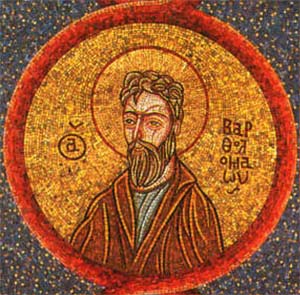
Feast of St. Bartholomew, Apostle

The name "Bartholomew" appears in the New Testament only on lists of the names of the twelve apostles. This list normally is given as six pairs, and the third pair in each of the Synoptics is "Philip and Bartholomew" (M 10:3; P 3:18; L 6:14; but A 1:15).


John gives no list of the Twelve, but refers to more of them individually than the Synoptists. He does not name Bartholomew, but early in his account (John 1:43-50) he tells of the call to discipleship of a Nathaniel who is often supposed to be the same person. The reasoning is as follows: John's Nathanael is introduced as one of the earliest followers of Jesus, and in terms which suggest that he became one of the Twelve. He is clearly not the same as Peter, Andrew, James, John, Philip, Thomas, Judas Iscariot, Judas (not Iscariot, also called Lebbaeus or Thaddeus), all of whom John names separately. He is not Matthew, whose call is described differently (M 9:9). This leaves Bartholomew, James the son of Alpheus, and Simon Zelotes. Of these, Bartholomew is the leading candidate for two reasons:

(1) "Bar-tholomew" is a patronymic, meaning "son of Tolmai (or Talmai)." It is therefore likely that he had another name. (A historical novel which may not be well researched informs me that a first-century Jew would be likely to use the patronymic instead of the forename as a mark of respect in speaking to a significantly older Jew.) "Nathanael son of Tolmai" seems more likely than "Nathanael also called James (or Simon)."
(2) Nathanael is introduced in John's narrative as a friend of Philip. Since Bartholomew is paired with Philip on three of our four lists of Apostles, it seems likely that they were associated.

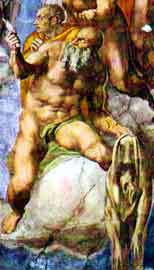
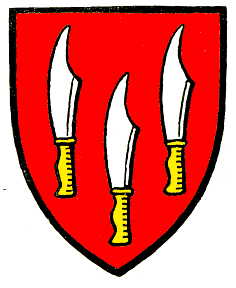
We have no certain information about Bartholomew's later life. Some writers, including the historian Eusebius of Caesarea (now Har Qesari, 32:30 N 34:54 E, near Sedot Yam), say that he preached in India. The majority tradition, with varying details, is that Bartholomew preached in Armenia, and was finally skinned alive and beheaded to Albanus or Albanopolis (now Derbent, 42:03 N 48:18 E) on the Caspian Sea. His emblem in art is a flaying knife. The flayed Bartholomew can be seen in Michelangelo's Sistine painting of the Last Judgement. He is holding his skin. The face on the skin is generally considered to be a self-portrait of Michelangelo.

Readings:

Psalm 91 or 91:1-4
Deuteronomy 18:15-18
1 Corinthians 4:9-15
Luke 22:24-30

Preface of Apostles

PRAYER (traditional language)

Almighty and everlasting God, who didst give to thine apostle Bartholomew grace truly to believe and to preach thy Word: Grant that thy Church may love what he believed and preach what he taught; through Jesus Christ our Lord, who liveth and reigneth with thee and the Holy Ghost, one God for ever and ever.

PRAYER (contemporary language)
Almighty and everlasting God, who gave to your apostle Bartholomew grace truly to believe and to preach your Word: Grant that your Church may love what he believed and preach what he taught; through Jesus Christ our Lord, who lives and reigns with you and the Holy Spirit, one God for ever and ever.