
Shamelessly ganked from Bore Patch.

Anybody remember those old Fahrvergnügen commercials?
They spawned a whole industry of cheap t-shirts of German-sounding neologisms:

Fahrfromthinkin - an idiot
Fahrfrompukin - partying
Fahrfromnewgen - old/used
 You get the picture. Anyway, I've been thinking of a new word to describe the fiasco over the fake science & data manipulation that has been at the heart of the global warming scam. Here's what I've come up with: FARFROMPROVEN

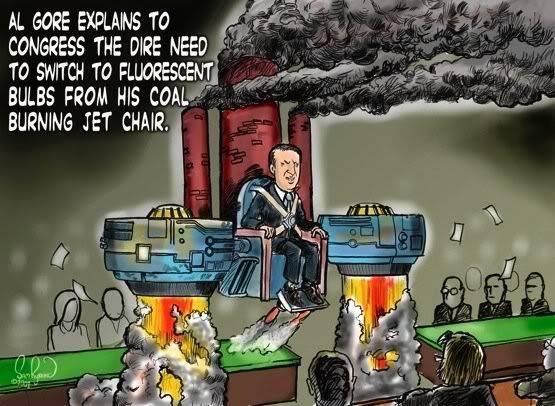
 Sorry, Goracle, you're just going to have to find another way to make a living than jetting around the world telling people that they have to...stop jetting around the world.
 A recent study in Climactic Change offers one of the most hopeful solutions to the production of green-house gases: Bring the Green Revolution to the earth's great deserts.
 Looks like somebody didn't get the memo.
An international team of scientists led by the National Center for Atmospheric Research (NCAR) used more than a century of weather observations and three powerful computer models to tackle one of the more difficult questions in meteorology: if the total energy that reaches Earth from the Sun varies by only 0.1 percent across the approximately 11-year solar cycle, how can such a small variation drive major changes in weather patterns on Earth?
The answer, according to the new study, has to do with the Sun's impact on two seemingly unrelated regions. Chemicals in the stratosphere and sea surface temperatures in the Pacific Ocean respond during solar maximum in a way that amplifies the Sun's influence on some aspects of air movement. This can intensify winds and rainfall, change sea surface temperatures and cloud cover over certain tropical and subtropical regions, and ultimately influence global weather.
"The Sun, the stratosphere, and the oceans are connected in ways that can influence events such as winter rainfall in North America," says NCAR scientist Gerald Meehl, the lead author. "Understanding the role of the solar cycle can provide added insight as scientists work toward predicting regional weather patterns for the next couple of decades."
What? you mean my van isn't causing global warming, but instead it's that ginormous thermonuclear furnace near our planet? Preposterous.
 Whew...that's better. So would this be vehicular confession?
 The Goracle has tripped to the ridiculous...he's now saying that global warming (or, more properly, skeptics of anthropogenic global warming) is the Nazism of our time.
 On this day, in 1215, King John of England agreed to pave the path to constitutional monarchy. The Magna Carta ensured that the king (and his descendents, in perpetuity) would be bound by laws, and that it would his job to uphold the rights of the nobles and freemen who forced him into the pact.
 Similarly today, a tyrant named Mahmoud Ahmadinejad is being challenged to hear the voice of his people. It's clear that some sort of election rigging occurred in order for him to declare a landslide victory.
 From the DUH department....
Over the past century, Earth's average temperature has increased by approximately 0.6 degrees Celsius (1.1 degrees Fahrenheit). Solar heating accounts for about 0.15 C, or 25 percent, of this change, according to computer modeling results published by NASA Goddard Institute for Space Studies researcher David Rind in 2004.
The sun is relatively calm compared to other stars. "We don't know what the sun is going to do a hundred years from now," said Doug Rabin, a solar physicist at Goddard. "It could be considerably more active and therefore have more influence on Earth's climate."
Or, it could be calmer, creating a cooler climate on Earth similar to what happened in the late 17th century. Almost no sunspots were observed on the sun's surface during the period from 1650 to 1715. This extended absence of solar activity may have been partly responsible for the Little Ice Age in Europe and may reflect cyclic or irregular changes in the sun's output over hundreds of years. During this period, winters in Europe were longer and colder by about 1 C than they are today.
Since then, there seems to have been on average a slow increase in solar activity. Unless we find a way to reduce the amount of greenhouse gases we put into the atmosphere, such as carbon dioxide from fossil fuel burning, the solar influence is not expected to dominate climate change. But the solar variations are expected to continue to modulate both warming and cooling trends at the level of 0.1 to 0.2 degrees Celsius (0.18 to 0.26 Fahrenheit) over many years.

"There has been no trend in the number or intensity of storms at landfall since 1900," says Pielke, a professor of environmental studies at the University of Colorado. "The storms themselves haven't changed."
Before we become hopelessly lost in despair, however, there is good news: we can do something about this problem. We can enact meaningful building codes and stop keeping insurance premiums artificially low in flood zones.
But first we need to understand that disasters aren't just caused by FEMA and greenhouse gases. Says Tierney: "I don't think that people have an understanding of questions they should be asking — about where they live, about design and construction, about building inspection, fire protection. These just aren't things that are on people's minds."
In real estate, the old mantra is Location, location, location. It should be. Some plots are naturally good for building. Others have to have a lot of preparation, then maintenance. It is a poor use of our resources to continually try to fight against natural consequences. It ties up capital and man-power in maintenance rather than expansion.
 People sometimes ask me why I'm so against the whole global warming topic.
 He apparently has a new House Boat that he calls Bio-Solar One. He says it's environmentally friendly - run on solar and bio-fuels.

 The BBC recently reported on some archaeological finds from the Alps indicating fluctuating temperatures over the last 7,000 years. Included were paleolithic artifacts, Roman coins, and Medieval clothing.
 If somebody says that their energy policy is to get us off of fossil fuels, make sure they elaborate step two.
 Iran is now sabre-rattling about its "newest weapon" for strikes at sea. Some people want to say that Iran is a peace-loving country
  (and I'm sure her people are), and that the nuclear facilities they hid from the world for nearly two decades are for peaceful energy purposes (in a country with enough oil and natural gas to see it through the next century or more, given steady growth). I find that naive, based on the escalation of tensions - largely on the part of Iran - in the region.

I'm sure it's all just that FauxNews crap and right-wing neocon tripe because I only believe the credible people at Huffinpuff Post and Altermedia. After all, this report is being opposed by all the right people. Let's see, the genteel peace-loving souls at StormFront forum have something to say, as does the good doctor and LA state legislator David Duke. And the fact that it's a propaganda piece supported by the Elders of Zion just proves that it's meant to urge Amerikkka into starting WWIII (especially if McCain - WIII himself - gets elected). Remember, Iran is the good guy.
OnePlusYou Quizzes and Widgets
I'm glad to know, however, that I could easily handly 15 more!
(P.S. Click here if the Malthus reference didn't ring a bell.) whom I've recently taken to affectionately calling the Collared Greens,
  I say this: why would you advocate for the destruction of the one thing that has shown itself capable of increasing the quality and quantity of human life (viz. energy affluence)? Even if you think we should lay off the fossil fuels (something I would advocate), why not put your energy into advancing nuclear power? If we hadn't had the environuts scaring us witless about it, we could have saved gigatons of carbon being spewed into the atmosphere - and provided electricity to some of the most remote places on the planet. Electricity means refrigerated food, non-dung-cooked food, medical equipment, and information availability for self-improvement. But no...we're too busy denying the real messiah and playing our own hand at taking his place... uggh!


