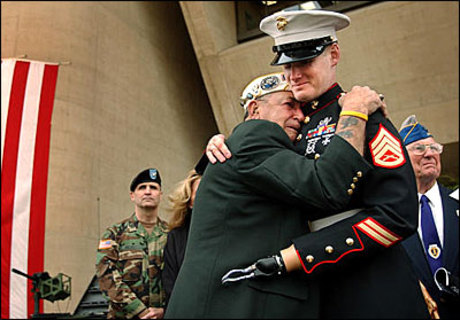
 can say WAY MORE than 1,000 words.
Take that, iconoclasts!
There's still time to make plans for joining us tonight at 7PM at St. Stephen Anglican Church for Evening Prayer in remembrance of veterans and soldier-saints.
 can say WAY MORE than 1,000 words.
In English cathedrals these days it is common to find stands of lighted candles. In York Minster there is just such a stand.On a table nearby there is a notice saying that it is a nice idea to light a candle and pray. The use of candles has become very popular, not only as a symbol of prayer, but to mark various kinds of aspirations-for the freedom of hostages, to emphasize all manner of political and social issues, and as a mark of public sorrow. Lights of various kinds are used in a number of world religions. and Christians are heirs, to a certain extent, of ancient Jewish customs. Is there, then, a specific Christian use of candles and lamps?
Beyond the obvious practical need to give light in dark buiIdings, there are two uses which have special Christian significance. The first is the symbolic use, representing Christ as the Light of the world. The gift of a lighted candle at Baptism, the blessing of candles at Candlemass and the ceremonies of the New Fire and the Easter Candle are all examples of this use of lights.
The second use is that of candles and lamps in the sanctuaries of churches and those which are placed in front of statues and pictorial images (icons). It is thought that this custom originated in the ancient Roman manner of honouring their chief magistrates, the Consuls, by carrying lighted candles or torches before them in public. This honorific custom was adopted by the Roman emperors, and then passed over into the ceremonies of the Church. The candIes which now stand on our altars are permanent versions of the candles carried in procession at the beginning of Mass and in full ceremonial, the solemn reading of the Gospel is still attended by portable lights. This second use is intended to mark out with honour objects and actions of special sacredness-for this reason we keep a light burning permanently before the Blessed Sacrament when it is reserved.
The same idea of paying honour is attached to the lighting of candles or lamps before the images which depict Our Lord and His Holy Mother, and the Saints. Such acts have a special significance and history attached to them.
We are only too familiar with the unhappy fact that most Churches are sliding toward secularism. Faith in the living Christ becomes a mere philosophy. The joy of the Holy Spirit is replaced by the dullness of humanistic moralism. This is not the first time the Gospel has been threatened in this way-although, in our day, it may have been taken to greater lengths than before.
The threat appeared clearly for the first time some twelve hundred years ago and the distance in time makes no difference to the effect. A Byzantine Emperor, Leo Ill, unleashed an attack on the use of images in the worship of the Church. Leo and his followers accused orthodox Christians of idolatry, and demanded that, in obedience to the Second of the Ten Commandments, the use of the images should cease. Many people agreed with Leo-his message seemed simple, honest, and pious too. It was true that there were people who acted as though the images had some supernatural power of their own. The supporters of Leo's movement became known as "The Destroyers of the images (icons)" or 'Iconoclasts'. Few realised that Iconoclasm was actually an attack on the True Faith. For one thing it put the clock back to the Old Testament-making Christianity a religion of rules and not of salvation through grace. Again it made Christianity out to be either a coldly intellectual thing, or a mere matter of emotional response.
Those who wished to honour the images knew that they had centuries of Christian tradition to support them. They knew also that the honour they paid to the icons was quite different from their worship of the Holy Trinity (they even had distinct words to make sure that there was no confusion). There was, though, need for someone to point out to orthodox believers the deeper significance of honouring the icons. The man who did this was a Christian monk who had at one time been a high government official representing the Christian subjects of the Caliph of Damascus.
St John of Damascus pointed out that the Incarnation of the Son of God as Jesus of Nazareth changed completely our understanding of God's relationship with His creation and of the Second Commandment against idolatry. "In earlier times, he wrote, "God, who is without form or body, could never be depicted. But now, when God is seen in the flesh conversing with men, I make an image of the God I see. I do not worship matter: I worship the Creator of matter Who became matter for my sake. Who willed to take His abode in matter: Who worked out my salvation through matter. Never will I cease honouring the matter which wrought my salvation. I honour it, but not as God ... Because of this I salute all remaining matter with reverence, because God has filled it with grace and power." St John could see that the attack on the images concealed a denial of the reality of the Incarnation of Christ and a rejection of the sacramental way in which the new life in Christ is received by us. At the Seventh Ecumenical Council, which restored the place of images in the life of the Church, a senior bishop exclaimed of Iconoclasm. "This is the worst of heresies because it includes them all."
The calling of the Seventh Ecumenical Council proved a turning point in the struggle against Iconoclasm-a battle which, nevertheless, still had many years to run. In the later Middle Ages when the true significance and use of the images tended to be obscured by superstition, there was a revival of Iconoclasm and this attitude became part of the Reformation programme. In consequence the older formularies of post-Reformation Anglicanism are definitely Iconoclastic in character and this is why Anglicanism has never accepted officially the decisions of the Seventh Council.
The modern influence of Iconoclasm is not to be seen in church buildings with plain walls and clear glass, but in a reducing of the Faith to 'rational' principles, an emphasis on secular issues at the expense of spiritual need. The lighting of a candle in a cathedral becomes an expression of the human need to pray, not an acknowledgement of the Christ to Whom we pray. In an Anglican Catholic Church we find should always find an opportunity provided to light a candle before an image of Christ, His Holy Mother, or one of the Saints. Here we have prayer meaningfully directed and honour rightly bestowed. Such shrines are a practical fulfilment of the decrees of the Seventh Council which the ACC has never hesitated to accept.
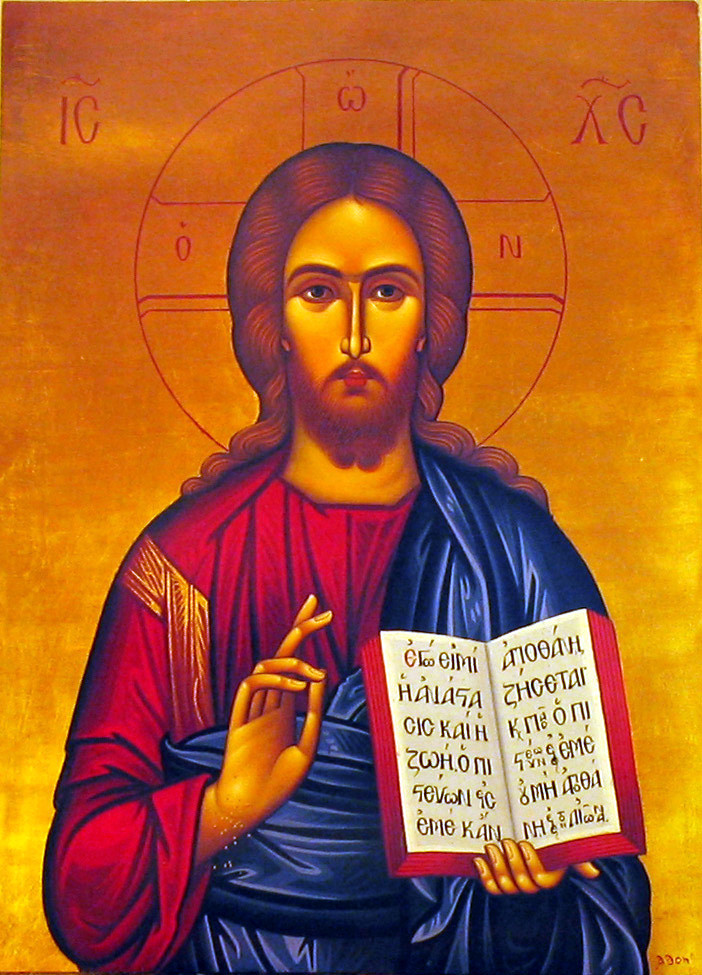
An image is never an invitation to idolatry. It may depict Our Lord. or His Holy Mother. It may represent Our Lady with the Child Jesus, again it may represent one of the Saints, a scene from the Scriptures. or an incident in the subsequent life of the Church. In all cases the image is a window upon the realities of the Heavenly Kingdom, never an object of adoration in itself. St. Basil the Great said that the honour paid to the image passes to the original. So when we light candle in front of an image we are honouring Christ Himself, recalling his Incarnation and the way in which, through His Death and Resurrection, He lives, by the power of the Holy Spirit, in the lives of His Saints. Our prayers through or to the Saints are prayers to Christ Himself and, in Christ, to the Holy Trinity.
When we honour the images we are honouring the fullness of the Gospel Faith. The proclaiming of this Gospel, in word and deed, is our task as members of the Body of Christ. It is to the fullness of the Gospel that, as members of the ACC in fellowship with all Catholic believers, we have a joyful commitment-a commitment we renew every time we light a candle before the holy images.
Two points refute this:
 First, the Commandment specifically mentions heaven, earth, sea, etc. God seems to be pointing out the type of worship the Israelites encountered in their pagan neighbors like Egypt, Babylonia, Philistia, Canaan, etc. In other words, “heavens,” meaning astrology, “earth,” meaning animism and nature worship, and “sea” meaning various forms of aquatic idolatry, such as Nile worship. So, God is not railing against the inherent evil of an image, but against the practices of the Israelite neighbors, which included any or all of the above.
(Ironically, many will allow an American flag - replete with eagle at the top, symbol of Roman power - to be in their places of worship without a peep!)
3. The Bible itself is full is symbolism, which is merely another form of the use of images. Thus, the Holy Spirit appears in the form of a dove at Christ’s baptism. A dove, then, is legitimately used as an image of the Holy Spirit. The paschal lamb is an image of Christ, and so on. God presents Himself to us in Scripture through a variety of images. Human fathers, then, are an image of our heavenly Father. St. Paul, in Colossians 1:15, says that Christ is the image (Greek is “ikon”) of the invisible God. It was, in fact, the Jews who were enraged at Christ’s claim of divinity, a claim that provoked their erroneous zeal against holy images. How could the invisible Jehovah be Incarnate in a human image? To the Pharisees this was idolatry. But the catholic view gives due honor to the Incarnation by recognizing the validity and holy nature of images as part and parcel of the Incarnation, and this was the reasoning of Nicea II.
5. In Acts 19:11-12, cloths and handkerchiefs are touched by St. Paul, and are then placed upon those possessed and the spirits are driven out by these “relics.” Likewise, the woman with an issue of blood touches the hem of Jesus’ garment and “virtue goes forth from him” to heal her. The bones of Elisha even resurrect a dead soldier (2 Kings 13): this is the entire principle behind relics. Things–matter–stuff can be consecrated/sanctified for a holy purpose. Thus, Jesus spits in the sand and makes clay, rubbing it on the blind man’s eyes to heal him. Jesus could have simply spoken a word and healed the man, but in this instance He chose to use mud–stuff, to do the miracle. We call this the “Incarnational Principle.” It is the same thinking behind all sacramental practice.
6. Likewise, in the OT period, even places were holy. Places like Mt. Sinai, the Temple, etc. But this practice is not rejected in the NT, contrary to what many Protestants may think. In John 5, there is a pool where an angel stirs up the water and the first to enter the pool is healed. This is the principle behind shrines and healing icons. In 2 Peter 1:16-18, St. Peter calls the mountain that he witnessed the transfiguration on the “holy mountain.” So, even in the New Testament the principle of holy places is not abolished as something strictly Old Testament. One sees, then, that there is biblical basis for the catholic practices of relics, images and icons. If there is discernment, it must lie not with strict prohibition, but with regard to application.

“We do not worship, we do not adore [non colimus, non adoramus], for fear that we should bow down to the creature rather than to the Creator, but we venerate [honoramus] the relics of the martyrs in order the better to adore Him whose martyrs they are.” Against Riparium -St. Jerome
“We by no means consider the holy martyrs to be gods, nor are we wont to bow down before them adoringly, but only relatively and reverentially.” Against Julian -St. Cyril of Alexandria
“We, the Christian community, assemble to celebrate the memory of the martyrs with ritual solemnity because we want to be inspired to follow their example, share in their merits, and be helped by their prayers. Yet we erect no altars to any of the martyrs, even in the martyrs’ burial chapels themselves.”


