2007-08-27

Vestments FAQ

By request, I'm posting a document I drew up for the Office of Theology and Worship 0n the use of vestments. Peruse my predilections; I hope you'll find some use for it.

Historical Introduction

In Exodus 28 God dictated the vestments to be worn by the priests of the Old Testament; and for most items, he gave their symbolic meaning. Under the radical liberty of the New Testament, however, there is no such prescription or symbolism imposed by the Divine. Almost no Christian Church tried to use the vestments of the Aaronic priesthood. Instead, the common street clothing of the Roman Empire was used - however, rubrics from the time mention that those worn by the leader of a service should be clean and were normally white.[1] The early Christians saw their gatherings around the Eucharist as festive moments and sought to dress well, as if for a party (not out of any sense of sacerdotalism). As the Roman Empire declined in political sway, the dress of the general populace became shorter and tighter fitting, reflecting the fashions of the Germanic and Gallic tribes that had once been part of the Empire. The clergy, however, retained the older forms. Perhaps it was because at one time the tax systems of the Empire had paid their salary, or it may have been a near-universal conservative impulse among the clergy. Whatever the case, the clergy gave new symbolism to the clothing which they wore. We still have writings from the late Imperial and early medieval period where a new symbolism is gradually seen in what had once been ordinary clothes shared by everyone (see below under the description of each item for specific information).

As the centuries rolled on and the power and wealth of the Church increased, so too did its prestige. Out of an almost giddy sense of liturgical openness, following the expansion into lands far from Rome, a massive influx of music, poetry, narrative, and cultural distinctives changed the look and feel of the Church. Resources were directed toward the elaborate furnishings of the Church as worshipping communities sought to give their very best to the Church. It should be remembered that initially this was an outgrowth of the desire to honor God in their worship[2] and to provide sensory stimuli that would aid in the retention of teaching and of tradition among the illiterate. However, by the late 14th century, less noble intentions became normative. Various religious movements,[3] both lay and clergy-led, had called for radical vows of poverty and demanded that financial corruption and greed be purged from the Church. Reformed adherents to what the Puritans would later call “the Regulative Principle”[4] did away with the historic liturgical vestments as having no Scriptural mandate. In their place, the early Reformers wore their street clothes. At a time when you could tell a person’s profession by what they wore, persons with academic credentials wore their gowns at almost all times. Thus, the learned ministry wore the marks of their scholastic achievements in the pulpit. This was later enshrined and became a new sort of conservative holdover long after these clothes ceased to be everyday dress.

As the Church came into America, there grew an impulse towards simplification – silk gowns are not practical in the wilderness. Furthermore, many ministers had no formal academic degree that would entitle them to the gown of previous generations. Therefore, most Protestant ministers lost the tradition of wearing anything other than the “Sunday best.” They also noticed that this was in many ways a return to the earliest Christian communities who had no regulated forms of dress. Such egalitarianism also fit well with the ethic of the emerging country. A push toward progress relegated many traditions to a position of dusty, “Old World” obsolescence.

In recent years, particularly due to the influence of the Christian ecumenical movement, there has been a trend toward rediscovering traditions laid down by previous generations. Liturgical renewal has created a new demand for symbolism that engages as many of the senses as possible. Thus resurgence in the wearing of vestments that connect us with our forbears across time and denominational tradition is being realized. Below you will find a commonly accepted symbolic meaning for each garment as well as the ancient vesting prayer traditionally employed while one dressed, where applicable. May the reader find them edifying, profitable, and of benefit for both the wearer and worshiper.

Vestment Descriptions

The Alb is a full, white, ankle length garment. It has become popular is recent years because of its cheerful white color and innovative styling. The most ancient of Christian vestments, its origins are traced to the Roman tunic, a common piece of clothing until the 5th century. After a catechumen was baptized, they often received a bright white alb as a symbol of their spiritual washing. Thus, the alb is truly the garment of the baptized; as such, it can be worn by any baptized Christian who is taking a part in leading worship. After the fall of Rome, it became a garment unique to the clergy as normal dress. The alb was still worn by anyone providing service in the liturgy until it was supplanted by the surplice and cotta. The alb is best presented in its simplest form – without lace or ornamentation – so that its beauty may flow in its drape. Likewise, its meaning is best preserved when it is kept bright white instead of the flaxen or cream colors that are coming to dominate its usage in some places. It reminds Christians of the multitude dressed in robes, who “have washed their robes and made them white in the blood of the Lamb.” (Rev. 7:14)[5]. The image reminds each believer that they now stand clothed in the righteousness of Christ and proclaims the hope that someday we will stand with that white-robed multitude washed in the blood of the Lamb. This hope is expressed in the alb’s vesting prayer: “Clothe me, O Lord, and cleanse my heart, that cleansed in the blood of the Lamb I may always enjoy eternal happiness.”

The Amice is a rectangular white cloth, worn as a collar with the alb. Originally designed to protect the finer, silken vestments from natural body and hair oils[6] and to ensure that the neck was unexposed (both for warmth and modesty). It is often omitted with contemporary albs because they close more tightly around the neck. Its historic use recalls the “helmet of salvation.” (Eph. 6:17) This vestment also served as the basis for the later academic hood. “O Lord, place on my head the garment of salvation to expose and reject the attack of the devil.”

Band or Tabs are worn on the style of academic black gown. The academic gown was originally used outside the church, but as a church garment was used first in England and later in Germany and among the Magisterial Reformers. Bands are the remnant of a wider ruff collar (such as was worn in the Elizabethan era). By the latter part of the 18th century they had become the provenance of all who had a university degree. Rarely seen in the US on anyone other than a minister, they remain in common use in the United Kingdom and Canada by barristers and academics. The shape, however, is somewhat different: barristers and graduates tend to wear bands that splay out at approximately an 30º angle and are approximately 6” long; ministers tend to wear bands that have a minimal, or even non-existent, angle so that the overall effect is of a set of bands that appear as a solid piece measuring 4” wide by 5” long. To some, the two tabs suggest the two tables of the Law (as in the Church of Scotland). Others think of “rightly dividing the word of truth” (2 Ti 2:15), law and gospel, or Word and Sacrament, but neither of these fanciful notions spring from original use. In some Scandinavian branches of the Church, it remains a rather wide ruff collar.

The Cassock is a full-length black or scarlet (for Doctors of Divinity) garment worn with a clerical collar. Like a fitted shirt above the waist and a full ankle-length skirt below the waist, the cassock comes in two styles. The Roman cassock buttons down the middle (traditionally having 33 buttons, one for each year in Christ’s life). The Sarum (more often called Anglican) cassock buttons at the right shoulder and the waist, with a special button on the chest for the anchoring of an academic hood. This garment began as a simple overcoat that was used for warmth by all classes of peoples in the Middle Ages. Its length was increased and the garment died dark black for the modesty of the clergy. The cassock is the traditional street clothing of the clergy. As such, it is not a liturgical garment in the strictest sense. It became a symbol of the public ministry of the gospel and for that reason was common clothing for preachers. In the pulpit, it is most often worn with bands (see above) under an open preaching gown (see below). In the liturgical churches, it is commonly worn underneath the alb or surplice. Thus, the contrast of the white on black serves as a vivid reminder that any righteousness the minister has is only by the imputation of Christ.

The Chasuble developed from the poncho-like cloak the Paul refers to in 2 Timothy 4:13. Originally it was a warm raincoat worn by virtually everyone until the time of the Frankish kings (c. ad 800). In the church of the High Middle Ages, the chasuble became a highly ornamented garment, made from expensive silks and embroidered in gold and silver thread. For that reason it became know as “the vestment.” The chasuble is worn over the alb during the celebration of the Lord’s Supper. Since it is exclusive to those ministers that are ordained to administer the sacrament, some associate it with the Roman Mass and sacerdotal privilege. More recently, liturgical churches of the Reformation have reclaimed this ancient, colorful and graceful vestment as more egalitarian than those vestments rooted in academic rank. Yoked around the neck and burdening the shoulders, the chasuble suggests Jesus’ words, “my yoke is easy and my burden light.” What a compelling invitation to Jesus’ supper when we recall that just before, he said, “Come to me, all you who are weary and burdened, and I will give you rest.” (Mt. 11:28) The prayer used as the chasuble is put on reflects this, “Lord, you said, ‘My yoke is sweet and my burden is light,’ enable me always to rely on your grace and assistance.”

The Cincture is the name given to the robe or belt used around the waists of an alb or cassock. The use of such a belt in Scripture is associated with a call to serve or be ready for action. (Ex 12:11, Lk 12:35 and 1 Pe 1:13) Bible students who recall Agabus’ use of Paul’s belt (Ac 21:11) might well be reminded of the chains of persecution (Mt 5:10,11; 10:17ff) or how Jesus was bound. (Mt 27:2) The traditional cincture vesting prayer sadly suggests a confusion of law and gospel. “Bind me, O Lord, with the cincture of purity and extinguish within me unwanted passions so that I may experience the virtue of continence and chastity.”

The Geneva gown is a V-neck academic gown. Historically black, it has in recent times been used in a variety of colors, and with other adornments. It bears the name of the University of Geneva, from which Calvin adapted it for clerical use. Even to this day, its predominant use is outside the church, worn by graduates, magistrates and judges. It signifies an academically trained person and especially one performing a public function. The Geneva gown has historically been preferred in the non-liturgical protestant churches that use gowns. Historically, the gown was worn open, over a cassock and bands and, in the English-speaking churches, the hood of the preacher’s degree. The sleeves were open, wide and bell-shaped. However, as the cassock ceased to be worn under the gown, the bell sleeve had a cuff inserted to simulate the cassock sleeves underneath. It was traditionally worn with a wide scarf of silk (see Tippet below) that was later changed to velvet and sown directly onto the front of the gown. When someone has a doctoral degree, Americans show the academic rank by adding three doctoral chevrons to the sleeve. In other times and places, it has been considered most appropriate to wear the academic gown of the officiant – whether that be a bachelor’s, master’s, or doctorate. However, the Geneva gown (upon which the American doctoral gown is based) has a long pedigree within the Reformed tradition and emphasizes the learned preaching of the Word (the doctoral, or teaching, function of the minister). While all vestments cover up the person wearing them the Geneva gown seems to draw the worshipers attention to a void, while vestments with liturgical significance, when properly understood, focus attention on the good news which is the reason and content of our joint worship.

The Maniple is a small stole worn across the left wrist. It is worn only when the chasuble is worn during the Eucharist. Probably because it was an impractical nuisance, it fell out of usage except for Roman Catholics after the Reformation. Originally, like the linen napkin a waiter wears across his arm, the maniple was used by Roman officials as they served. It became a symbol worn by an official when serving on duty. The maniple declares: “This person is here to serve you.” While a symbol of the minister’s public calling to serve, the maniple reminds all believers that true freedom is found only in a life of serving the Lord, not sin and its appetite. “May I fittingly wear the maniple of freedom, O Lord, so that I may always take satisfaction in my calling.”

The Stole is a silk or cloth band of the color of the liturgical season, worn around the neck and hanging down at the front. Originally it was a neck scarf used to wipe the face and chase away insects. Its practical function gave way to its symbolic indication that the wearer is functioning in his called office. It became thin (normally 2-3” wide) and was worn crossed across the chest for those ordained to the presbyterate and for deacons, from the left shoulder to the right hip. The stole was always worn under the chasuble. A recent trend is for a broader stole (often called a preaching or overlay stole) that is approximately 5” wide – which has virtually brought an end to the practice of crossing the stole across the chest. It often has symbols embroidered or appliquéd onto the front at breast-level and is worn over top of the chasuble (or, in the chasuble’s absence, just the alb or surplice). The pastor’s calling is to counter the effects of sin by proclaiming the mysteries of Christ. The stole’s vesting prayer reflects this symbolism. “Give me again, O Lord, the stole of immortality which I lost in the transgression of my first parents, and though I am unworthy to come to Thy sacred mystery, grant that I may rejoice in the same everlastingly.”

The Surplice is a full long, flowing white garb with full sleeves worn over a cassock. A Scandinavian innovation, it allowed pastors serving in cold churches to wear extra-heavy, fur-lined cassocks, which wouldn’t fit under an alb. The surplice serves as an alb, and by the time of the Reformation it replaced the alb for non-communion services. Most consider its symbolism to be the same as that of an alb; however, many have taken note of an alternate symbolism. A white garment worn over a black cassock, it can be thought of as symbolic of Christ’s righteousness covering our sin, or Christ’s glory driving out darkness. The surplice is worn with a stole if ordained, an academic hood if entitled (though never together with a stole), but the surplice is never worn under a chasuble.

The Tippet, or Preaching Scarf, is worn over a preaching gown or surplice. This remnant of the academic and monastic hood developed into a garment that was used to denote a special office – normally that of chaplain to a member of the gentry. However, it also had associations with academic institutions and was always worn by those who had been granted the Doctor of Divinity degree. It is part of the official “choir dress” (what is worn at a non-sacramental service) of the churches in the Anglican Communion. The tippet is also commonly worn in very traditional Presbyterian Churches (“traditional” in a manner that is consistent with usage prior to the turn of the 20th century). At its best, it is a 36” wide scarf of silk which is cut to a length that falls approximately 4” above the hem of the academic gown. Some demand that silk be reserved for those who have a doctorate, however major clerical outfitters only seem to sell one sort so the point is often moot. The tippet is folded and gathered at the nape of the neck, often under a cord designed for the purpose (still seen on finer academic and preaching gowns today). There is little done to curb the fullness of the garment apart from that gathering, allowing it to fall in graceful folds down the front of the gown. Though it is often seen with embroidered crosses or the seal of the seminary from which one graduated, it was not originally appareled in any way. For ease of handling, many tippets now come with pleats sown in permanently for ease of donning. It should also be noted that the velvet panels down the front of the Geneva gown are derived from this vestment. It is first and foremost a sign of the learned exposition of the Word and the authority of the minister to exercise pastoral leadership – but it does not carry the connotation of sacramental authority which is so heavily invested in the stole.

Practices Within Reformed Churches


Are you surprised by the wealth of God’s Word illustrated by these garments? Suddenly they are more than strange, but beautiful clothes. They are vivid reminders of truth and potential stimulants to gospel meditation. Obviously they were created by hearts moved by the message of reconciliation in Christ. However, as they became an end to themselves instead of a means to an end, their usefulness as symbols of the extension of Christ’s continuing ministry within and to the Church were obscured. Against such abuses, the Reformers vehemently protested the use of any “sacerdotal” vestment. Yet, with the abeyance of the 16th century need to differentiate churches as either Protestant or Roman Catholic (as though those were the only viable categories) and with the increase of ecumenical activities, it seems right to re-evaluate the usefulness of ecclesiastical vesture within the modern setting. They were edifying and profitable to Christians in the past and can be to Christians in the present and in the future, so long as they convey a meaning that is not tied to mere ornament.

First, it should be noted that the magisterial Reformers set out to completely do away with any “Romish innovations” and adopted the street-clothes of their day. As noted above, at that time graduates of academic institutions dressed in a distinctive manner (which, incidentally, is largely based on monastic forms of dress). This eventually became a new form of traditional vesture that was preserved in the pulpit long after it had been abandoned in the streets.

The churches of Scotland, Ireland, Switzerland, and non-conformists (i.e., non-Anglicans) in England preserve this antiquated form of ecclesial-academic street dress most faithfully. There, the normal vesting of the minister is: full-length cassock (normally of the Sarum design), cincture (either a belt or wide strip of cloth that matches the cassock), bands and clerical collar, open gown (academic or Geneva), and (if appropriate) academic hood. The hood is worn on top of the bands. On top of the hood is often worn a scarf or tippet. If the preacher is particularly magisterial, he or she might wear a cap of some sort while not in pulpit (normally a John Knox cap or other piece of academic headgear).

One might wear the time-honored garb of the magisterial Reformation. The ubiquitous modern Geneva gown (and the “preaching gown” variations of it) is an updated version of those garments. One could certainly stretch back further in time and reclaim the cassock, gown, and bands that predominated the pulpit of Presbyterians from the 16th through the early 20th centuries. It provides for an element of sobriety and seriousness which can sometimes be inappropriately lacking in the pulpit. The caution is to recognize the legitimate human need for variety and color and provide alternative avenues for this need to be met when not done from the vesture of the minister.

Second, one might choose to wear the ancient vestments of the Church. In most Presbyterian Churches, this will not be something achieved in one week – or even one year. The strong antipathy of the Reformer’s anti-papal rhetoric still colors much of Presbyterian thought concerning church ornamentation. The renewed use of banners was largely responsible for the appearance of stoles worn over the Geneva gown. In Australia, Canada, and England – where Baptists, Methodists, and Presbyterians are largely governed by one ecclesiastical body (the United Church) – there has been a movement toward a uniform dress of alb and stole (with cincture optional). This has been done as a way of fostering ecumenical recognition of the clergy. The alb, being the garment of all of the baptized from ancient times, is a sign of solidarity with those who have been inducted into the common ministry of reconciliation in all times and in all places. The alb is also appropriate for any baptized church member who has a role in leading public worship (praying, assisting in the sacraments, presiding at ordinations and installations, etc.) and seems especially appropriate for officers of the Church. The stole, in like manner because of ancient use, is a sign of solidarity with all of those who have been set apart to labor in the ministry of Word and Sacrament to the Church in all times and in all places. Whether the chasuble and maniple are still too closely tied to a non-Reformed view of the sacraments is still unclear.

Thirdly, some churches that come from the magisterial reformation have chosen to abandon any type of vesture that may distinguish the pastor from any other person in the congregation. Rankled at the slightest hint of any clericalism, and affirming the verity of the priesthood of all believers, these Christians respond in a faithful manner that attempts to remove that which divides. However, we have seen that even in the adoption of street dress, certain decorum has always restricted flamboyance and immodesty.


[1] Thus you will notice the most primitive vesture of the Christian liturgical year is in the white vestments of Easter.

[2] cf. the overflowing generosity of the Israelites in Exodus 35:20-29 & 36:2-7.

[3] e.g., Waldensians, Franciscans, and the heretical Cathari and Albigenses.

[4] See Book of Confessions 6.103 and The Regulative Principle in Worship: A brief article.
by C. Matthew McMahon available at http://www.apuritansmind.com/PuritanWorship/McMahonRegulativePrinciple.htm

[5] All Scriptural citations are from the New Revised Standard Version unless otherwise specified.

[6] Which could be quite substantial – in the medieval period, bathing was thought to expose one to disease. It was also seen an immodest. Perhaps this is why incense was so common in the churches!

2007-08-21

God's Warriors

[sarcasm]
My favorite "sinister minister" recently drew his reader's attention to the insanity of the Christofascist theocrats behind BattleCry. I sniffed a little bias, so I took a look at Amanpour's CNN docuganda called God's Warriors and I have to admit, I can think of nothing more vital than pointing out the dangers of those Christian wack-job evangelicals.

I mean...those crazy theocrats at BattleCry are pointing people to Jesus' command to love your enemies (and they even reference John Calvin!). Along with my colleague, I think all Christian leaders should be pointing out this thuggish behavior of "speaking out" and "praying" and "voting" so that we don't become a DEMONocracy under their oppressive strain.

And can you believe the nerve of that Amanpour woman...She actually wastes our time referencing murders by Jews in Hebron and throat-slitting Muslims in the Netherlands, but not doing the hard work of turning up a single Evangelical act of violence? I mean...Christofascism is the greatest threat to humanity. Surely there's got to be more than trying to keep kids out of drugs, pornography, and pre-marital sex. After all...the show is promoted as an examination of how religious fundamentalists are the cause of violence in our political and cultural systems.

I demand of CNN a recount. They need to retract any negative portrayals of Judaism and Islam and focus solely on the dangers of those Christians who are hell-bent on equipping their children to articulate a Biblicist worldview (which we all know is just a pretext to further violence).

[/sarcasm]
Talk about biased reporting!

2007-08-16

Bad Week for Global Warming Alarmism

This must have the Greens seeing Red (and not just in their destructive policies...).

Why We Fight

This is a response to a fellow candidate (who is also having trouble getting certified ready-to-call):
Heather,
...

What I really want to focus on is your last paragraph. I think that as a denomination, we've already bulldozed the road to being a practices-only institution. This demonic trend began when we refused to do the hard work of discipline in the 1920s. We also refused to do the hard work of finding a way forward within the boundaries of Westminster-styled orthodoxy.

As you know, both personal and institutional integrity depend on appropriate boundaries. The Presbyterian church always allowed some leeway within Westminster Confessionalism through clear and full declaration of scruples antecedent to licensure. Afterwards, you could always go before the Presbytery to declare or renege any points. There was a sense that it was appropriate to be accountable to the larger church for your doctrine. It also fostered a healthy ecumenism because it recognized the catholicity inherent in our system whereby we delimited the body so that we could pursue ministry with less destructive friction and more constructive friction (still a useful end for denominations, as recent studies show).

Joan Gray held up a tiny book that is on my shelf as well. It was the Book of Order for the PCUS. It was small and simple, and it relied on people trusting others. Contrast that with the other small PCUS book on my shelf, entitled The Confession of Faith. It has the Westminster Confession and Catechisms with full Scriptural annotations printed underneath the text on every page. Because you trusted your neighbor on these eternal truths, the outworking of day-to-day decisions could be trusted as well. It didn't mean we agreed on every decision, but that there was a strong layer of cohesion (social, intellectual, theological, and ecclesial) that provided the necessary elasticity to deal with contentious issues. As a minister in my presbytery has repeatedly shown, doctrinal integrity carries very little importance in the PC(USA). You have to know it in order to pass the ords, but believing and preaching good doctrine doesn't really matter.

No wonder we're left with nothing to fight about except bedroom matters and money!

2007-08-14

Who is obsessed?

Alan, a blogger who is posting over at Classical Presbyterian, accuses "conservatives" of being hung up on "the gay issue." He thinks that evangelicals have nothing better to do than file accusations against those who disobey their church's constitution. He thinks conservatives are just obsessed with gay issues to the exclusion of having any kind of life. I'm guessing Alan would not identify himself as a conservative.

However, by his own criteria, I would classify Alan as a closet conservative. Of course, I do so dispassionately because 5 out of the last 15 blog posts of his have to do with "the gay issue." Interestingly, world-renowned obsessive gay-basher Toby only manages to obsess over gays in 2 out of the last 15 of his posts with anything concerning gay issues (although you could argue that this one does as well).

Hey Toby...maybe the meds are working after all!

2007-08-09

Abortion - My Turn

There are so many crises facing the church that it seems overwhelming to choose one. I have chosen abortion because of recent investigations into my affirmation of the literal virgin birth. My framework for making ethical decisions is as follows:

1. Gather the relevant facts.
2.
Determine the ethical issues.
3.
Ask what principles have a bearing on the issue or case.[1]
4.
List the alternatives.
5.
Compare the alternatives with the principles.
6.
Consider the consequences.
7.
Make a decision.

1. Gather the Facts[2]

What does the Bible Say?

Since the Holy Scriptures are the rule of faith and life,[3] the first place I look for facts are from it. There I find that human beings are made uniquely, in the image of God.[4] Conception and the resulting birth of a child are not simply acts which propagate a species. Rather, conception is a particular blessing of God.[5] This fruit of the love between a husband and wife is special evidence of God’s love and sovereignty.[6] The birth of a child is a reward and a gift, or heritage, from God.[7] Scripture commonly refers to conception, rather than birth, as the moment of our beginning.[8] God speaks of us as known, cared for, protected, and loved by Him before birth[9]. He often announces His specific purpose for individuals while they are yet unborn.[10] The Hebrew דלי and the Greek βρεφος, used to refer to newborns and youth, are used in Scripture to refer to the unborn. This teaches us the continuity of existence before and after birth.[11] Thus, it seems that the Scriptures portray God as recognizing a person as human even before they are conceived – and all the more so once there is a sign of conception.

What does medical science say?

Abortion is defined[12] as “the termination of a pregnancy after, accompanied by, resulting in, or closely followed by the death of the embryo or fetus.” There are two types of abortion: spontaneous and induced.[13] Only induced abortions are in view during this discussion as they are the only ones that involve human agency. Pregnancy is defined as “the condition of being pregnant.” Pregnant is defined as “containing a developing embryo, fetus, or unborn offspring within the body.” Embryo is defined as “the developing human individual from the time of implantation to the end of the eighth week after conception.” A fetus is “a developing human from usually three months after conception to birth.” Offspring is “the product of the reproductive processes of an animal or plant.” By these definitions, induced abortion is the intentional killing of a developing human.

Conception is “the process of becoming pregnant involving fertilization or implantation or both.” Within twelve hours of the initial contact between a sperm and ovum, their haploid pronuclei have fused to create a genetically unique cell.[14] It is either male or female, and is distinct from the cells surrounding it in many ways. Nothing else will need to be added to make it more or less genetically human than it already is;[15] all it needs now is nutrition and protection. Within eighteen hours, this genetically unique cell will have begun the process of autonomous cellular division. Medically speaking, there are three differences between the human life of the zygote and of the mother: maturity, location, and independence. Providing nutrition and protection, this zygote will move inexorably toward those three goals. This, along with the pattern of growth outside of the womb, shows that the adult human being is the end result of the continuous growth of an organism from conception. This development will not need any further input that changes the essential nature of the fetus while it grows. Therefore it seems that there is no essential difference in the personhood of the fetus and that of a mature adult.

2. Determine the ethical issues.

What is at stake, ethically, is whether or not this act of intentional killing is murder.[16] Murder – the unjustified, intentional killing of another human – is recognized as wrong in virtually every ethical and legal system. By the definitions provided above, it would seem that abortion is murder. Yet, since jurists, legislators, professional ethicists, theologians, pastors, and church members do not speak with one voice concerning whether or not abortion is murder, the situation is not to be resolved by a simplistic resort to lexical denotation. To determine if abortion is to be recognized as murder we must show that the life so ended is human in legitimate ways. If this be shown, then we must find adequate justification for the intentional ending of the life in order to not be murder.

3. What principles have a bearing on this issue?

From the Biblical data it is clear that God has meaning and purpose for each human life, and at times He declares as much before birth[17] or even conception.[18] God forbids us to kill innocent human life.[19] God requires us to protect and care for the needy and helpless.[20] Apart from the Scriptures, there stand at least three questions to answer. First, is the product of conception (whether a blastocyst, embryo, or fetus) a person? Second, does the product of conception deserve protection and “rights” equal to those of humans? The third question centers around the interrelation of a mother’s rights and the rights of an unborn. Once these questions are synthesized with a person’s moral framework, they will decide between a basic pro-abortion or anti-abortion stance (regardless of how they nuance this in terms of their ability to make normative demands on others).

4. List the alternatives.

Once these questions are synthesized with a person’s moral framework, they will decide between a basic pro-abortion or anti-abortion stance (regardless of how they nuance this in terms of their ability to make normative demands on others).

5. Compare the alternatives with the principles.

Pro-abortion[21]

1. A woman has the right to do with her own body whatever she chooses.

Medical science (as well as common sense) tells us that the cells are not genetically her body but are rather are cells that are in her bodily space. In approximately half of the cases, the cells are XY in chromosomal sex! We should also note that, though the fallopian tubes and womb are hers, neither law nor moral codes recognize a person’s absolute right over their own body. For instance, laws prohibit illicit drug use and prostitution. Similarly, the exercise of bodily autonomy is constrained by the possibility of risk proposed to others in the use of that body (e.g., assault). The argument is untenable if the fetus is actually a person. If the fetus is female, does this right to somatic autonomy not reach to her as well (lest we risk ageism) Moreover, it begs that very question, a question that our investigation into medical knowledge does not seem to negate. If indeed there is an independent life at stake, morality has conventionally sided with life rather than freedom as that which is to be preserved.

2. It creates overwhelming financial hardships which threaten the mother and the baby.

The argument assumes that without access to abortion, women will not be able to control the size of their families, condemning them all to a life of poverty and undue burden. The argument fails by logical extension: if we were to exterminate all persons who are defined as financial burdens by someone else, at what point would we count their contribution to society worthwhile enough that they deserve to live? Only if the fetus is not a person is it justifiable eliminate it as a means of cost control. The argument also confuses exterminating the focus of a problem with eliminating the cause it.

3. Unwanted or handicapped children should not be forced upon parents.

If a child is not wanted, it seems a more apt commentary on the parent’s worthiness for existence than the child’s. No one wants the homeless to be in their state – poor and rejected; yet we deny that extermination is an option because of their basic human dignity. Instead, we take up their cause and struggle to ameliorate their suffering. In the more problematic case of the severely deformed and handicapped, we must guard against any statement that could be used to justify the killing the handicapped ex utero.[22] Again, this statement begs the question of the personhood of the fetus. Moreover, it claims to know that the life of a handicapped or deformed person is somehow so debased that death is preferable.

Anti-abortion / Pro-Life

The personhood of the fetus makes it morally reprehensible to terminate it.


6. Consider the consequences.

As many have argued that virtue would be increased should “every child be a wanted child” we should note that, rather than decreasing child abuse, abortion has had just the opposite effect upon our national psyche. According to figures from the National Center of Child Abuse and Neglect (U.S. Department of Health and Human Services), child abuse has dramatically increased since abortion as legalized.[23] In 1973, the year the Supreme Court legalized abortion, the agency reported 167,000 cases of child abuse. In 1983, it reported 929,000 cases. By 1991, the number of cases had soared to 2.5 million cases – with the numbers still going up today. And, of course, such figures do not even include the 36 million children killed by abortion – the ultimate form of child abuse. Reporting errors (whether in under or over reporting) have been statistically accommodated in the above sampling and seem an unlikely source for the increase.


I have mentioned some of the consequences that occur when these arguments are extended to others whom we acknowledge as persons. We have simply investigated the outworking of the fact that "No one has the right to choose to do what is wrong.” There is the concern of areteic ethics that asks what virtue is created by these actions. A culture that consistently dehumanizes a group will end up themselves inhumane.[24] Calvin said:

“...for the fetus, though enclosed in the womb of its mother, is already a human being, and it is almost a monstrous crime to rob it of the life which it has not yet begun to enjoy. If it seems more horrible to kill a man in his own house than in a field, because a man’s house is his place of most secure refuge, it ought surely to be deemed more atrocious to destroy a fetus in the womb before it has come to light.”[25]

Calvin points out that once we are able to do the thing deemed more atrocious (kill the fetus)then the less monstrous becomes easier for us. (Matt. 6:23) Likewise, Jesus said that in the end days “because lawlessness will abound, the love of many will grow cold.” (Matt. 24:12) Moreover, the extension of care for the helpless and the weak is a virtue commended to us by Christ.[26] In so far as we do we show the kingdom of God on earth – a place where people are valued and objects are used.

7. Make a decision


It seems as though the only option I can find for a Christian to hold given my particular stance towards scripture, my understanding of immutable truths, moral accountability before God, and the human propensity toward the magnification of sin is to become an ardent pro-lifer. However, this stance cannot simply work itself out in standing in front of abortion facilities or calling legislators (though both would be effective). Instead, as Jesus entered deeply into the experience of sinful humanity (without sinning), so we must be willing to enter into the pain and anxiety of those women facing the prospect of single parenthood or the temptation to abort. This means re-ordering our own lives so that our physical and mental resources are made available to help those who are found at the end of their rope. If we believe that lives are at stake, then we must be willing to lead by example and show that the momentary material success achievable by aborting is a cheap bargain and – at best – a bait-and-switch tactic.
All of this we do in the hopes that Christ’s return will be soon and that we would have the privilege of announcing his kingdom through loving acts until such time. Even so, come, Lord Jesus, come! (Rev. 22:20)

Footnotes:

[1] My moral framework is deontological via divine command theory, yet resonant with aretaic ethics.

[2] I do not intend to address of the legal background of abortion in the American (or any other ) context here. Something can be immoral without it being illegal and vice versa.

[3] WCF I.2 (BoC 6.002).

[4] Genesis 1:27; Job 10:8-12; Ephesians 4:24.

[5] I Samuel 1:1-20

[6] Genesis 4:1; 20:18; 29:30-30:32.

[7] Psalm 127:3-5.

[8] Genesis 4:1;21:2; 29:33,34,35; 30:7; I Samuel 1:20; Matthew 1:20,21.

[9] Psalm 139:13-16; Jeremiah 1:4,5; Ecclesiastes 11:5; Job 31:15.

[10] Genesis 16:11,12; 25:23; Isaiah 49:1; Jeremiah 1:4,5; Galatians 1:15,16; Matthew 1:18-25.

[11] Genesis 25:22;I Peter 2:2; Luke 2:12; Acts 7:19; l Timothy 3:15; Luke 1:41,44; 18:15

[12] Unless otherwise noted, definitions are from Merriam-Webster's Collegiate Dictionary, Eleventh Edition, (Springlfield, MA: Merriam-Webster, Inc. 2003). (Emphases added.)

[13] s.v. “abortion.” The Columbia Encyclopedia, Sixth Edition, (New York: Columbia University Press, 2003).

[14] Jones and Schraeder, “The Process of Human Fertilization,” Fertility and Sterility, vol. 48, no. 2, Aug. 1987, p.
191.

[15] Unlike any cells around it, this cell, by multiplication, will produce every other kind of cell in the body.

[16] As I have promised to not deal with the issue of legality, the moral definition of murder is in view rather than the legal definition of murder.

[17] Genesis 16:11.

[18] As is the case with Isaac (Genesis 15:4; 18:10; 21:1ƒƒ), Samson (Judges 13:3ƒƒ), Immanuel (Isaiah 7:14); John the Baptizer (Luke 1:5ƒƒ, 11-17, 24); and Jesus Christ (Genesis 3:15 / Galatians 4:4; Isaiah 7:14 / Matthew 1:18-25 / Luke 1:26-38; Genesis 21:12, 22:18 / Luke 3:23ƒ, Galatians 3:16 etc.).

[19] Genesis 9:5,6; Exodus 20:13; Ezekiel 20:31; Amos 1:13; Leviticus 18:21; Jeremiah 32:35; WLC, Q. 136 (BoC, 7.246).

[20] Proverbs 24:11,12; Psalm 10:17,18; Psalm 41:1; Matthew 18:10 (cf. BoC, 4.111; 5.114).

[21] I shall begin with the arguments posited in scholarly and popular forums of debate concerning the issue.

[22] A fact that has not been lost on the handicapped community.

[23] D.J. English. “The Importance of Understanding a Child’s Maltreatment Experience Sectionally and Longitudinally.” Child Abuse & Neglect, 27:2003, pp. 877-882.

[24] Stephen Ray, lecture on the Language of Sin and the Other (10/02/03).

[25] Commentaries on the Four Last Books of Moses, (Grand Rapids, Eerdmans, 1950), 3:41,42.[26]
Most poignantly in the Sermon on the Mount, Matthew 5.

2007-08-02

Abortion, Aric, and Me

Aric and I have "crossed swords" a time or two. Most of the time, when we can get past our irascible instincts, it turns out to be iron sharpening iron. He's a smart guy and - more importantly - a brother in Christ. Despite being a bit pomo and more liberal than me, he's ardently Trinitarian and believes that Jesus made a difference. We share a commitment to examining our Confessional material, we're both fathers, and we both have what can only be described as "presbytery issues." That gives plenty of common ground for us to work from. Below is his response to my last entry.

Chris,

I am with you. Abortion is always a tragedy and when it is elective it is also a sin. I would have more respect for "Pro-Lifers" if they were consistently pro-life. ie: opposed death-penalty, war, supported adoption, child-care, welfare etc... However, I don't have a basic disagreement with them on this one issue. Abortion is wrong.

Now, (you knew some kind of disagreement was coming) I think that the way we frame the Abortion discussion is unhelpful. It tends to focus exclusively on the choice of the mother whether or not to keep her child. By that point we have already failed as a society. That one choice is not really an isolated incident that it is fair to put the entire moral weight of the situation upon. The morality of Abortion begins back in the mother's childhood with adequate support and instruction for the proper use of contraception, encouragement of abstinence, insistence upon responsibility etc... It is immoral that men bear so little of the responsibility or public shame of unwanted pregnancies. It is immoral that we as a society don't provide better, healthier, safer options than abortion for women with unwanted pregnancies. It is immoral that so many children in this country don't have health care etc.. etc...

Essentially I don't think it is an issue that can be addressed on its own, but has to be addressed as part of a network of issues. This does not mean I'm okay with the status quo of 3,700 abortions a day. I just don't think the best route to fixing that is legislation around abortion itself. I'd rather see fewer unwanted pregnancies, or better support for mothers.

As to the question that was actually asked, about the value of a fetus' life - I think it is worthwhile to approach it from a historical perspective. Every society I know of, including our own, has placed less value on the life of the fetus than on the life of born humans. As tragic as it is, abortion and infanticide have been a universal feature of human society. I personally think this is an instance of progress, that we are now arguing so fiercely over the life of a child which previously would have been regarded as unimportant. I believe that we are correct to begin placing more and more value on the life of the fetus.

The question I have philosophically, and I realize it is difficult to talk about moral issues that affect us personally in a philosophical manner, is whether we have the right approach to determining value. Most people take a medical or forensic approach to determining the value of the fetus' life - is it fully developed? Would it survive without the mother? etc... In my mind this is an unsatisfactory approach because it leads to a whole system of gradiated (sic.; graduated?) value. Am I more valuable than a mentally disabled person because I am less dependent? Clearly God does not value us in this way depending on our capacities.

Other people take the approach of debating when the "soul" enters the person. This approach is even less satisfactory because it relies on unprovable metaphysics, and quite frankly I don't buy the dualistic anthropology. Humans aren't "souls encased in flesh" we're corporeal beings through and through. But that is a digression.

In my opinion the most theologically appropriate (and scripturally accurate) approach to determining the value of a life is by its relationships to other lives. Alexander Schmemann and other theologians go so far as to say that a single Human Being isn't really a human being. We become who we are by being in relationship. The complete realization of who we are is consummated in perfect communion with God. With this approach I can say a couple things about a fetus. Most women I know feel like they have a relationship with the fetus inside them when they are pregnant. My wife certainly did. She had a sense of his personality, and she would have been devastated to lose him. There is no question in my mind that a relationship existed there. There is also no question in my mind that the relationship developed and became more complex later in pregnancy, whereas early on it is difficult (maybe impossible) to really relate to something smaller than your fingernail which you can't feel or sense in anyway. Late in pregnancy I was even able to have a relationship with our children. However, that only became really possible for me once the baby was moving sufficiently for me to feel and respond to. Essentially, it seems that relationship is possible, but only in a limited way. Had some kind of tragedy struck during my wife's pregnancies and a horrible choice was forced, I wouldn't have hesitated to choose to save my wife rather than the baby. I can't lift my feelings up into any kind of moral law, but I have a sense that most people feel this way.

Anyway, that was a long ramble and it probably didn't answer anything, but hey!

2007-08-01

When the Bible Becomes a Science Book

Let me get this straight.

The Bible can't be used as a science book, unless it's casting doubt on when a fetus becomes a human?

2007-07-31

Christians pray-test, Hindus firebomb!

Recently there was a kerfluffle over some obnoxious Christians shouting their national repentance over the attempted prayer of a Hindu chaplain. A certain *ahem* enlightened fellow expressed his desire that this peaceful (if rude) act of protest would be met with violence.

What he fails to realize is that macing the Christians is even more merciful than what happens to Christians when they simply try to meet for private prayer in India, or have a press conference addressing Hindu violence against Christians, or just try to live their lives in peace. If only we could be happy pluralists like the Hindus.

I just wish we could live like the peace-seeking Indians in the largest democracy on the planet rather than in this Christofascist Republican Theothugocracy.

[NB: I've had lots of Hindu friends and none of them acted this way. But I can't stand it when people point to Christians protesting - a constitutionally-protected right - and overlook the violent abuses heaped on followers of Christ by all the other religions. A test of sincere moral indignation is if it's applied evenly, and in this case, TN420 is sounding a *ahem* token alarm.]

2007-07-24

My Potter Persona

The best part of it is that one day, I'll get to wear a cassock and gown on a fairly regular basis!


You scored as Severus Snape, Well you're a tricky one aren't you? Nobody quite has you figured out and you'd probably prefer it stayed that way. That said you are a formidable force by anyone's reckoning, but there is certainly more to you than a frosty exterior and a bitter temper.

Severus Snape


90%

Albus Dumbledore


80%

Hermione Granger


80%

Harry Potter


75%

Draco Malfoy


70%

Remus Lupin


70%

Ginny Weasley


65%

Sirius Black


60%

Ron Weasley


55%

Lord Voldemort


55%

Your Harry Potter Alter Ego Is...?
created with QuizFarm.com

2007-07-20

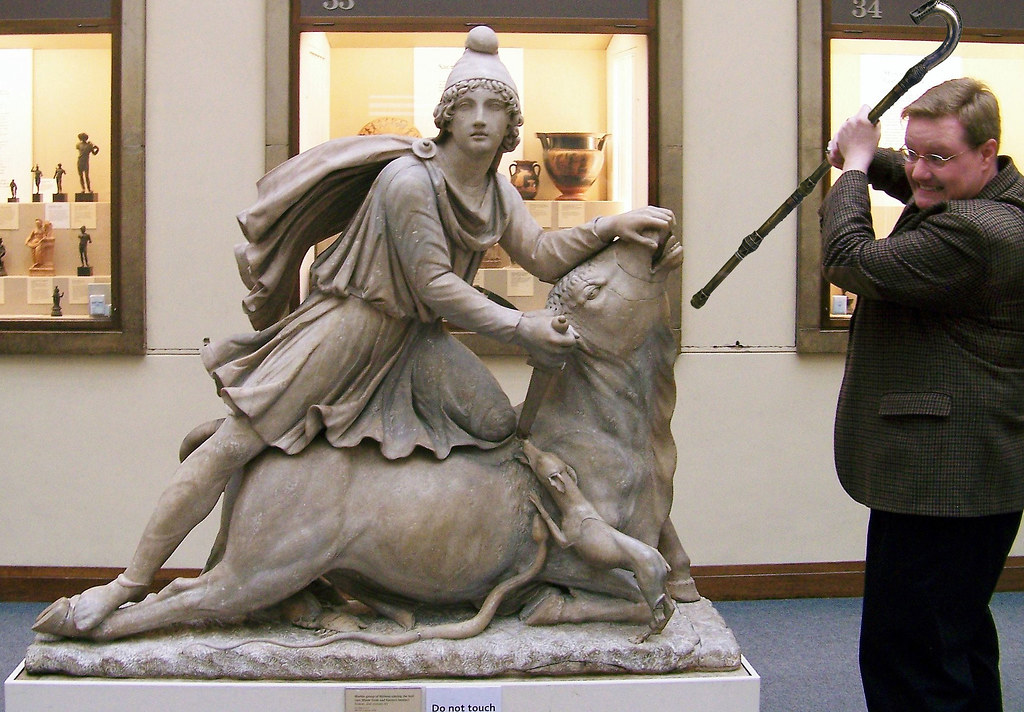
MITHras BUSTERS

This is me being dorky in the British Museum. I saw this Mithraic tauroctony and had an idea that could only make punsters grimace, my Latin and NT teachers grin, and my apologist friends clap.


(Full size here.)

Somebody should tell the bull to watch out for his gonads.

And yes...that is a poorly Photoshopped Irish crozier I'm using for the attack! Watch out, or I just might turn into a mitred smiter!

Let there be light!

Or at least fiber optic cable.

Just culled from the web, septuagenarian Segbritt Löthberg has the fastest internet connection installed in a residence in the world. At 40 gigabits per second, she can download a typical 90 minute movie in roughly two seconds.

And at 75, I'd say she doesn't need to spend her time waiting for something to load!

2007-07-18

Insufficient reflection on Sola Fide

Some people argue that while Christians are fussing over doctrine, they are ignoring the work that Christ left for us to do. I retort that that those who don't understand the work Christ did while he was on earth are hardly capable of continuing it in any meaningful way! So talk of Christianity that is separated from truth claims on the nature of Christ's work is not particularly defensible. Further, I think that history would show how Christianity is, historically, uniquely tied to its truth claims (both dogma and pragma) in a way that other faiths (often being more practice-driven) are not. This is merely a matter of history, not of theology. And secular thinkers have said as much in recent days.

A colleague's recent thoughts on justification and faith brought to mind Luther's famous statement, that "the doctrine of justification is the article by which the church stands or falls." He was referring to its articulation in the fourth article of the Augsburg Confession that justification is by faith alone in Christ alone (Melancthon's commentary on which may be found here). Similarly, Calvin said that justification by faith is "the principle hinge by which religion is supported." To be a Protestant means that you understand salvation, however you parse that (salvation from Hell and God's wrath, restoration to right relationship with God and others, etc.) is accomplished by Jesus Christ's work plus nothing! The recent Cambridge Declaration reiterated the belief, calling sola fide the "chief article" of Protestant Christianity.

I think that we lose perspective on this belief when we aren't anchored in understanding the history surrounding it. The Roman Catholic Church, for all its errors and excesses, was doing a decent job of urging charity and contributing to social cohesion. It had hospitals, schools, diplomats, amnesty workers, etc. And when the Reformers got off the ground, they had similar organizations. Their belief in this doctrine of justification by faith was obviously a matter of great intellectual and pietistic reflection, as is evidenced by the amount of ink spilled on the topic in the following four centuries. (Turretin's work on this is massive!) But it also had a very practical outworking in the building of schools, hospitals, charitable organizations, etc... all of which flourished in Reformed countries (despite the current mischaracterization that concern for doctrine diminishes "living out the kingdom of God").

What Protestants have always affirmed is that saving faith is God's work in us. It is an abandonment of faith in ourselves and a reliance upon the work of Christ as the sole means by which we have joyful fellowship with God and (ultimately) with ourselves and with others. If we look at any thing we do as somehow changing God's mind about communing with us, we fail to trust in Christ. If we think our good deeds make God like us more, we flubbed it. If we think God will love us less if we misbehave, we've fallen into error.

For legalists, this often takes the form of a "don't" list. Don't murder. Don't fornicate. Don't steal. Don't drink. Don't smoke. Don't XXXX. People that think God loves us or thinks better of us because we don't do these things are taking glory away from the sufficient righteousness that is ours in Jesus Christ.

For others - often (and inaccurately) labeled as "liberals" - this takes the form of a "do" list. Do feed the hungry. Do clothe the poor. Do justice for the orphan, widow, and alien. Do recycle. Do activism. Do XXXX. People that think God loves us or thinks better of us because we do these things are taking glory away from the sufficient righteousness that is ours in Jesus Christ.

Both of these forms of autosoterism are detestable and are unreformed. Reformed people eschew sin (some of which is found in the "don't list") and act righteously (some of which is found in the "do list") because God has revealed that his glory is manifested in us in those ways. Our life is one of thankful response whereby we "glorify God and enjoy him forever."

Every time we move away from the doctrine - the belief - that the work of reconciliation is complete in Christ and manifested in time by its application to us through the Holy Spirit, we err in one extreme or the other. We may say that we're just trying to live right (whether that's "good, clean livin'" or "ethical, green livin'"). But if we don't trust in Jesus for all of salvation (setting us right with the Godhead, each other, and the created order), then we'll fall into the trap of autosoterism (Pelagianism, Romanism, or whatever stripe it wears). Then, the God we worship is an idol who exists to rubber stamp our failures or successes in "doing justice" or "acting righteously."

Recommended reading:

One Faith: The Evangelical Consensus, by Alister McGrath and Thomas Oden. They've both written on the topic for academic audiences (
vide infra). More importantly, they show how Protestants who identify themselves as Reformed and as Arminian have a common ground of belief. In terms of bang-for-your-buck, this is the tops!

Iustitia Dei, by Alister McGrath. This is a historical overview of the doctrine, solid and interesting but a little dry and
very, very expensive.

Dr. Sproul does a better job at detailing this within the Reformed family, but his work has a more narrow appeal than the McGrath/Oden piece. Still, if you are Reformed, his book is a better representation of our mindset on the issue. (There's an interesting critique of Sproul's handling of Luther here.)

Faith Alone, by Martin Luther. Last but not least, this is the exposition of his stance from the Smalcald Articles. I also recommend this examination of his position on how living justification by grace through faith results in our sanctification and wholeness.

2007-07-17

Pagan Panties in a Wad

The Cerne Abbas giant, a paleolithic fertility carving, is taking a good ribbing from a sex symbol of our own age: Homer Simpson.


This is a publicity stunt to promote the release of the Simpsons Movie, but it's riled some pagans. They've promised to perform some "rain magic" so that the painted image will be washed away for its sacrilege. Hmm...making it rain in jolly old England? IT MUST BE MAGIC! (excuse me...magick or majik or however the fluffbunnies are spelling it now)

They've also demanded that it be removed. Aren't these the same folks that cry "theocracy" every time a Christian complains about the latest NEA-funded masterpiece? Gads...what will they do with this?

(My favorite tagline for this has to be from the Guardian's blogger!)

Vatican's Product Recall

Defects found in Protestant and Eastern Orthodox sects.


ROME—Pope Benedict XVI restated Tuesday what he said were the "defects" of Christian faiths other than Roman Catholicism, prompting anger from Protestants who question the Vatican's respect for other beliefs.
Ian Fisher, New York Times, July 11, 2007

NEWS FROM THE HOLY SEE
Office of Information and Public Affairs
Vatican City, Rome

FOR IMMEDIATE RELEASE
Vatican Recall Hotline: (800) ASK-RATZ
July 10, 2007

VATICAN CITY—Pope Benedict XVI today announced a voluntary recall of the following consumer products. Consumers should stop using recalled products immediately unless otherwise instructed.

Name of Products: African Methodist Episcopal (A.M.E.), Amish, Anabaptist, Anglican, Baptist, Calvinist, Christian Science, Congregationalist, Episcopalian, Evangelical, Fundamentalist, Huguenot, Jehovah's Witness, Lutheran, Mennonite, Methodist, Moravian, Mormon, Pentecostal, Presbyterian, Puritan, Quaker, Seventh-Day Adventist, Shaker, and Zwinglian Christian sects (frequently labeled "Protestant").

Name of Products: Albanian Orthodox, Bulgarian Orthodox, Coptic Orthodox, Czech Orthodox, Cypriot Orthodox, Estonian Orthodox, Finnish Orthodox, Greek Orthodox, Latvian Orthodox, Macedonian Orthodox, Montenegrin Orthodox, Polish Orthodox, Romanian Orthodox, Russian Orthodox, Serbian Orthodox, Slovak Orthodox, and Ukranian Orthodox sects (frequently labeled "Eastern" or "Oriental" Orthodox).

Manufacturer: The devil (listed on the New York Stock Exchange as "Angel of the Bottomless Pit," "Beelzebub," "Belial," "Dark Prince," "Evil One," "Fallen Angel," "Foul Fiend," "His Infernal Majesty," "Lucifer," "Mephistopheles," "Mr. Applegate," "Mr. Scratch," "Prince of Darkness," "Satan," and "Tempter").

Hazard: Can fail to achieve salvation on contact.

Incidents/Injuries: Widespread reports of salvific malfunction and consequent exclusion from the Kingdom of Heaven. Users complain of being rerouted to Purgatory and in a few instances to the Fiery Pit.

Cause: Because Jesus Christ subsists only in the Catholic Church of Rome™, adherents to other faiths that self-advertise as Christian must rely on infrequent guest appearances. Although He is omnipresent, He can't be everywhere at once.

Sold at: A complete list of retail outlets has been unavailable to the Church for the past five centuries. We continue our efforts to compile one and will post it online when we can.

Manufactured in: Wittenberg, Germany; Istanbul, Turkey; Alexandria, Egypt; Geneva, Switzerland; London, England; Boston, Mass.; Palmyra, New York.

Remedy: Consumers should desist adherence to the abovementioned sects, now proven unreliable, and transmit their souls to the Catholic Church of Rome™. United States residents may use this Catholic Church locator. For those who are already deceased, and therefore ineligible for salvation, the Church has commenced discussions about reopening Limbo, which the Vatican decommissioned in April.

2007-07-16

Money Changers and Baptized Capitalism?

Jim Ketchum, a writer for the Times Herald of Port Huron, MI said this:

Remember the Bible story about Jesus driving the moneychangers and other first-century capitalists from the temple in Jerusalem?

They were selling animals for sacrifices and padding their pockets doing currency exchanges.

Guess what: They're back.

Only this time they're in the United States.

There's no denying you can transform a product's desirability by slapping the adjective "Christian" on it - Christian books, Christian music, Christian clothing lines - as opposed to "pagan" or "heathen" books, music and clothing lines, I guess.

The word implies that buying the product in question somehow will help extend the kingdom of God and propagate the faith. What it really does is help pave someone's personal financial streets with gold.

Now while I agree with him on some parts of his article, I took umbrage with his mischaracterization of Jesus' temple thrashing, so I wrote him the following letter.

Jim,

I had to smile after reading your recent article on the sort of baptized commercialism in the market these days. Baptized inflation, you could call it! However, I'm not so quick to lampoon it seeing as similar things could be said of Jewish and Muslim markets. (Ever noticed the Kosher mark on foods, Jewish dating sites, or the recent increase of Halal markets?) Regardless, I do want to challenge you on one aspect of your criticism. You said that Jesus was attacking 1st century capitalists. While there was probably some up-market pricing, I don't think you have a good view of what was happening.

Jewish pilgrims from across the Greco-Roman and Persian world came to Jerusalem at the Passover to worship in the land of their ancestors (much as Muslims still go on hajj today). While the Torah instructed them to bring animals from their own flocks, many of these urban dwellers were no longer directly involved in herding and farming. Even if they had been, it would be quite impractical to drag an animal from home all the way across the desert sands or the Mediterranean Sea just to sacrifice it in Jerusalem. (What would happen if it died on the way?) Therefore, providing a service to their fellow Jews, certain people set up places where people could buy animals when they got to Jerusalem. Were the prices higher than what you would get elsewhere? Yes. But having recently returned from holiday in London, I can tell you that umbrellas, film, and batteries were more expensive near the major attractions than they were at the local pharmacy. That just makes sense - the space to rent is more expensive.

As for the money changers, they also provided a service. Coins from across the realm were carried by these pilgrims. While the precious metals in the coins were easy to value, the image of Caesar (or some other divine image) on the coin made it sacrilegious to use in paying the Temple Tax. Thus, the money changers exchanged the currency so that it was suitable to use in the Holy City. Again, we do the same thing today. There's a "cut" taken by the money changers at airports, and the same was true back then. Maybe it was exorbitant...we can't be sure.


One thing we can be sure of is that part of Jesus' ire was stoked at the place where the money changers were setting up shop.* The gospel accounts note that a bazaar had been set up in the Court of the Gentiles - the only place where non-Jews (commonly called god-fearers) could worship the true God on the Temple Mount. The court in which all this noise and hustling (literal and metaphorical) occurred was the only court of access for Gentiles when they wished to pray or meditate in the temple. They ought to have been able to worship in peace. Perhaps we could go so far as to say that they had the right to worship in peace. Instead they found themselves in the midst of a noisy bazaar. That's why Jesus specifically says that the Temple was to be a house of prayer for all nations.

*"It is erroneous to suppose that Jesus' action is an attack on the whole sacrificial system. His motive was one of reverence for my Father's house, and of deep concern that the spirit of worship should thus be dissipated at its very door...A place that should have stood as a symbol for the freedom of access of all nations in prayer to God, had become a place associated with sordid pecuniary interests" Wright, quoted in Leon Morris, The Gospel According to John, (Grand Rapids: Eerdmans, 1971) p. 195, fn. 68.

Killer Bees invade Palestine!

Yet another salvo from the religion of peace. This time, they're training their children to become jihadist martyrs through television programming.

Here's a transcript, if you can't open the viewer:

Saraa, child host: Who are you, and where did you come from?

Nahoul the Bee: I am Nahoul.

Saraa: Nahoul who?

Nahoul: I’m Nahoul, Farfour’s cousin.

Saraa: What do you want?

Nahoul: I want to continue the path of my cousin Farfour.

Saraa: How do you want to do this?

Nahoul: I want to be in every episode with you on the Pioneers of Tomorrow show, just like Farfour. I want to continue in the path of Farfour – the path of Islam, of heroism, of martyrdom, and of the mujahideen. Me and my friends will follow in the footsteps of Farfour. We will take revenge upon the enemies of Allah, the killer of the prophets and of the innocent children, until we liberate Al-Aqsa from their impurity. We place our trust in Allah.

Saraa: Welcome, Nahoul...

2007-07-10

Well done, thou good and faithful servant!

Professor Harold O. J. Brown fell asleep on Sunday night and woke up in glory. He'd been on a slow decline from terminal cancer. When a former student asked him how he was a few weeks ago, he said: "In view of my swallowing and speaking difficulties, my short-term prognosis is unknown but the long-term prognosis is good."

Dr. Brown influenced me indirectly through my friendship with several of his former students. His book on the history and function of heresy in the church (originally titled Heresies: The Image of Christ in the Mirror of Heresy and Orthodoxy) changed the way I view the nature of orthodoxy and heresy. And his ardor in the fight for the Right to Life kindled a flame that has been burning ever more brightly in the past decade. He was a scholar of the highest caliber, holding his BA, BD, ThM, and PhD from Harvard. He was imminently sensible, cautious, and informed in his writings. He was unashamed of being a Christian and a part of Western Civilization.

Above all, his students tell me, he was a pastor. He shepherded his family, students, and two fledgling seminaries into maturity. And now, having himself put away childish things, he sees face to face and knows as he is known.

Almighty and everliving God,
whose goodness it is ever to raise up pastors and teachers for your church,
receive, we beseech thee, the soul of Joe Brown.
Before ever he was an undershepherd to thee, O Christ,
he was a lost sheep which you found.
As he enters the company of the saints triumphant,
grant him rest from his burdens,
reward for his labors,
and the full measure of thy good pleasure,
Thou in whom he didst glory and worship,
in the power of the Holy Spirit. Amen.

Put that in yer pipe and....well

I was inspired by Toby's recent ruminations to revisit the bane of my wife, pipe-smoking.

Here's a poem by R. F. Murray, taken from The Scarlet Gown: being verses by a St. Andrews Man on the subject:

THE BEST PIPE

In vain you fervently extol,
In vain you puff, your cutty clay.
A twelvemonth smoked and black as coal,
’Tis redolent of rank decay
And bones of monks long passed away—
A fragrance I do not admire;
And so I hold my nose and say,
Give me a finely seasoned briar.

Macleod, whose judgment on the whole
Is faultless, has been led astray
To nurse a high-born meerschaum bowl,
For which he sweetly had to pay.
Ah, let him nurse it as he may,
Before the colour mounts much higher,
The grate shall be its fate one day.
Give me a finely seasoned briar.

The heathen Turk of Istamboul,
In oriental turban gay,
Delights his unbelieving soul
With hookahs, bubbling in a way
To fill a Christian with dismay
And wake the old Crusading fire.
May no such pipe be mine, I pray;
Give me a finely seasoned briar.

Clay, meerschaum, hookah, what are they
That I should view them with desire?
Both now, and when my hair is grey,
Give me a finely seasoned briar.

2007-07-09

Armchair Theologian but Pew-packin' Participant

Armchair has some excellent Biblical thoughts about participating in local church fellowship!

2007-07-04

Register Young People to Vote

Yes - I know that a lot of young people swing Democratic on a large number of issues. But there's one issue that I really care about where youth and I meet on the same grounds: restricting the acceptability of abortion. While most youngsters don't want the government making a complete ban on the procedure, they do support reasonable restrictions (e.g., abortion only in the case of danger to the life of the mother - which the pro-abortion, Planned Parenthood funded Guttmacher Institute reports as the cause of only 1% of all abortions sought).

Peace begins in the womb, and as the ticker on the left shows...we're doing a miserable job of being peace-seekers.

2007-07-03

The Death of God(dess)

Dangit! It looks like the "Death of God" theology has finally infiltrated Hinduism and Nepali Buddhism.

This is worse than when Karol Wojtyla died and for nearly 12 days, there wasn't a single infallible person on the face of the earth!