Showing posts with label pagan. Show all posts

2010-03-08

Micah 6:8 on the Skids

Princeton Seminary recently sent me a continuing education opportunity from their Institute of Faith and Public Life. The chief discussion will be around what it means to "do justice, love mercy, and walk humbly" from within an integrated theological and ethical framework.

For that, they've made a lovely little banner. Have a look.


Notice anything? They've taken the Micah 6:8 trifecta and given us examples of people they believe embody those virtues. They even color code them for us. Let's have a look.

Do Justice = Rev'd Martin Luther King, Jr. Okay...fair enough. MLK is one of my all-time favorite Republicans. And social justice that seeks to alleviate suffering through addressing all the causes of poverty (rather than simply looking at the symptom - not much money) is a worthwhile effort on the part of Christians that doesn't always get its proper attention from conservative-minded persons.

Love Mercy = Dr. Dietrich Bonhoeffer. Um...this is a strange call. It's not as though he worked to help out the Jews. While he did seek to assassinate Adolf Hitler, I'd hardly equate that with mercy. (And if it is, then just war theory and ministries of compassion just got a whole lot more interesting.) And the Hebrew word hesed here translated has strong overtones of COMMITMENT and LOYALTY. Again, not a virtue that first comes to mind for someone plotting the overthrow of his government and the military defeat of his own nation. (Granted, I think he was unflinchingly loyal to the historic church and his Confessing Church movement embodied that.)

Not only is Bonhoeffer not a notorious do-gooder, but do-gooding isn't even the point. What God requires is not doing good for good’s sake. What God requires of his followers is that they be committed and love being committed to God. Which makes it all the more curious that, right next to him - but colored in a way that doesn't tie her to a specific virtue, is a very paragon of mercy to others and commitment to God in Blessed Theresa of Calcutta. This woman embodied mercy (humility, too...though the left would excoriate her as anti-justice because she rebuffed them for murdering our unborn). What is Princeton saying with this?

But this isn't the strangest appellation or slight, either.

Walk Humbly = Mohandas Gandhi, Esq. Okay...his simplicity of dress and lifestyle indicate an epitome of living for others. I'll grant that. Humility, though, is a hard virtue to peg on someone who overthrew British rule in his home country. Moses, who cast off Egypt's chains, was meek - but he wasn't particularly humble.

Moreover, sheer humility is not what is in view in the Scriptures. Read it again: walk humbly with your God. Your God is covenant language. And it's used in Micah's burden against the Israelite's idolatry. "You've fallen to idol worship, and it has produced a profound effect throughout your entire society!" he says.

Here's the problem. Gandhi was a committed Hindu. He'd read the Bible and knew a great deal about it, but kept to the faith of his forbears.

Let me ask you...have you ever been to a Hindu temple?


And that's just the outside.

Hinduism is full of idolatry. And Ghandi was an idolater. He was concerned about the poor...I'll grant it. But he hated the Creator, and proved it with every act of devotion rendered to the idols. (We know where that worship ends up going...to demons.)

Mohandas Ghandi is not humble in the biblical sense. He was an arrogant, prideful, self-glorifying idolator who shook his fist in the face of God every day of his rebellious demon-worshiping life.

Princeton has made some extremely bad decisions in how they've cast this seminar. (Which may or may not be helpful.)

If you're a regular supporter of theirs - either personally, or through giving within the PC(USA), I advise you to let them know what you think.

2009-11-04

Christian Burial

I present this excellent article by Dr. Long on what it means to have a good funeral. So much of what is done in funerals - as in marriage - represents more our modern twisting of life rather than a Christian expression of life lived before the face of God.


The Good Funeral: Recovering Christian practices, by Dr. Tom Long
(taken from the Christian Century)

When Elizabeth Janzen died in a Minneapolis nursing home, the staff immediately notified the closest relative, her daughter Sarah in St. Louis. Sarah, who had faithfully visited her mother once a month, arranged for Elizabeth to be cremated, for the ashes to be sent to St. Louis and for an obituary to be placed in the Minneapolis newspaper. A month later, Sarah took the ashes to a lake in rural Minnesota, where Elizabeth and her family had often vacationed, and scattered them on the water.

A week later, a memorial service was held in the chapel of the Minneapolis church where Elizabeth had kept her membership, though her health had prevented her from attending for a number of years. On a table at the entrance to the chapel were placed several photographs of Elizabeth at various stages in her life, her Bible, a ceramic vase she had made, and a few other personal mementos.

At the service, Sarah read one of her mother's favorite poems, Elizabeth's younger sister told an amusing story about their childhood, the chaplain from the nursing home read Psalm 23 and prayed a brief prayer giving thanks for Elizabeth's life, and two of Elizabeth's former students (she had taught high school for more than 30 years) read fond reminiscences of her as a teacher. After a time of quiet reflection, during which they listened to a recording of Judy Collins's rendition of "Amazing Grace" (one of Elizabeth's favorite hymns), the small group in the chapel silently dispersed.

Elizabeth Janzen is fictitious, but the rituals marking her death represent a rapidly emerging trend in Christian funeral practices. With surprising swiftness and dramatic results, a significant segment of American Christians has over the past 50 years abandoned previously established funeral customs in favor of an entirely new pattern of memorializing the dead. This new pattern is not firmly fixed (indeed, variations, improvisations and personal customizations are marks of the new rituals) but it generally includes the following characteristics:

• a memorial service instead of a funeral (i.e., a service focused on remembering the deceased, often held many days after the death, with the body or the cremated remains of the deceased not present)

• a brief, simple, highly personalized and customized service, often involving several speakers (as opposed to the standard church funeral liturgies presided over primarily by clergy)

• a focus on the life of the deceased (often aided by a physical display of photos and other mementos)

• an emphasis on joy rather than sadness, a celebration of life rather than an observance of the somber reality of death

• a private disposition of the body, often done before the memorial service, with an increasing preference for cremation

The shift toward this new pattern has not happened everywhere, of course. It is most pronounced among white, suburban Protestants, and the older customs often still prevail in rural areas, among nonwhites and in many Catholic parishes. But these differences seem more a matter of lag time than anything else. The trend lines are clear, and it is apparent that funeral practices for all Christians, as a part of the larger culture, are moving at various rates of speed toward this new pattern.

A significant number of Christian clergy, especially those who are more progressive and better educated, applaud many of these changes. While they may be troubled somewhat by the open-mike atmosphere of these new services or by the inevitable banalities of some of the poems, songs, readings and other elements imported into them, they nevertheless find them preferable to the older, often depersonalized and more somber rituals of the past—primarily for two reasons.

First, the preference for memorial services, the emphasis on joy or even on laughter, the de-emphasis on the body of the deceased, and the celebration of the personal aspects of the life of the one who has died all seem more commensurate with the Christian witness to the resurrection. Second, the valuing of simpler, less formal services provides leverage for people to break loose from the stranglehold of showy, expensive and burdensome funeral practices so prized by the funeral industry.

These clergy are unquestionably well intentioned, and they are right to find some encouraging signs here, but I want to raise some basic theological questions about this emerging pattern of death practices. I would like to suggest that these newer rituals, for all of their virtues of freedom, simplicity and seeming festivity, are finally expressions of a corrupted understanding of the Christian view of death. These newer practices are attractive mainly because they seem to offer relief from the cosmeticized, sentimental, impersonal and often costly funerals that developed in the 1950s, which were themselves parodies of authentic Christian rituals. Contemporary Christian funeral practices certainly need to be changed, but change should be more a matter of recovery and reformation than innovation and improvisation.

In the early years of the Christian movement, Christians developed distinct funeral practices that, while woven from local customs, still reflected Christian theology. At the beginning of the third century, Tertullian could already speak of an "appointed office" for Christian burial in North Africa, and certainly by the late fourth century the contours of a distinct Christian funeral rite began to appear. This rite was composed of three movements: preparation, processional and burial.

In the preparation movement, the body was washed, anointed and clothed in garments representing baptism. In the processional phase, the body was carried to the grave, and sometimes the procession entered the church on the way for prayer and the reading of scripture. The burial phase took place at graveside and included the commendation of the deceased to God and the actual burial of the body. During each movement, the church prayed, chanted psalms and sang hymns of joy. Often a Eucharist was held, either in the church or at the grave.

The theme of the service was the completion of baptism, and the church accompanied a brother or sister to the place of union with God through the resurrection of Christ. Taken as a whole, the early Christian funeral was based on the conviction that the deceased was a saint, a child of God and a sister or brother of Christ, worthy to be honored and embraced with tender affection. The funeral itself was deemed to be the last phase of a lifelong journey toward God, and the faithful carried the deceased along the way to the place of final departure with singing and a mixture of grief and joyful hope.

In subsequent centuries, this basic funeral pattern sometimes struggled for visibility against cultural and theological changes. For example, the joyful Easter motif of the early Christian funeral was nearly submerged by a gloomy "Day of Wrath" theology of the late Middle Ages, and the Puritans, offended by what they saw as excesses in Anglican funerals, tried, unsuccessfully as it turns out, to get rid of funeral ceremony altogether. Nevertheless, the basic pattern and practices of Christian burial managed to weather the storms and continued to exert a strong force on Christian funerals until the late 19th century.

This review of the development of classic Christian funeral practices should make it evident that the pattern for funerals now appearing is not simply a modernization and adaptation of traditional customs but a radical, and finally diminished, replacement of Christian ritual.

For example, the current shift to a memorial service with the body absent means that Christian death practices are no longer metaphorical expressions of the journey of a saint to be with God. The saint is not even present, except as a spiritualized memory, a backdrop for the real action, which happens in the psyches of the mourners. The mourners are the only actors left, and the ritual now is really about them. Funerals are "for the living," as we are prone to say. Instead of the grand cosmic drama of the church marching to the edge of eternity with a fellow saint, singing songs of resurrection victory and sneering in the face of the final enemy, we now have a much smaller, more privatized psychodrama, albeit often couched in Christian language. If we take the plot of the typical memorial service at face value, the dead are not migrating to God; the living are moving from sorrow to stability.

How did the church shift from the understanding of a funeral as the joyful accompanying of a saint on "the last mile of the way" to a reflective, disembodied, quasi-Gnostic cluster of customs and ceremonies? What happened in the latter part of the 19th century?

Because this is precisely the time that embalming became widespread and the modern funeral parlor developed, it is almost irresistible to blame the newly minted funeral professionals for all the mischief. As the argument goes, undertakers reinvented themselves as funeral directors and rode the technological advances in embalming all the way to the bank. They first took the dead away from us in order to embalm them, and then they took the funeral itself away and turned it from a worship service into a vulgar display of conspicuous consumption.

The truth, however, is that a guild of embalming technicians could never have become directors of any sacred Christian ritual, could never have taken the funeral away, had not church and culture been more than ready to hand it over. Almost every developed society, even ancient Rome, has had "undertakers" who assist with the preparation of the dead, but even if 19th-century undertakers had hatched a plot to hijack the Christian funeral, it would have failed if our death rituals had been healthy and full of meaning.

If Christian funerals today are impoverished, we must look primarily to the church's own history and not look with scorn at the funeral director. The fact is that many educated Christians in the late 19th century, the forebears of today's white suburban Protestants, lost their eschatological nerve and their vibrant faith in the afterlife, and we are their theological and liturgical heirs. It was not, of course, as if the whole of 19th-century Christian society woke up one morning and suddenly found that they no longer believed in eternal life. The loss of conviction about the otherworld came slowly and gradually.

In the decades after the Civil War, the quite literal views of many American Christians regarding heaven, hell, the end of the world, the resurrection of the body and the second coming of Jesus began to ebb away. A recent study by Drew Gilpin Faust points out that the sheer devastation of the Civil War itself, the staggering number of dead, the violence and loss of life out of all proportion to the ability of most people to make meaning from it, accelerated the 19th century's already growing crisis of faith. She writes:

Civil War carnage transformed the mid-nineteenth century's growing sense of religious doubt into a crisis of belief that propelled many Americans to redefine or even reject their faith in a benevolent and responsive deity. But Civil War death and devastation also planted seeds of a more profound doubt about human ability to know and understand. . . . The Civil War compelled Americans to ask with intensified urgency, "What is Death?" and in answering to find themselves wondering why is death, what is life, and can we ever hope to know? We have continued to wonder ever since.
Part of the crisis of faith was about eschatology. In the 1840s, some Christians confidently calculated the exact date of Jesus' return, only to have their hopes, and for many of them their naive faith, crushed when Jesus did not come—a time that came to be called the Great Disappointment. Even less advent-minded Christians of the time had to reckon with the impact of the rising sciences, of Darwinism, and of the new skeptical philosophies imported from Europe. Consequently, the literalisms of the past came under severe stress. Pictures of Jesus coming in the clouds, of the dead rising bodily from the graves, of the saints arrayed in glory, became less and less imaginable, less and less plausible.

The notion of heaven was not altogether abandoned. Instead, it was revised and domesticated. Heaven was reimagined as a place very much like the best of earth, sometimes not a place at all but simply an intensification of earthly delights, and the idea of the resurrection of the body yielded to the more gentle and continuous notion of the immortality of the soul. One late-19th-century member of the clergy characteristically said, "To me, heaven means only myself with larger opportunity. It means this earth-life grown into perfection." Lucy Larcom, in a devotional essay characteristic of the period, wrote:
Surprises doubtless await us all, across the boundaries of this earthly existence. But none, perhaps, will be more surprised than those humble, faithful, self-sacrificing souls who have often almost dreaded the strange splendors that might open upon them beyond the gates of pearl, when they find that it is the same familiar sunshine in which they have been walking all their days, only clearer and serener. They will wonder that they have no new language to learn, no new habits to form, almost no new acquaintances to make. They will at last discover what their humility hid from them here, that while on earth, without knowing it, they had already been living in heaven.
No wonder the metaphor of journeying to be with God began to break apart at the seams. If people had "already been living in heaven," then there was, after all, nowhere for the dead to travel, and without letting go of the vocabulary of the otherworld, mainline Protestants in the late 19th century, long before John Lennon, could well "imagine there's no heaven."

A second significant development was the creation of rural cemeteries located some distance away from towns and villages. At first, cemeteries were separated from the living because of the notion that putrefying bodies produced miasmas, noxious gases that caused disease, but by the end of the 19th century, rural cemeteries were less about avoiding pollution and more about aesthetics. They were landscaped, gardenlike environments designed to encourage quiet and restful contemplation of nature, immortality and the meaning of life.

The more practical effect of these remote cemeteries, as Susan J. White has pointed out, was the division of the previously unified funeral ritual into two discrete parts: the funeral in the church and the burial in the distant cemetery. It was not long before this separation in distance became a separation in liturgical fact and in theological symbolism. The funeral was no longer a journey to the place of burial; it became a stationary event completely contained within the church building. The graveside ritual became a mere optional afterword. As White observes, "The removal of the gravesite to a location far away from the precincts of the church depletes a fund of theological and communal images and severely reduces the sense . . . that the living and the dead are part of one 'holy communion.'" So, with heaven gone and with the cemetery miles away, neither the dead nor the living had anywhere to go, and the metaphor of the journey to God collapsed.

Surely the task before the church now is to retrace our steps and to recover the grand liturgical theater in which Christians embrace their dead with tender affection, lift up their voices in hymns of resurrection and accompany the saints to the edge of mystery. This will not involve a mere repristinating of funeral practices or a rejection of cremation, but a recovery in our time and in contemporary forms of the governing symbols of the communion of saints, the resurrection of the body, and the journey of Christian dead toward the life everlasting.

In the meantime, the seeds planted in the 19th century continue to bear weeds. Since literalistic views of heaven and the saintly journey are no longer plausible to us, and since we lack the theological imagination to grasp the poetic truth and power of these metaphors, dead Christians have nowhere to go but to evaporate into the spiritual ether and into our frail memory banks. With heaven domesticated, the soul morphed into an immortal gas, the corpse become a shell and the cemetery moved out of sight, it was almost inevitable that the dead with their embarrassing bodies would be banned from their own funerals and the living would be condemned to sit motionless, contemplating the meaning of it all and pretending to celebrate life as the nephew of the deceased sings "When Irish Eyes Are Smiling."

Surely our culture will eventually weary of such liturgical and spiritual thinness and be ready for more depth, for more truth—for our sake and for the sake of those we love. When we are, the great drama of the journey to God will be there, beckoning us to join the procession of the saints. We will travel toward eternity with those we have loved, singing as we go and calling out to the distant shore in words of confident hope, like these from an ancient Coptic funeral prayer:
Let the shadows of darkness be full of light. Let the angels of light walk before him.
Let the gate of righteousness be opened to him. Let him join the heavenly choir.
Bring him into the paradise of delight. Feed him from the tree of life.
Let him rest in the bosom of our ancestors, Abraham, Isaac and Jacob, in your kingdom.
This article is excerpted from Thomas G. Long's book Accompany Them with Singing: The Christian Funeral, just published by Westminster John Knox.
Thomas G. Long is professor of preaching at Emory University's Candler School of Theology in Atlanta and the author of Preaching from Memory to Hope (Westminster John Knox).

2009-05-28

King College Confessions over Cathaginian Christians

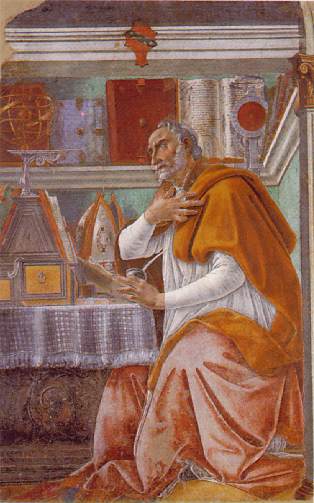
At King College, the English curriculum rotated around a reading of Augustine's Confessions. It's imprinted on my mind because, to my horror, the library only had a copy in Latin by the time I got around to checking it out. (I hate buying books unless I know I want it forever - it's nearly impossible for me to throw them away.) I can still hear, with fear, those quiet questions from Dr. Woolsey..."Chris, you have the Latin. Can you shed any light on this sentence?"

Yowsa.

Anyway, we all had strategies for dealing with reading the text. One student said "Just read until he starts talking about how sorry he is for his sins, skip seven pages, and you'll pick back up to his original thought." Not a bad strategy. But you miss all the lamentin' over lust. So, if you went to ole' KC and took an upper classmen's advice, here's a memorable way to experience what you missed.


"Confessionz"
A Rap about the Confessions of St. Augustine. Written and performed by Christ "MCG" Gehrz...with some help from puppets.

Lyrics:

Now Augustine of Hippo dropped in three and fitty-four
Constantine had gone Nicene almost thirty years before
But Auggie grew up hatin' on the prayin'
See his momma was a Christian, but his daddy was a pagan

On the mean streets of Thagaste, A-Dawg's on a tear
They call him Del Monte 'cause he's gotta have the pear
Didn't even taste it but he's grinnin'
See, it's not about the Benjamins; it's all about the sinnin'

Yeah, and playa had his way wit all da ladies
Until the girl said, "Boo, chill - we're gonna have a baby"

CHORUS:
Oh, Augustine!
(Or Augustine, Augustine)
Augustine!
(Yeah, he's lustin', he's lustin')
Augustine!
(But he's trustin', he's trustin')
God made us for himself
And our hearts'll find their rest in him

Went back to school in Carthage (the town the Romans flattened)
And holla! He's a scholah at philosophy and Latin
Told 'em all that "Cicero's da illest!"
Some Manicheans told him, "Son, you don't know what ill is!"

"What's goin' down's a battle, good and evil warrin'
The spiritual is admirable, the physical's abhorrent"
He thought they'd give him answers that were hidden
But when they said to give up sex, he said, "Oh no, you di'n't!"

Still, playa became a praya when he said
"Give me chastity and continence, Lord... but not yet!"

CHORUS: (repeat)

Took a job in It'ly and read up on the Plat'nists
Learned that evil's just the lack of good, and only good exists
A man in Milan named Ambrose tried to reach him
A. said, "I don't believe his words, but bro's da bomb at preachin'!"

Still he read the Holy Scripture and the picture started shiftin'
He prayed to God to save him from himself but he kept driftin'
Until he fell down weepin' at his knees
He heard the voice of children singin' "Take up and read"

And playa read Paul's playa-hatin' epistle
"Clothe yourself in Jesus Christ" hit him like a missile!

CHORUS: (repeat, 2x)

2008-10-30

Exodus 32 to CBN

Self-appointed "prophet" and dubiously-doctored Cindy Jacobs recently announced on CBN that she had a vision - a word from God Almighty - that Christians needed to go to New York City and "pull down the strongman" that was blighting our economy.
The Lord further said, “October 29 was Black Tuesday, the day the stock market crashed, and Satan wants to do it again.” We must be proactive in prayer. At the beginning of the year many intercessors began to hear from the Lord that without divine intervention, a major shaking was coming to Wall Street. This would spread until there were food shortages....On September 29 last month, the US stock market went down 777 points in one day. Cindy says it was no coincidence that this happened on the first day of the Jewish New Year, Rosh Hashanah.
Okay... While I disagree that God Rosh Hashanah had anything to do with it (other than, maybe, the smartest financiers in NYC were at Synagogue that day), I'm cool with her asking people to pray. I pray for the nation every day - and for people caught up in this economy. Christians are to pray for the welfare of all, and especially their country and its leaders.

But I think Cindy makes some SERIOUS missteps. First, she has this charismaniac idea of territorial spirits - a larger part of a mistaken notion of Spiritual Warfare as something other than sanctification. Here's what she asked people to do:
“We are going to intercede at the site of the statue of the bull on Wall Street to ask God to begin a shift from the bull and bear markets to what we feel will be the 'Lion’s Market,' or God’s control over the economic systems,” she said. “While we do not have the full revelation of all this will entail, we do know that without intercession, economies will crumble.”


When people that claim to follow God start getting around brazen cattle, I get nervous.


Here's some video of them singing and marching around the bull.

Dancing and singing isn't enough...they even "lay hands" on the thing!


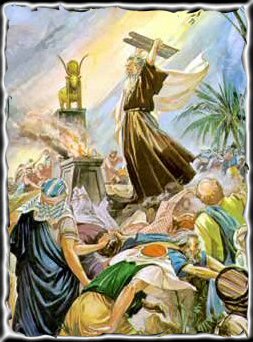
I'll bet these folks know every verse about dreaded sexual sins. I just wonder if they've ever stopped to read Exodus 32.

I'm not waiting for Moses (or Charlton Heston) to come down the mountain and toss stone tablets at them.

But the idolatry police are about to throw the book at'em!!!

This is what happens when we let orthodoxy become something we "used to do." This is what happens when we're so concerned that everyone's spiritual experience become celebrated that we refuse to be biblically discerning for fear of being "critical." We like to think it's something that only "the left" does...but there's so much of it on the right, too.

With "Christianity" like this, America deserves any and every plague God throws at us.

Learn more about Spiritual Warfare here, here, and here.

Irving Norman had the right idea...

2008-10-08

Losing God the Father

Last Spring, a seminary friend of mine was invoking his privilege as a senior to give one sermon at the midweek chapel service. The senior sermon serves as an opportunity to share something of your faith with the community that, for two or more years, has been part of shaping that very faith. There are basic, "broad middle" sermons. Some sermons that question the person's call after 2.5 years of education. Many sermons that criticize the Bush administration. And a plethora of GLBT, Social Justice, or other standard Christian Left sermons. Fine and dandy.

But my friend was called in to the dean's office. His crime? He dared to use masculine pronouns and speak of God the Father. Apparently, inclusive language isn't meant to include half of the population.

Don't get me wrong. Inclusive language in regards to humans is a good thing (though it can make for poor writing in the hands of less-skilled writers). It's a seminary policy to use inclusive language.

But a recent Touchstone article asks, "What are we losing?"

A lot of feminist and post-modernist theologians talk about how people have felt excluded by masculine god-talk. (Which, let's be clear, is MASCULINE, but not necessarily MALE.) They want to jettison 4,000 years of linguistic reflection on the basis of 40-60 years of empowerment talk. But I don't think they've thought through all the implications. They can tell you why they don't want masculine god-talk, but have a harder time justifying the alternative they propose.

Do you know why masculine god-talk is important? Please feel free to use the comments section to elucidate. And stay tuned...the vicar is about to stir things up.

2008-09-21

You are what you eat

Apparently, researchers at Oxford University have found out that if you are a vegan you're more likely to become a vegetable in later life.

Of course, one look at the proto-vegetotalitarian could tell you that.


Ooh...looks like the effects are starting early for some EarthFirsters.

So what do we do with Romans 14 now?

2007-08-16

Bad Week for Global Warming Alarmism

This must have the Greens seeing Red (and not just in their destructive policies...).

2007-07-17

Pagan Panties in a Wad

The Cerne Abbas giant, a paleolithic fertility carving, is taking a good ribbing from a sex symbol of our own age: Homer Simpson.


This is a publicity stunt to promote the release of the Simpsons Movie, but it's riled some pagans. They've promised to perform some "rain magic" so that the painted image will be washed away for its sacrilege. Hmm...making it rain in jolly old England? IT MUST BE MAGIC! (excuse me...magick or majik or however the fluffbunnies are spelling it now)

They've also demanded that it be removed. Aren't these the same folks that cry "theocracy" every time a Christian complains about the latest NEA-funded masterpiece? Gads...what will they do with this?

(My favorite tagline for this has to be from the Guardian's blogger!)

2007-04-05

Online Evangelism

Below is a transcript of a conversation I had this morning. A 13 year old boy (TW) raised by Wiccans has apparently had a friend telling him about Jesus. He turned to me for some answers. Please pray that God uses the planted seed to the salvation of this young man.

TW: Hi

TW: my name is Xxxx

Me: Hi, Xxxx.

TW: I found your profile on the yahoo members page, and I think it said you were a minister......or at least a christian

Me: Yes.

TW: ok

Me: The least of Christians, perhaps.

TW: really?

Me: Probably not - I’m a big guy. What can I do for you?

TW: I had a few questions if thats ok

Me: Sure

TW: ok

TW: What do you worship as a christian?

TW: one God.......instead of a God and Goddess right?

Me: One God, that’s correct.

TW: ok

Me: It’s not exactly accurate to say God has a gender, though God has revealed as a Father.

TW: ok

TW: So is Jesus another name for God?

TW: or someone seperate

Me: Ah...it looks like you are asking for some clarification on the greatest mystery of the faith.

Me: The Doctrine of the Holy Trinity, correct?

TW: im not sure what that is

Me: Fair enough.

Me: There is only one “thing” that can be called “god”

TW: im 13, and my family is wiccan, so I know nothing about christianity

TW: but i am curious and maybe one day I want to become christian

Me: It’s okay - I was actually Wiccan during college.

TW: wow

TW: and your a minister?

TW: for a christian church

Me: One of the greatest heroes of our faith, a man named Paul of Tarsus, was a persecutor of the early church (in the decades following Jesus’ death).

Me: Nevertheless, God used Paul to write nearly half of the New Testament (the portion of the Bible that deals explicitly with Jesus).

TW: ok

TW: Ive read some of John in the new testiment

Me: God uses all kinds of people, and his greatest delight is in making his enemies his friends.

Me: John is a great place to begin.

Me: It not only tells the story, but it also talks about the importance of those events.

TW: thats what I was told

TW: are you parents christian

Me: Yes.

TW: ok

Me: I was raised a Christian and believed in “god” but didn’t want to accept Jesus as the focus of God’s work in the world.

TW: ok

Me: To go to your original question, you were asking what Christians believe about the nature of God.

TW: right

Me: We believe that there is only one God - one entity, if you will - that is God. And that God is all powerful, all knowing, all loving, all holy, all GOOD, etc.

Me: However, God is also three persons: the Father, the Son, and the Holy Spirit.

TW: ok

TW: I think I understand

Me: To be honest, we can say more about what we know God is not rather than what/who God is.

TW: ok

TW: what is God not

Me: To illustrate: There are not three Gods, but only one God. God is not “made up” of three persons; rather God is three persons.

Me: God doesn’t “switch hats”: now acting like the Father, then acting like the Son, and sometimes acting like the Holy Spirit.

Me: Rather, each of those persons is fully God.

Me: One of the most ancient - and beautiful - explorations of God is called the Athanasian Creed.

TW: ok

Me: Another place to look for why Christians believe this doctrine is found here.

TW: ok

TW: thanks

Me: No problem.

Me: Here is a helpful analogy, comparing the Trinity to a book. For example, a book has length, width, and thickness. The length is not the book’s width, the width is not the book’s thickness. These three dimensions can be described separately, yet they are connected together. If you remove one dimension, you are no longer describing a book. In the same way, the Godhead has three separate members that are connected together, and if you try to remove one you no longer have the Godhead.

TW: ok

Me: Does that make sense?

TW: i think so

Me: Don’t worry if you find this perplexing.

Me: Any honest Christian will say the same thing.

TW: ok

Me: God is so much greater than we are - it’s impossible for us (trapped in bodies, experiencing time in a linear fashion, of limited mental/spiritual capacity) to truly understand a God who is infinite.

TW: ok

Me: The important thing to know is that God loves us, and we see that love in the person and work of Jesus Christ.

Me: Have you ever felt guilty?

TW: maybe

Me: I have. That’s because we know that there are some things that are right and some things that are wrong.

Me: Even the Wrede teaches that to harm another is to bring harm to yourself and the world (three-fold harm)!

TW: right

Me: Yet we say nasty things to each other, and sometimes do nasty things to each other.

Me: And we heap the same abuse upon ourselves.

TW: ok

Me: The things that we do to hurt others and our world is called “sin.”

Me: Sin breaks our relationships with other people, with ourselves, with our world, and - most importantly - with God.

TW: ok

Me: God does not want us to miss out on who he is - all of his goodness.

Me: So Jesus - who is God the Son in human flesh - came to earth.

TW: ok

Me: He taught us how to live, he healed the sick, he fought the powers of darkness, and then - at the appointed time - he died on a cross.

Me: The Bible says that the wages of sin is death.

Me: That means that when we sin, we’ve earned death.

Me: But the gift of God is eternal life. God the Son takes our punishment for us.

Me: The debt for sin - which is death - is paid for in his death on the cross.

Me: God proved to us that the sin-debt was canceled by raising Jesus from the dead.

TW: ok

Me: Because of Jesus Christ, we can have peace with God.

TW: awsome

Me: When we have peace with God, we begin to change from the inside out.

Me: God restores all those relationships that we messed up with our sin.

Me: He makes us able to love him and know him, for the first time.

Me: He makes us able to really love other people - for who they are, rather than what they can do for us.

Me: Peace with God means we can have peace in ourselves, too.

TW: what makes you think I cant already love people for who they are?

Me: I didn’t say you couldn’t.

Me: Genesis - the first book of the Bible - tells about how God made the world.

Me: When God made humankind, the Bible says that he made us “in his image.”

Me: That is - there is something inside of us that resembles God.

TW: ok

Me: And when we are able to love God, we can love other people in a deeper sense because we understand that they carry the image of God in themselves.

TW: ok

Me: You’ll understand - hopefully - one day when you have children.

Me: I have four children, and when I look at them I see something of myself reflected back at me - yet with their own distinctiveness.

Me: And I love what I see - myself and my wife in them, as well as the unique person they are.

TW: sooo

TW: whats your name dude jw

Me: My name is Chris.

Me: Christopher, actually. It means: “Bearer of Christ” or someone who carries the message of Christ into the world.

Me: My mother named me well.

Me: Brent, let me just say that it is a real privilege for me to get to speak with you.

TW: thanks

TW: but why

Me: Why? Have you got your Bible?

Me: Or the Gospel of John?

TW: i know of an online bible

Me: Read this: http://tinyurl.com/32ll8t

Me: It’s a privilege for me to share with you what little I know about how much God loves us in Jesus Christ.

TW: ok

Me: That link was to Jesus’ words.

Me: The sin in our lives keeps us from even being interested in learning about God.

Me: So when someone has these...stirrings...it can only be because God is already at work in their lives.

Me: God brings us to himself, draws us into his embrace.

Me: And it’s a real privilege for me to see how God is already calling out to you.

TW: i gotta go

Me: God bless you!

TW: later

Me: Keep reading that gospel of John


Keep going out into those information highways and byways, folks!

"May the Lamb that was slain receive the reward of His suffering!"