2008-09-28

Preaching Hell in a Tolerant Age

Brimstone for the broad-minded.
by Tim Keller

The young man in my office was impeccably dressed and articulate. He was an Ivy League MBA, successful in the financial world, and had lived in three countries before age 30. Raised in a family with only the loosest connections to a mainline church, he had little understanding of Christianity.

I was therefore gratified to learn of his intense spiritual interest, recently piqued as he attended our church. He said he was ready to embrace the gospel. But there was a final obstacle.

"You've said that if we do not believe in Christ," he said, "we are lost and condemned. I'm sorry, I just cannot buy that. I work with some fine people who are Muslim, Jewish, or agnostic. I cannot believe they are going to hell just because they don't believe in Jesus. In fact, I cannot reconcile the very idea of hell with a loving God—even if he is holy too."

This young man expressed what may be the main objection contemporary secular people make to the Christian message. (A close second, in my experience, is the problem of suffering and evil.) Moderns reject the idea of final judgment and hell.

Thus, it's tempting to avoid such topics in our preaching. But neglecting the unpleasant doctrines of the historic faith will bring about counter-intuitive consequences. There is an ecological balance to scriptural truth that must not be disturbed.

If an area is rid of its predatory or undesirable animals, the balance of that environment may be so upset that the desirable plants and animals are lost—through overbreeding with a limited food supply. The nasty predator that was eliminated actually kept in balance the number of other animals and plants necessary to that particular ecosystem. In the same way, if we play down "bad" or harsh doctrines within the historic Christian faith, we will find, to our shock, that we have gutted all our pleasant and comfortable beliefs, too.

The loss of the doctrine of hell and judgment and the holiness of God does irreparable damage to our deepest comforts—our understanding of God's grace and love and of our human dignity and value to him. To preach the good news, we must preach the bad.

But in this age of tolerance, how?

How to preach hell to traditionalists

Before preaching on the subject of hell, I must recognize that today, a congregation is made up of two groups: traditionalists and postmoderns. The two hear the message of hell completely differently.

People from traditional cultures and mindsets tend to have (a) a belief in God, and (b) a strong sense of moral absolutes and the obligation to be good. These people tend to be older, from strong Catholic or religious Jewish backgrounds, from conservative evangelical/Pentecostal Protestant backgrounds, from the southern U.S., and first-generation immigrants from non-European countries.

The way to show traditional persons their need for the gospel is by saying, "Your sin separates you from God! You can't be righteous enough for him." Imperfection is the duty-worshiper's horror. Traditionalists are motivated toward God by the idea of punishment in hell. They sense the seriousness of sin.

But traditionalists may respond to the gospel only out of fear of hell, unless I show them Jesus experienced not only pain in general on the cross but hell in particular. This must be held up until they are attracted to Christ for the beauty of the costly love of what he did. To the traditional person, hell must be preached as the only way to know how much Christ loved you.

Here is one way I have preached this:

"Unless we come to grips with this terrible doctrine, we will never even begin to understand the depths of what Jesus did for us on the cross. His body was being destroyed in the worst possible way, but that was a flea bite compared to what was happening to his soul. When he cried out that his God had forsaken him, he was experiencing hell itself.

"If a mild acquaintance denounces you and rejects you—that hurts. If a good friend does the same—the hurt's far worse. However, if your spouse walks out on you, saying, 'I never want to see you again,' that is far more devastating still. The longer, deeper, and more intimate the relationship, the more torturous is any separation.

"But the Son's relationship with the Father was beginning-less and infinitely greater than the most intimate and passionate human relationship. When Jesus was cut off from God, he went into the deepest pit and most powerful furnace, beyond all imagining. And he did it voluntarily, for us."

How to preach hell to postmoderns

In contrast to the traditionalist, the postmodern person is hostile to the very idea of hell. People with more secular and postmodern mindsets tend to have (a) only a vague belief in the divine, if at all, and (b) little sense of moral absolutes, but rather a sense they need to be true to their dreams. They tend to be younger, from nominal Catholic or non-religious Jewish backgrounds, from liberal mainline Protestant backgrounds, from the western and northeastern U. S., and Europeans.

When preaching hell to people of this mindset, I've found I must make four arguments.

1. Sin is slavery. I do not define sin as just breaking the rules, but also as "making something besides God our ultimate value and worth." These good things, which become gods, will drive us relentlessly, enslaving us mentally and spiritually, even to hell forever if we let them.

I say, "You are actually being religious, though you don't know it—you are trying to find salvation through worshiping things that end up controlling you in a destructive way." Slavery is the choice-worshiper's horror.

C. S. Lewis's depictions of hell are important for postmodern people. In The Great Divorce, Lewis describes a busload of people from hell who come to the outskirts of heaven. There they are urged to leave behind the sins that have trapped them in hell. The descriptions Lewis makes of people in hell are so striking because we recognize the denial and self-delusion of substance addictions. When addicted to alcohol, we are miserable, but we blame others and pity ourselves; we do not take responsibility for our behavior nor see the roots of our problem.

Lewis writes, "Hell … begins with a grumbling mood, and yourself still distinct from it: perhaps even criticizing it. … You can repent and come out of it again. But there may come a day when you can do that no longer. Then there will be no you left to criticize the mood or even enjoy it, but just the grumble itself going on forever like a machine."

Modern people struggle with the idea of God thinking up punishments to inflict on disobedient people. When sin is seen as slavery, and hell as the freely chosen, eternal skid row of the universe, hell becomes much more comprehensible.

Here is an example from a recent sermon of how I try to explain this:

"First, sin separates us from the presence of God (Isa. 59:2), which is the source of all joy (Ps. 16:11), love, wisdom, or good thing of any sort (James 1:17) . …

"Second, to understand hell we must understand sin as slavery. Romans 1:21-25 tells us that we were built to live for God supremely, but instead we live for love, work, achievement, or morality to give us meaning and worth. Thus every person, religious or not, is worshiping something—idols, pseudo-saviors—to get their worth. But these things enslave us with guilt (if we fail to attain them) or anger (if someone blocks them from us) or fear (if they are threatened) or drivenness (since we must have them). Guilt, anger, and fear are like fire that destroys us. Sin is worshiping anything but Jesus—and the wages of sin is slavery."

Perhaps the greatest paradox of all is that the people on Lewis's bus from hell are enslaved because they freely choose to be. They would rather have their freedom (as they define it) than salvation. Their relentless delusion is that if they glorified God, they would lose their human greatness (Gen. 3:4-5), but their choice has really ruined their human greatness. Hell is, as Lewis says, "the greatest monument to human freedom."

2. Hell is less exclusive than so-called tolerance. Nothing is more characteristic of the modern mindset than the statement: "I think Christ is fine, but I believe a devout Muslim or Buddhist or even a good atheist will certainly find God." A slightly different version is: "I don't think God would send a person who lives a good life to hell just for holding the wrong belief." This approach is seen as more inclusive.

In preaching about hell, then, I need to counter this argument:

"The universal religion of humankind is: We develop a good record and give it to God, and then he owes us. The gospel is: God develops a good record and gives it to us, then we owe him (Rom. 1:17). In short, to say a good person, not just Christians, can find God is to say good works are enough to find God.

"You can believe that faith in Christ is not necessary or you can believe that we are saved by grace, but you cannot believe in both at once.

"So the apparently inclusive approach is really quite exclusive. It says, 'The good people can find God, and the bad people do not.'

"But what about us moral failures? We are excluded.

"The gospel says, 'The people who know they aren't good can find God, and the people who think they are good do not.'

"Then what about non-Christians, all of whom must, by definition, believe their moral efforts help them reach God? They are excluded.

"So both approaches are exclusive, but the gospel's is the more inclusive exclusivity. It says joyfully, 'It doesn't matter who you are or what you've done. It doesn't matter if you've been at the gates of hell. You can be welcomed and embraced fully and instantly through Christ.' "

3. Christianity's view of hell is more personal than the alternative view. Fairly often, I meet people who say, "I have a personal relationship with a loving God, and yet I don't believe in Jesus Christ at all."

"Why?" I ask.

They reply, "My God is too loving to pour out infinite suffering on anyone for sin."

But then a question remains: "What did it cost this kind of God to love us and embrace us? What did he endure in order to receive us? Where did this God agonize, cry out? Where were his nails and thorns?"

The only answer is: "I don't think that was necessary."

How ironic. In our effort to make God more loving, we have made God less loving. His love, in the end, needed to take no action. It was sentimentality, not love at all. The worship of a God like this will be impersonal, cognitive, ethical. There will be no joyful self-abandonment, no humble boldness, no constant sense of wonder. We would not sing to such a being, "Love so amazing, so divine, demands my soul, my life, my all."

The postmodern "sensitive" approach to the subject of hell is actually quite impersonal. It says, "It doesn't matter if you believe in the person of Christ, as long as you follow his example."

But to say that is to say the essence of religion is intellectual and ethical, not personal. If any good person can find God, then the essential core of religion is understanding and following the rules.

When preaching about hell, I try to show how impersonal this view is:

"To say that any good person can find God is to create a religion without tears, without experience, without contact.

"The gospel certainly is not less than the understanding of truths and principles, but it is infinitely more. The essence of salvation is knowing a Person (John 17:3). As with knowing any person, there is repenting and weeping and rejoicing and encountering. The gospel calls us to a wildly passionate, intimate love relationship with Jesus Christ, and calls that 'the core of true salvation.' "

4. There is no love without wrath. What rankles people is the idea of judgment and the wrath of God: "I can't believe in a God who sends people to suffer eternally. What kind of loving God is filled with wrath?"

So in preaching about hell, we must explain that a wrathless God cannot be a loving God. Here's how I tried to do that in one sermon:

"People ask, 'What kind of loving God is filled with wrath?' But any loving person is often filled with wrath. In Hope Has Its Reasons, Becky Pippert writes, 'Think how we feel when we see someone we love ravaged by unwise actions or relationships. Do we respond with benign tolerance as we might toward strangers? Far from it. … Anger isn't the opposite of love. Hate is, and the final form of hate is indifference.'

"Pippert then quotes E. H. Gifford, 'Human love here offers a true analogy: the more a father loves his son, the more he hates in him the drunkard, the liar, the traitor.'

"She concludes: 'If I, a flawed narcissistic sinful woman, can feel this much pain and anger over someone's condition, how much more a morally perfect God who made them? God's wrath is not a cranky explosion, but his settled opposition to the cancer of sin which is eating out the insides of the human race he loves with his whole being.' "

A God like this

Following a recent sermon on the Parable of Lazarus and the Rich Man, the post-service question-and-answer session was packed with more than the usual number of attenders. The questions and comments focused on the subject of eternal judgment.

My heart sank when a young college student said, "I've gone to church all my life, but I don't think I can believe in a God like this." Her tone was more sad than defiant, but her willingness to stay and talk showed that her mind was open.

Usually all the questions are pitched to me, and I respond as best I can. But on this occasion people began answering one another.

An older businesswoman said, "Well, I'm not much of a churchgoer, and I'm in some shock now. I always disliked the very idea of hell, but I never thought about it as a measure of what God was willing to endure in order to love me."

Then a mature Christian made a connection with a sermon a month ago on Jesus at Lazarus' tomb in John 11. "The text tells us that Jesus wept," he said, "yet he was also extremely angry at evil. That's helped me. He is not just an angry God or a weeping, loving God—he's both. He doesn't only judge evil, but he also takes the hell and judgment himself for us on the cross."

The second woman nodded, "Yes. I always thought hell told me about how angry God was with us, but I didn't know it also told me about how much he was willing to suffer and weep for us. I never knew how much hell told me about Jesus' love. It's very moving."

It is only because of the doctrine of judgment and hell that Jesus' proclamation of grace and love are so brilliant and astounding.

Tim Keller is pastor of Redeemer Presbyterian Church in New York City.

Originally published in Leadership journal, October 1, 1997.

Copyright © 1997 by the author or Christianity Today International/Leadership Journal.

For more on Hell from Tim Keller, go here.

2008-09-26

Gas Crisis Gets Violent

Think the gas crisis is only painful at the pump? Think again!!! Have you seen a clearer indication that we're moving to a poolice state?

Of course, it was later dismissed. The magistrate didn't want to see what this guy might [[ahem]] "bring up" in court. He's lucky that the Goracle didn't have some sort of green-house gas emissions legislation to slap on him.

(Please...no Fanny Mae jokes...)

Ignorance is no excuse

Does this scare anyone else?

2008-09-25

Witchcraft and Wrightcraft


Alright... If Jeremiah Wright can rant and rave about the powers of evil as he sees them (you know, middle-classness, capitalism, whitey making AIDS to infect blacks, heterosexism, whatever) and pray against them, then nobody should be surprised that an evangelist from Africa would pray against the powers of evil as he sees them (including indifference by evangelicals, the powers of darkness - both human and spiritual, etc).

Our Life


And my wife thinks I keep those books for me...

I think every pastor - especially those who homeschool - can sympathize.

h/t Wondermark

2008-09-24

Palin Foreign Policy

In news of the ridiculous, Facebook now has a group called "I have more foreign policy experience Sarah Palin." The description: "For all of you dumbfounded by the selection of Governor Sarah Palin as John McCain's running mate. This moose-eating political featherweight could be a heartbeat away from the presidency—what a frightening thought." Hooray for the politics of CHANGE!!!


So how should Palin respond the next time an inquisitor seasoned and unbiased journalist asks about her INcompetence in foreign policy?

"I’m at least as competent in foreign affairs as Democratic Arkansas Governor Bill Clinton was in 1992, unless you count the time he spent as a draft dodger during the Vietnam War leading anti-American demonstrations in Europe. But you in the press never asked about his foreign policy qualifications."

Too soon for the sainted serial seducer?

Okay, how about this one:

"I’m at least as competent in foreign policy as Georgia Governor Jimmy Carter was in 1976. But, then, as President, Jimmy Carter helped topple America’s ally the Shah of Iran leading to the present nuclear weapon-seeking theocratic regime in Tehran. And that’s what started the Iran-Iraq war that led to Saddam Hussein having the world’s fourth biggest army. And Mr. Carter’s incompetence also led to the Soviet invasion of Afghanistan, which spawned a terrorist group called al-Qaida led by Osama bin Laden, which used what it learned to attack our World Trade Center and Pentagon — 3,000 American deaths on the bloody hands of Jimmy Carter."

The media can shine a nice light on an empty suit, but it's still an empty suit.

Preaching the Profit


Somebody call the prosperity preachers (ahem...I'm talking to you, Joel Osteen) and tell'em their missing out on a good marketing experience.

No offense intended to Warren Wiersbe or Mr. B Natural.


Is your preacher equipping you to serve Jesus? Or just to live your best life now?

2008-09-23

What is best in life?

If you ask Conan the Barbarian what is best in life, he'll give you a straight answer.


He couldn't be more wrong.


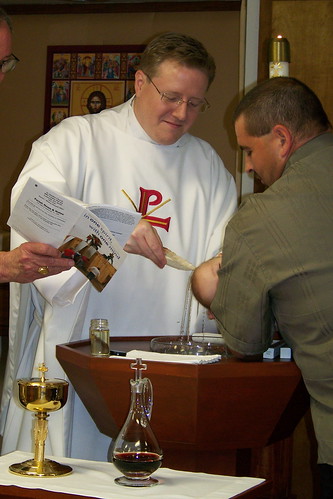
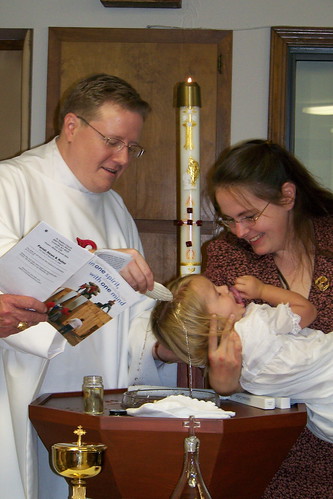
What is better than that is to bring your children into the household of faith by covenant baptism.


Presenting Lillianah Kathryn-Marie and Elias Zebulun Larimer - born anew of water and the word (John 3:5) on the Feast of St. Matthew the Apostle & Evangelist (Sept. 21, 2008).

"...here Christ is speaking of baptism, of real and natural water such as a cow may drink, the baptism about which you hear in the sermons on this subject. Therefore, the word water does not designate affliction here; it means real, natural water, which is connected with God's word and becomes a very spiritual bath through the Holy Spirit or through the entire Trinity. Here Christ also speaks of the Holy Spirit as present and active, in fact, the entire Holy Trinity is there. And thus the person who has been baptized is said to be born anew. In Titus 3:3 Paul terms baptism 'a washing of regeneration and renewal of the Holy Spirit.' In the last chapter of Mark we read that 'he who believes and is baptized will be saved.' (Mark 16:16.) And in this passage Christ declares that whoever is not born anew of the water and the Holy Spirit cannot come into the kingdom of God. Therefore, God's words dare not be tampered with."
(
Martin Luther's Sermons on the Gospel of Saint John, Vol. 22, p. 283.)

Eye of the Beholder


h/t: Cagle Cartoon Index

2008-09-22

New Posters at Spurgeon.org

Here's a teaser


Here's a hint: When people say they want Jesus apart from the Bible or the apostolic witness of the historic church, they're just giving you their own time-bound ideas packaged in religious nicetude and riding on the coat-tails of "mere" Christianity.

2008-09-21

You are what you eat

Apparently, researchers at Oxford University have found out that if you are a vegan you're more likely to become a vegetable in later life.

Of course, one look at the proto-vegetotalitarian could tell you that.


Ooh...looks like the effects are starting early for some EarthFirsters.

So what do we do with Romans 14 now?

2008-09-20

Hymn for Ordination Today

God the Spirit, Guide and Guardian

Tune: Hyfrydol

God the Spirit, guide and guardian, wind-sped flame and hovering dove,
Breath of life and voice of prophets, sign of blessing, power of love,
Give to those who lead your people, fresh anointing of your grace.
Send them forth as bold apostles to your church in every place.

Christ our Savior, sovereign, Shepherd, word made flesh, love crucified,
Teacher, healer, suffering servant, friend of sinners, foe of pride,
In your tending may all pastors learn and live a shepherd's care;
Grant them courage and compassion shown through word and deed and prayer.

Great Creator, life bestower, truth beyond all thought's recall,
Fount of wisdom, womb of mercy, giving and forgiving all,
As you know our strength and weakness, so may those the church exalts
Oversee its life steadfastly yet not overlook its faults.

Triune God mysterious being, undivided and diverse,
Deeper than our minds can fathom, greater than our creeds rehearse,
Help us in our varied callings your full image to proclaim,
That our ministries uniting may give glory to your name.

*GOD THE SPIRIT, GUIDE AND GUARDIAN

Words by Carl P. Daw, Jr.; Music by Rowland H. Prichard © 1989 Hope Publishing Company, Carol Stream, IL 60188

2008-09-19

Useless Boycott

WARNING: Links in this blog post may not be safe for work or children!!!

Americans for Truth are upset that Miller Light took out an ad in the booklet for the notoriously licentious Folsom Street Fair. It's one of the most perverse displays this side of Sodom.

But somehow, I don't think you're going to be effective marketing a beer boycott to Baptists.

P.S. None of what they do is free speech. I think the framers of our liberties were wise to make freedom of speech - not freedom of expression - our right.

2008-09-18

Hockey Moms for Truth


If that doesn't change your vote, I don't know what will.

The Goracle Flubs Again

He apparently has a new House Boat that he calls Bio-Solar One. He says it's environmentally friendly - run on solar and bio-fuels.

Unfortunately, photographers caught him plugged in to not one, but TWO regular outlets at the marina!


Al is shameless.

He also has him a gas-guzzling sea-doo on the back! As Glenn Reynolds often says: I’ll start acting like there’s a climate crisis when Al Gore does.

2008-09-17

Jedi Jesus


Introducing
The Star Wars Savior

JEDI JESUS

Now with improved SMITESABER action!!!

Only uses the Light-of-Men Side of the Force.

2008-09-16

Glacier Gladness for Global Madness

The BBC recently reported on some archaeological finds from the Alps indicating fluctuating temperatures over the last 7,000 years. Included were paleolithic artifacts, Roman coins, and Medieval clothing.

I really hope people will take time to listen to history before attempting to abandon a way of life that has produced some of the greatest humanitarian advances of all time.

2008-09-12

Palin and the Prochoice Problem

It seems that an OBGYN in Canada is concerned about ArchVillainess... I mean, Republican VP Candidate Gov. Sarah Palin's decision to give birth to Trig, her youngest who also happens to have an extra chromosome. His concern is not about her ability to do the job, or the impact on the family. It's not even about Sarah or Trig's health and well-being.

He's concerned that such a prominent role being given to a woman in this situation might reduce abortions.

You just can't make some stuff up.*

Thankfully, some Canadians actually think it's not so bad an idea to let children with Down Syndrome live. Now Trig has become, literally, their poster-child.

If you've known a person with Down Syndrome, you could probably attest to their near-angelic nature. While I can't say I've had extensive experiences, I will say that each encounter has led me to experience something more of the mysterious love that God has for me in Christ Jesus. Their utter openness, compassion for others, and gentleness....

It puts most Christians I know to shame. Since last Sunday's epistle was on letting your love be genuine, let's ask God how he might be giving us another chance to learn a lesson we desperately try to forget.

*p.s. It's still better than uber-moonbat Wendy Doniger is able to manage. I think her work on androgynes has confused her about what actually makes a woman. "Pretense of a woman", indeed!

Spare Change

Everybody is talking about Change these days.

Especially reverent tones regarding change are used when speaking of The One.


Well... at least this lady can count on some change.

Why? Because it turns out that Barack Hussein Obama only pays the ladies pennies on the dollar. That's right...

Barack Obama pays his women campaign staff less than he pays the men on his campaign staff.

2008-09-11

Palin Facts

Look at it this way. One VP candidate could protect you from zombies. The other... well, he looks like one.

Even Chuck Norris is running scared.


h/t PalinFacts

Help Hurricane Vicitims

Rev'd Bill Crawford at First Presbyterian of Thibodaux has set up a PayPal account where the church can process donations for immediate relief of hurricane victims.

Please help if you can.

2008-09-09

Imminent Domain

Does it bother anyone else that the government now holds close to 90% of all mortgages? I refer, of course, to the $200 billion dollar bailout of Fannie Mae and Freddie Mac.

Before bailing out mortgage companies, the United States government had direct ownership of nearly 30% of its total territory. These federal lands are used as military bases or testing grounds, nature parks and reserves and indian reservations, or are leased to the private sector for commercial exploitation (e.g. forestry, mining, agriculture). They are managed by different administrations, such as the Bureau of Land Management, the US Forest Service, the US Fish and Wildlife Service, the National Park Service, the Bureau of Indian Affairs, the US Department of Defense, the US Army Corps of Engineers, the US Bureau of Reclamation or the Tennessee Valley Authority. This map details the percentage of state territory owned by the federal government.

The top 10 list of states with the highest percentage of federally owned land looks like this:
  1. Nevada 84.5%
  2. Alaska 69.1%
  3. Utah 57.4%
  4. Oregon 53.1%
  5. Idaho 50.2%
  6. Arizona 48.1%
  7. California 45.3%
  8. Wyoming 42.3%
  9. New Mexico 41.8%
  10. Colorado 36.6%

Notable is that all these states are in the West (except Alaska, which strictly speaking is also a western state, albeit northwestern). Also notable is the contrast between the highest and the lowest percentages of federal land ownership. The US government owns a whopping 84.5% of Nevada, but only a puny 0.4% of Rhode Island and Connecticut. The lowest-percentage states are mainly in the East, but some are also in the Midwest and in the South:

  1. Connecticut 0.4%
  2. Rhode Island 0.4%
  3. Iowa 0.8%
  4. New York 0.8%
  5. Maine 1.1%
  6. Kansas 1.2%
  7. Nebraska 1.4%
  8. Alabama 1.6%
  9. Ohio 1.7%
  10. Illinois 1.8%

Even the 10th place is still below the two percent mark.

Where's that right to private property when you need it, if the government can now exercise fiscal controls to get you out of your house WITHOUT having to go through eminent domain payments?

h/t StrangeMaps

2008-09-08

The Bullwinkle Stops Here


The Dennis Miller show was discussing Palin's acceptance speech. Miller asked a middle aged female caller "Are the Democrats scared?" She replied "They woke up with a moose head in their bed this morning!"

2008-09-04

Abstinence Education and Its Consequences

Some low-lifes have taken a couple of punches at Sarah Palin's position on abstinence based sex-ed because of what happened to her daughter, Bristol.

Well let me show you what choice we're really making.


So much for HOPE overcoming all things.

I'll take a woman living up to her principles, even when it isn't expedient, to a bloviating pro-abort ANYDAY!

2008-09-02

Who Ya Gonna Call?


Does your denomination require its ministers to affirm the doctrine of the Trinity?

What difference does it make?

In a series of blog posts, I'd like to consider what is at stake when we discard orthodox theology. I hope my readers will join me in this effort to "put wheels on" our proclamation.

2008-08-29

2008-08-28

Forty-five years later

"I have a dream that my four little children will one day live in a nation where they will not be judged by the color of their skin but by the content of their character."

-- The Rev'd Dr. Martin Luther King, Jr.
August 28, 1963


Ask your local Obama supporters what they know of the content of his character. Ask them if their presidential candidate believes that little children have a right to life. (Obama opposes every sensible restriction on abortion/infanticide - protections that are granted the preborn in the most liberal of European democracies!)

Live the dream of looking beyond skin color - either to assume guilt or to be absolved of guilt. And recognize that all who are created in God's image - male and female, black and white and brown and red, Jews and Gentiles, Protestants and Catholics, preborn and postborn, intellectually gifted or developmentally retarded - ALL WHO BEAR GOD'S IMAGE have a fundamental right to life. And no government on earth can condone the taking of that life without due process for God's laws writ large in nature.

In the word's of Dr. King, "Now is the time to make justice a reality for all of God's children."

Putting the MESS in Messiah


Would somebody please sic the Americans United for Separation of Church and State on these guys?

Oh wait...they're only concerned if someone believes that Jesus is the Messiah.

2008-08-27

If You Thought They Messed Up the Olympics

This little gem is from the English (Engrish?) subtitles on a Chinese-made hack of Star Wars Ep III.
Believe it or not, Anakin Skywalker would be an improvement over some of the folks I know that got "made" [ministers] by the Presbyterian Church.

Indecision 2008

I'm having trouble.


I'm not sure if this gets tagged under politics, humor, or zombies....

2008-08-26

Was Spong Wrong?

For some reason, people are still reading John Shelby Spong. His recent article in the Washington Post is titled "Good Show, Poor Theology."

When I first read the title, I thought: "He must be talking about a rather up-the-candlestick Anglo-Catholic parish in TEC." You know the kind. Appareled amices and albs on every server. Chanted Psalms, sung gospels, and solemnities abounding. A priest that enters in cassock, surplice, hood, tippet, cope, zuchetto and biretta, then changes during the anthem into alb, amice, crossed stole, silk cincture, and chasuble. Lot's of bells, smells, bowing and wowing - but the sermon is about the latest episode of 60 Minutes or the View.

No such luck. Instead, Mr. Spong was talking about Dr. Rick Warren's forum for Obama and McCain. He went on to say this:
Homosexuality is no more a choice for gay and lesbian people than heterosexuality is a choice for straight people. It takes a while for that knowledge to trickle down to the masses. Prejudice lives only in the untrickled down gaps. The condemnation of homosexuality as a sin or as a distortion by the hierarchy of the Vatican or the leaders of evangelical Christianity is simply a sign that both groups live in the backwaters of knowledge and education. As this knowledge spreads, those groups will look like what they are - dated people similar to the members of the Flat Earth Society.
Tell you what, Spong... I'll publicly acknowledge that "homosexuality is no more a choice for gay and lesbian people than heterosexuality is a choice for straight people" if you'll publicly acknowledge that there might be a reason other ignorant prejudice for resistance to homosexual acts.

2008-08-25

My Brother's Keeper?

Obama has been spending plenty of time finger-pointing and telling Americans that we're not living up to the Bible's social ethic - that we just pull it out when it's convenient, then tuck it away. His stab at Saddleback Church showed how out-of-touch he is with most people whose behavior reflects a high degree of Christian devotion.

But little shows his own grasp of the faith "with its boots on" than his rhetoric being held up to his own action. For instance, he chides America for its wealth, though he is raking in MILLIONS each year in book sales. I don't begrudge him his cash, but I'd appreciate if he would practice giving away more than 1% of it before he asks me to give him another 10-15% of my income.

Secondly, if you want to talk about personal ethics, just consider the case of George Obama. What... haven't heard of him yet? Just hearing more and more about McCain having seven or eight houses (even though several of them are investment properties owned / managed by his wife's estate)?

George is Obama's little brother. He lives on $1 / mo, eking out an existence in a violent urban ghetto outside of Nairobi, Kenya. Now when I was a little kid, we sent $18/mo to a child in Haiti and $22 /mo to a child in Niger. That money came from the meager support my father paid...but we felt we had plenty compared to the rest of the world. It provided food, clothing, medicine, and education so that the children could pull themselves (and hopefully their family) out of crushing poverty. I don't know what happened to them because we lost touch after middle school. But I do know that for a while, our meager American funds were able to make them rich.

Nairobi is one of the least expensive cities on earth. It would cost very little for Obama to send cash to his half brother - who has ambitions of higher education - and it would dramatically improve George's life. So why aren't we hearing about this as an example of Christian virtue?

1 Timothy 5:8 might have something to do with that.

Before Obama opens his mouth again about McCain's money (which is mostly his heiress wife's) or American avariciousness, he needs to look to another one of those conveniently ignored passages from the Sermon on the Mount.

2008-08-22

When Believers Don't Believe

I'm increasingly troubled by the unbelief encountered every day in the church.

Yeah... there's the lib'rals that don't believe the stuff that the Church has always believed (on the authority of the Scriptures). That's dangerous.

But equally dangerous are those who do believe all those things, and for whom it does not make a difference. I-Monk's recent jab gets at the heart of this problem.

One of the good things about having a systematic exposition of the Scriptures (at least a lectionary) is that you are held accountable for public reading and preaching on the breadth of biblical teaching. That's also what I love about systematic theology.

Each of us - right, left, up, down, and centrist-as-all-get-out have a tendency to narrow our field of vision. We need the latitude of our normative patterns (Scripture and Sacred Science) to even out our peculiarities.

Lord, I believe. Help Thou my unbelief.

2008-08-21

Archaeological Affirmations

Since turnabout is fair play, here's an interesting archaeological tidbit.

It seems the seal of one of the enemies of Jeremiah has been unearthed. The Paleo-Hebrew script reads Gedalyahu ben Pashur, who served as minister to King Zedekiah (597-586 BC).

Gedaliah (as we know him in the English transliteration) petitioned King Zedekiah to shut Jeremiah up. They won their case and threw the prophet into a cistern.

What's the takeaway?

1) Just because you occupy a place of influence with people who have power does not mean you are with people who have authority. Zedekiah and his advisors had all kinds of power...but because they refused to listen to the one man who had God's authority to speak, we hold them in no esteem. Indeed, we'd scarcely know or care about them except that they have a part to play in the life of the man who spoke with authority - the man who spoke God's words.

2) If you want to be part of a faith tradition that makes a real difference in the world, make sure your faith tradition has actually interacted with the world. All kinds of New Agers and non-realists in religion insist that faith is an entirely subjective experience. The only "objective" element is what happens when you act like a better person or some such.

Well, while I can't disagree that changing us changes the world, I would say that it's difficult to see the difference between that sort of religion and a philosophy of life.

There is a God...someone out there, who also chooses to make a dwelling place with humankind. If you know that you can't make it on your own, then you just might need something more than your own inner reserves. And if you're going to trust in that something, you'd better make sure that something can act.

Christianity affirms that God acts in history, pointing to the incarnation of Jesus Christ as proof that God does indeed choose to be with us and for us, rather than against us or apathetic towards us. And we have the Scriptures which detail how God has stepped into historical events and changed their course or guided the people.

If your faith can't make that claim and have it backed up by rational evidence, may I have the privilege of pointing you from the shifting sands of life to a faith built on bedrock? A faith that consists of loving relationship with the Rock himself?

2008-08-19

Zombies and Hockey

Yet another surprisingly [ahem] tasty mix. PUCKer up!


If this doesn't make sense to you, Monroeville Mall is the site of George Romero's 1978 classic Dawn of the Dead.

You can buy'em on hockey jerseys here.

2008-08-18

Putting the Red In Blue State

It looks like Obama's chickens are coming home to roost.

Obama's campaign finally admits that his mentor Frank (referred to in Dreams From My Father) is none other than Communist Party member Frank Marshall Davis.

Thanks, comrade!

2008-08-16

baRak Star

I couldn't resist.


h/t Tim Phillips at Gairney Bridge.

2008-08-15

Obama and co-Kaine

VA Governor and Democratic VP hopeful Tim Kaine credit's Obama's "tough words" and "smart approach" with Russia agreeing to a ceasefire, according to ABC News Senior Correspondent, Jake Trapper.

Somebody get that guy's nose some powder. (No...not the blow Senator Obama toyed around with to ease the pain of being a biracial kid.)

Here's what Obama said:
"Now is the time for Georgia and Russia to show restraint, and to avoid an escalation to full scale war... All sides should enter into direct talks on behalf of stability in Georgia" (8/8/08)
Notice who he starts off condemning? Yeah, Obama. Restraint is so necessary when your country is being invaded by a foreign aggressor. Those Georgians wouldn't be in this mess if they didn't insist on fending off invaders. Heck...Obama doesn't even think we should do that.

His second try shows that Georgia's ability to fend for itself is not wanted, but instead more centralized UN directed forces as peacekeepers:
"The current escalation of military conflict resulted in part from the lack of a neutral and effective peacekeeping force operating under an appropriate UN mandate. Russia cannot play a constructive role as peacekeeper." (08/09/08)
He goes on to reiterate something he's saying for the first time (check that 8/8/08 post again and see if he asked Russia to back down - or just "show restraint" - same as he asked Georgia).
I reiterate my call for Russia to stop its bombing campaign, to stop flights of Russian aircraft in Georgian airspace, and to withdraw its ground forces from Georgia. (08/09/08)
His third time around finally ends up blaming the Russian aggressors, but do notice how he starts things off:
"No matter how this conflict started, Russia has escalated it well beyond the dispute over South Ossetia and invaded another country. Russia has escalated its military campaign through strategic bombing and the movement of its ground forces into the heart of Georgia. There is no possible justification for these attacks.

"I reiterate my call for Russia to stop its bombing campaign, to stop flights of Russian aircraft in Georgian airspace, and to withdraw its ground forces from Georgia.
" (08/11/08)
It took Obama three tries to get to some form of real censure of Russia. McCain got it right the first time. In fact, Obama picked up his language. Here's what McCain said immediately upon learning of the debacle.
"Today, news reports indicate that Russian military forces crossed an internationally-recognized border into the sovereign territory of Georgia. Russia should immediately and unconditionally cease its military operations and withdraw all forces from sovereign Georgian territory. What is most critical now is to avoid further confrontation between Russian and Georgian military forces." (08/08/08)
If Obama is elected, it will be this kind of rookie inexperience that costs us big in the coming four years. Dick Morris is doing a fantastic job of reminding us just how much this looks like 70 years ago.

2008-08-14

Can we afford more Americans?

America has the highest rate of abortion in the free world. With everyone feeling the pinch at the pump (even though our economy is still chugging away), I'm sure it will reinvigorate the Malthusian arguments about population control and costs. But can we really afford to care for these children?

It depends on what we're willing to give up. Consider the spending habits of US. consumers:

Peanuts 1 billion/year

(National Peanut Council)

Popcorn 1.2. billion/year

(Nielsen Marketing Research)

Chewing gum 2.3 billion/year

(National Association of Chewing Gum Mfgrs.)

Cookies 3.4 billion/year

(Nielsen Marketing Research)

Potato chips 4.6 billion/year

(Nielsen Marketing Research)

Movie box office receipts 4.8 billion/year

(Academy of Motion Pictures)

Candy 6 billion/year

(Nielsen Marketing Research)

Ice cream 10 billion/year

(International Ice Cream Associations)

Soft drinks 30 billion/year

(EPM Communications)

Restaurant dining 173.8 billion/ear

(National Restaurant Association)

Beer 50 billion/year

(Beer Institute)

Legal gambling 300 billion/year

(Discovery Channel, Cronkite Report)

Pet grooming 175.3 million/year

(Pet Industry Joint Council)

Cat furniture 23.5 million/year

(Pet Industry Joint Council)

Terrarium heaters 37.7 million/year

(Pet Industry Joint Council)

Dog snacks 39.3 million/year

(Pet Industry Joint Council)

Licensed sporting goods 2.2 billion/year

(The Licensing Letter, 1993)

Non-beer alcoholic beverages 39 billion/year

(Beer Institute)

Cosmetic products 27 billion/year

(Drug & Cosmetic Magazine)

Lawn & Garden Products 6.1 billion/year

(Better Lawn & Garden Products)


These suggest that maybe...just maybe... we can manage to take care of children instead of killing them.

2008-08-13

Taking a Stand in Seminary

Want to know what seminary felt like for me?


Yeah...truth really does win.

Unfortunately, many seminarians - especially young conservative males like myself - can side with the truth in an ungracious way. For the first two years or so of my experience, that's what I did. I made an *ss of myself. Towards the end, things got a little better.

I thank God that he has used some other disappointments, heartaches, and failures to bring about a deeper brokenness in my life. And I thank God that His TRUTH is still TRUTH no matter how lousy or feeble my witness to it was and will be.

2008-08-12

Loquacious Liberals and Progressive Pottymouth Presbyterians

Matthew Sheffield, a writer for the Poli-Tech side of the Washington Post, experimentally confirms what most folks know from first-hand experience.

Progressives are Pottymouths.

What kills me is how they want to regulate our speech to make it as non-offensive to their pet constituency as possible. But when it comes to standards of relatively-common decency, they can fly off the handle with impunity.

What's worse is when you see it tumbling from the lips of those whose speech should be bound to a higher standard than common decency or the Constitution.

2008-08-11

Bishop J. C. Ryle on Election

J. C. Ryle once used an upcoming election season to reflect on the changing nature of human politics and the immutable decree of God's election. It makes for salutary reading, and is a welcome antidote for those who doubt that a Reformation ever occurred within the Church of England.

“Knowing, brethren beloved, your election of God.”— 1 THESS. 1. 4.

“Give diligence to make your calling and election sure.”— 2 PETER 1. 10.

THE texts which head this page contain a word of peculiar interest. It is a word which is often in men’s minds, and on men’s tongues, from one end of Great Britain to the other. That word is “Election.”

There are few Englishmen who do not know something of a general election to Parliament. Many are the evils which come to the surface at such a time. Bad passions are called out. Old quarrels are dug up, and new ones are planted. Promises are made, like piecrust, only to be broken. False profession, lying, drunkenness, intimidation, oppression, flattery, abound on every side. At no time perhaps does human nature make such a poor exhibition of itself as at a general election!

Yet, it is only fair to look at all sides of an election to Parliament. There is nothing new, or peculiarly English, about its evils. In every age, and in every part of the world, the heart of man is pretty much the same. There have never been wanting men ready to persuade others that they are not so well governed as they ought to be, and that they themselves are the fittest rulers that can be found. A thousand years before Christ was born the following picture was drawn by the unerring hand of the Holy Ghost: —

Absalom rose up early, and stood beside the way of the gate: and it was so, that when any man that had a controversy came to the king for judgment, then Absalom called unto him, and said, Of what city art thou? And he said, Thy servant is of one of the tribes of Israel.

And Absalom said unto him, See, thy matters are good and right; but there is no man deputed of the king to hear thee.

Absalom said moreover, Oh that I were made judge in the land, that every man which bath any suit or cause might come unto me, and I would do him justice!

And it was so, that when any man came nigh to him to do him obeisance, he put forth his hand, and took him, and kissed him.” (2 Sam. xv. 2-5.)

When we read this passage we must learn not to judge. our own times too harshly. The evils that we see are neither peculiar nor new.

After all, we must never forget that popular election, with all its evils, is far better than an absolute form of government. To live under the dominion of an absolute tyrant, who allows no one to think, speak, or act for himself, is miserable slavery. For the sake of liberty W€ must put up with all the evils which accompany the return of members to Parliament. We must each do our duty conscientiously, and learn to expect little from any party. If those we support succeed, we must not think that all they do will be right. If those we oppose succeed, we must not think that all they do will be wrong. To expect little from any earthly ruler is one great secret of contentment. To pray for all who are in authority, and to judge all their actions charitably, is one of the principal duties of a Christian.

But there is another Election, which is of far higher importance than any election to Parliament, — an Election whose consequences will abide, when Queen, Lords, and Commons have passed away, — an Election which concerns all classes, the lowest as well as the highest, the women as well as the men. It is the Election which the Scriptures call “the Election of God.”

I ask the readers of this paper to give me their attention for a few minutes, while I try to set before them the subject of this Election. Believe me, it affects your eternal happiness most deeply. Whether you are in Parliament or not, whether you vote or not, whether you are on the winning side or not, all this will matter very little a hundred years hence. But it will matter greatly whether you are in the number of “God’s Elect.”

In handling the subject of Election, there are only two things which I propose to do.

  1. Firstly, I will state the doctrine of Election, and show what it is.
  2. Secondly, I will fence the subject with cautions, and guard it against abuse.

If I can make these two points clear and plain to the mind of all who read these pages, I think I shall have `one their souls a great and essential service.

I. I have firstly to state the doctrine of Election. What is it? What does it mean?

Accurate statements on this point are of great importance. No doctrine of Scripture perhaps has suffered so much damage from the erroneous conceptions of foes, and the incorrect descriptions of friends, as that which is now before us.

The true doctrine of Election I believe to be as follows. God has been pleased from all eternity to choose certain men and women out of mankind, whom by His counsel secret to us, He has decreed to save by Jesus Christ. None are finally saved except those who are thus chosen. Hence, the Scripture gives to God’s people in several places the names of “God’s Elect,” and the choice or appointment of them to eternal life is called “God’s election.”

Those men and women whom God has been pleased to choose from all eternity, He calls in time, by His Spirit working in due season. He convinces them of sin. He leads them to Christ. He works in them repentance Sand faith. He converts, renews, and sanctifies them. He keeps them by His grace from falling away entirely, and finally brings them safe to glory. In short, God’s eternal Election is the first link in that chain of a sinner’s salvation of which heavenly glory is the end. None ever repent, believe, and are born again, except the Elect. The primary and original cause of a saint’s being what he is, is eternal God’s election.

The doctrine here stated, no doubt, is peculiarly deep, mysterious, and hard to understand. We have no eyes to see it fully. We have no line to fathom it thoroughly. No part of the Christian religion has been so much disputed, rejected, and reviled as this. None has called forth so much of that enmity against God which is the grand mark of the carnal mind. Thousands of so-called Christians profess to believe the Atonement, salvation by grace, and justification by faith, and yet refuse to look at the doctrine of Election. The very mention of the word to some persons is enough to call forth expressions of anger, ill-temper, and passion.

But, after all, is the doctrine of Election plainly stated in Scripture? This is the whole question which an honest Christian has to do with. If it is not in the Book of God, let it be forever discarded, refused, and rejected by man, no matter who propounds it. If it is there, let us receive it with reverence, as a part of Divine revelation, and humbly believe, even where we are not able to understand completely or explain fully. What then is written in the Scriptures? “To the law and to the testimony: if they speak not according to this word, it is because there is no light in them.” (Isaiah. viii. 20.) Is Election in the Bible, or is it not? Does the Bible speak of certain persons as God’s Elect, or not?

Hear what our Lord Jesus Christ says: —

    “For the Elect’s sake the days shall be shortened.” (Matt. xxiv. 22.)

    “If it were possible they should deceive even the Elect.” (Mark xiii. 22.)

    “He shall send His angels, and they shall gather together His Elect.” (Matt. xxiv. 31.)

    “Shall not God avenge His own Elect?” (Luke xviii. 7.)

Hear what St. Paul says: —

    “Whom He did foreknow, He also did predestinate to be conformed to the image of His Son, that He might be the firstborn among many brethren. Moreover whom He did predestinate, them He also called: and whom He called, them He also justified: and whom He justified, them He also glorified.” (Rom. viii. 29, 30.)

    “Who shall lay anything to the charge of God’s Elect?” (Rom. viii. 33.)

    “God hath chosen us in Him before the foundation of the world.” (Ephes. i. 4.)

    “`Who hath saved us, and called us with an holy calling, not according to our works, but according to His own purpose and grace, which was given us in Christ Jesus before the world began.” (2 Tim. i. 9.)

    “God hath from the beginning chosen you to salvation through sanctification of the Spirit and belief of the truth.” (2 Thess. ii. 13.)

Hear what St. Peter says —

    “Elect according to the foreknowledge of God the Father, through sanctification of the Spirit, unto obedience and sprinkling of the blood of Jesus Christ.” (1 Peter i. 2.)

    “Give diligence to make your calling and Election sure.” (2 Peter i. 10.)

I place these eleven texts before my readers, and I ask them to consider them well. If words have any meaning at all, they appear to me to teach most plainly the doctrine of personal Election. In the face of such texts I dare not refuse to believe that it is a Scriptural doctrine. I dare not, as an honest man, shut my eyes against the plain, obvious sense of Bible language. If I once began to do so, I should have no ground to stand on in pressing the Gospel on an unconverted man. I could not expect him to believe one set of texts to be true, if I did not believe another set. The eleven texts above quoted seem to my mind to prove conclusively that personal Election is a doctrine of Scripture. As such I must receive it, and I must believe it, however difficult it may be. As such I ask my readers this day to look at it calmly, weigh it seriously, and receive it as God’s truth.

After all, whatever men may please to say, there is no denying that the Election of some men and women to salvation is a simple matter of fact. That all professing Christians are not finally saved, but only some, — that those who are saved owe their salvation entirely to the free grace of God and the calling of His Spirit, — that no man can at all explain why some are called unto salvation and others are not called, — all these are things which no Christian who looks around him can pretend for a moment to deny. Yet what does all this come to but the doctrine of Election?

Right views of human nature are certain to lead us to the same conclusion. Once admit that we are all naturally dead in trespasses and sins, and have no power to turn to God, — once admit that all spiritual life in the heart of man must begin with God, — once admit that He who created the world by saying, “Let there be light,” must shine into man’s heart, and create light within him, — once admit that God does not enlighten all professing Christians in this manner, but only some, and that He acts in this matter entirely as a Sovereign, giving no account of His matters, — once admit all this, and then see where you are. Whether you know it or not, you admit the whole doctrine of Election!

Right views of God’s nature and character, as revealed in the Bible, appear to me to bring us to the same position. Do we believe that God knows all things from all eternity, — that He governs all things by His providence, and that not even a sparrow falleth to the ground without Him? Do we believe that He works all His works by a plan, like an architect of perfect knowledge, and that nothing concerning His saints, as His choicest and most excellent work, is left to chance, accident, and luck? — Well, if we believe all this, we believe the whole doctrine which this paper is meant to support. This is the doctrine of Election.

Now what can be said in reply to these things? What are the principal weapons of argument with which Election is assailed? Let us see.

Some tell us that there is no such thing in Scripture as an Election of persons and individuals. Such an Election, they say, would be arbitrary, unjust, unfair, partial, and unkind. The only Election they admit is one of nations, churches, communities, — such as Israel in ancient times, and Christian nations, as compared to heathen nations, in our own day. Now is there anything in this objection that will stand? I believe there is nothing at all. — For one thing, the Election spoken of in Scripture is an Election attended by the sanctifying influence of the Holy Ghost. This certainly is not the Election of nations. For another thing St. Paul himself draws a clear and sharply-cut distinction between Israel itself and the Election. “Israel hath not obtained that which he seeketh for; but the Election bath obtained it.” (Rom. xi. 7.) — Last, but not least, the advocates of the theory of national Election gain nothing whatever by it. How can they account for God withholding the knowledge of Christianity from 350 millions of Chinese for 1800 years, and yet spreading it over the continent of Europe? They cannot, except on the ground of God’s sovereign will and His free Election! So that, in fact, they are driven to take up the very same position which they blame us for defending, and denounce as arbitrary and uncharitable.

Some tell us that at any rate Election is not the doctrine of the Church of England. It may do very well for dissenters and Presbyterians, but not for churchmen. “It is a mere piece of Calvinism,” they say, — “an extravagant notion which came from Geneva, and deserves no credit among those who love the Prayer-book.” Such people would do well to look at the end of their Prayer books, and to read the Thirty-nine Articles. Let them turn to the 17th Article, and mark the following words:

Predestination to Life is the everlasting purpose of God, whereby (before the foundations of the world were laid) He hath constantly decreed by His counsel secret to us, to deliver from curse and damnation those whom He hath chosen in Christ out of mankind, and to bring them by Christ to everlasting salvation, as vessels made to honour. Wherefore, they which be endued with so excellent a benefit of God be called according to God’s purpose by His Spirit working in due season: they through grace obey the calling: they be justified freely: they be made sons of God by adoption: they be made like the image of His only-begotten Son Jesus Christ: they walk religiously in good works, and at length, by God’s mercy, they attain to everlasting felicity.

I commend that Article to the special attention of all English Churchmen. It is one of the sheet-anchors of sound doctrine in the present day. It never can be reconciled with baptismal regeneration! A wiser statement of the true doctrine of personal Election was never penned by the hand of uninspired man. It is thoroughly well-balanced and judiciously proportioned. In the face of such an Article it is simply ridiculous to say that the Church of England does not hold the doctrine of this paper.

In controverted matters I desire to speak courteously and cautiously. I wish to make allowance for the many varieties of men’s temperaments, which insensibly affect our religious opinions, and for the lasting effect of early prejudices. I freely concede that Wesley, Fletcher, and a whole host of excellent Methodists and Arminians, have always denied Election, and that many deny it to this day. I do not say that to hold Election is absolutely necessary to salvation, though to be one of God’s Elect undoubtedly is necessary. But I cannot call any man my master in theological matters. My own eyes see the doctrine of personal Election most clearly stated both in Scripture and the 17th Article of the Church of England. I cannot give it up. I believe firmly that it is an important part of God’s truth, and one which to godly persons is “full of sweet, pleasant, and unspeakable comfort.”

II. The next thing that I wish to do is to fence the doctrine of Election with cautions, and to guard it against abuse.

This is a branch of the subject which I hold to be of vast importance. All revealed truth is liable to be wrested and perverted. It is one of Satan’s chief devices to make the Gospel odious by tempting men to distort it. Perhaps no part of Christian theology has suffered so much damage in this way as the doctrine of personal Election. Let me proceed to explain what I mean.

“I am not one of God’s Elect,” says one man. “It is no use for me to do anything at all in religion. It is waste of time for me to keep the Sabbath, attend the public worship of God, read my Bible, say my prayers. If I am to be saved, I shall be saved. If I am to be lost, I shall be lost. In the mean time I sit still and wait.” This is a sore disease of soul. But I fear it is a very common one!

“I am one of God’s Elect,” says another man. “I am sure to be saved and go to heaven at last, no matter how I may live and go on. Exhortations to holiness are legal. Recommendations to watch, and crucify self, are bondage. Though I fall, God sees no sin in me and loves me all the same. Though I often give way to temptation, God will not let me be altogether lost. Where is the use of doubts and fears and anxieties? I am confident I am one of the Elect, and as such I shall be found in glory.” This again, is a sore disease. But I fear it is not altogether uncommon.

Now what shall he said to men who talk in this way? They need to be told very plainly that they are wresting a truth of the Bible to their own destruction, and turning meat into poison. They need to be reminded that their notion of Election is a miserably unscriptural one. Election according to the Bible is a very different thing from what they suppose it to be. It is most intimately connected with other truths of equal importance with itself, and from these truths it ought never to be separated. Truths which God has joined together no man should ever dare to put asunder.

(a) For one thing, the doctrine of Election was never meant to destroy man’s responsibility for the state of his own soul. The Bible everywhere addresses men as free-agents, as beings accountable to God, and not as mere logs, and bricks, and stones. It is false to say that it is useless to tell men to cease to do evil, to learn to do well, to repent, to believe, to turn to God, to pray. Everywhere in Scripture it is a leading principle that man can lose his own soul, that if he is lost at last it will be his own fault, and his blood will be on his own head. The same inspired Bible which reveals this doctrine of Election is the Bible which contains the words, “Why will ye die, O house of Israel?” — “Ye will not come unto Me that ye might have life.” — “This is the condemnation, that light is come into tire world, and men loved darkness rather than light, because their deeds were evil.” (Ezek. xviii. 31; John v. 40; iii. 19.) The Bible never says that sinners miss heaven because they are not Elect, but because they “neglect the great salvation,” and because they will not repent and believe. The last judgment will abundantly prove that it is not the want of God’s Election, so much as laziness, the love of sin, unbelief, and unwillingness to come to Christ, which ruins the souls that are lost.

(b) For another thing, the doctrine of Election was never meant to prevent the fullest, freest offer of salvation to every sinner. In preaching and trying to do good we are warranted and commanded to set an open door before every man, woman, and child, and to invite every one to come in. We know not who are God’s Elect, and whom he means to call and convert. Our duty is to invite all. To every unconverted soul without exception we ought to say, “God loves you, and Christ has died for you.” To everyone we ought to say, “Awake, — repent, — believe, — come to Christ, — be converted, — turn, — call upon God, — strive to enter in, — come, for all things are ready.” To tell us that none will hear and be saved except God’s Elect, is quite needless. We know it very well. But to tell us that on that account it is useless to offer salvation to any at all, is simply absurd. Who are we that we should pretend to know who will be found God’s Elect at last? No! indeed. Those who now seem first may prove last, and those who seem last may prove first in the judgment day. We will invite all, in the firm belief that the invitation will do good to some. We will prophesy to the dry bones, if God commands us. We will offer life to all, though many reject the offer. In so doing we believe that we walk in the steps of our Master and His Apostles.

(c) For another thing, Election can only be known by its fruits. The Elect of God can only be discerned from those who are not Elect by their faith and, life. We cannot climb up into the secret of God’s eternal counsels. We cannot read the book of life. The fruits of the Spirit, seen and manifested in a man’s conversation, are the only grounds on which we can ascertain that lie is one of God’s Elect. Where the marks of God’s Elect can be seen, there, and there only, have we any warrant for saying “this is one of the Elect.” — How do I know that yon distant ship on the horizon of the sea has any pilot or steersman `on board? I cannot with the best telescope discern anything but her masts and sails. Yet I see her steadily moving in one direction. That is enough for me. I know by this that there is a guiding hand on board, though I cannot see it. Just so it is with God’s Election. The eternal decree we cannot possibly see. But the result of that decree cannot be hid. It was when St. Paul remembered the faith and hope and love of the Thessalonians, that he cried, I “know your Election of God.” (1 Thess. i. 4.) For ever let us hold fast this principle in considering the subject before us. To talk of any one being Elect when he is living in sin, is nothing better than blasphemous folly. The Bible knows of no Election except through “sanctification,” — no eternal choosing except that we should be “holy,” — no predestination except to be “conformed to the image of God’s Son.” When these things are lacking, it is mere waste of time to talk of Election. (1 Pet. i. 2; Ephes. i. 4; Rom. viii. 29.)

(d) Last, but not least, Election was never intended to prevent men making a diligent use of all means of grace. On the contrary, the neglect of means is a most suspicious symptom, and should make us very doubtful about the state of a man’s soul. Those whom the Holy Ghost draws He always draws to the written Word of God and to prayer. When there is the real grace of God in a heart, there will always be love to the means of grace. What saith the Scripture? The very Christians at Rome to whom St. Paul wrote about foreknowledge and predestination, are the same to whom Ire says, “Continue instant in prayer.” (Rom. xii. 12.) The very Ephesians who were “chosen before the foundation of the world:’ are the same to whom it is said, “Put on the whole armour of God — take the sword of the Spirit — pray always with all prayer.” (Ephes. vi. 18.) The very Thessalonians whose Election Paul said he “knew,” are the Christians to whom he cries in the same Epistle, “Pray without ceasing.” (1 Thess. v. 17.) The very Christians whom Peter calls “Elect according to the foreknowledge of God the Father,” are the same to whom lie says, “Desire the sincere milk of the Word — watch unto prayer.” (1 Pet. ii. 2; iv. 7.) The evidence of texts like these is simply unanswerable and overwhelming. I shall not waste time by making any comment on them. An Election to salvation which teaches men to dispense with the use of all means of grace, may please ignorant people, fanatics, and Antinomians. But I take leave to say that it is an Election of which I can find no mention in God’s Word.

I know not that I can wind up this part of my subject better than by quoting the latter part of the Seventeenth Article of the Church of England. I commend it to the special attention of all my readers, and particularly the last paragraph. — “As the godly consideration of Predestnation, and our Election in Christ, is full of sweet, pleasant, and unspeakable comfort to godly persons, and such as feel in themselves the working of the Spirit of Christ, mortifying the works of the flesh, and their earthly members, and drawing up their mind to high and heavenly things, as well because it doth greatly establish and confirm their faith of eternal Salvation to be enjoyed through Christ, as because it doth fervently kindle their love towards God: so, for curious and carnal persons, lacking the Spirit of Christ, to have continually before their eyes the sentence of God’s Predestination, is a most dangerous downfall, whereby the Devil doth thrust them either into desperation, or into wretchedness of most unclean living, no hem perilous than desperation.

“Furthermore, we must receive God’s promises in such wise, as they be generally set forth to us in holy Scripture: and, in our doings, that will of God is to be followed which we have expressly declared unto us in the Word of God.”

These are wise words. This is sound speech that cannot be condemned. For ever let us cling to the principle contained in this statement. Well would it have been for the Church of Christ, if the doctrine of Election had always been handled in this fashion. Well would it be for all Christians who feel puzzled by the heights and depths of this mighty doctrine, if they would remember the words of Scripture, — “The secret things belong unto the Lord our God: but those which are revealed belong unto us and to our children for ever, that we may do all the words of this Law.” (Deut. xxix. 29.)

I will now conclude the whole subject with a few plain words of personal application.

(1) First of all let me entreat every reader of this paper not to refuse this doctrine of Election, merely because it is high, mysterious, and hard to be understood. Is it reverent to do so? Is it treating God’s Word with the respect due to revelation? Is it right to reject anything written for our learning, and to give it hard names, merely because some misguided men have misused it, and turned it to a bad purpose? These are serious questions. They deserve serious consideration. If men begin rejecting a truth of Scripture merely because they do not like it, they are on slippery ground. There is no saying how far they may fall.

What after all do men gain by refusing the doctrine of Election? Does the system of those who deny Election save one soul more than that of those who hold it? Certainly not. — Do those who hold Election narrow the way to heaven, and make salvation more difficult than those who deny it? Certainly not. — The opponents of Election maintain that none will be saved except those who repent and believe. Well: the advocates of Election say just the same! — The opponents of Election proclaim loudly that none but holy people go to heaven. Well: the advocates of Election proclaim the same doctrine just as loudly! — What then, I ask once more, is gained by denying the truth of Election? I answer, Nothing whatever. And yet, while nothing is gained, a great deal of comfort seems to be lost. It is cold comfort to be told that God never thought on me before I repented and believed. But to know and feel that God had purposes of mercy toward me before the foundation of the world, and that all the work of grace in my heart is the result of an everlasting covenant and an eternal Election, is a thought full of sweet and unspeakable consolation. A work that was planned before the foundation of the world, by an Architect of almighty power and perfect wisdom, is a work which will never be allowed to fail and be overthrown.

(2) In the next place, let me entreat every reader of this paper to approach this doctrine of Election from the right end, and not to confuse his mind by inverting the order of truth. Let him begin with the first elements of Christianity, — with simple repentance toward God, and faith toward our Lord Jesus Christ, and so work Iris way toward Election. Let him not waste his time by beginning with inquiries about his own Election. Let him rather attend first to the plain marks of an Elect man, and never rest till these marks are his own. Let him break off from all known sin, and flee to Christ for pardon, peace, mercy, and grace. Let him cry mightily to God in prayer, and give the Lord no rest till he feels within him the real witness of the Spirit. He that begins in this fashion will thank God one day for His electing grace, in eternity if not in time. It is an old and quaint saying, but a very true one:” A man must first go to the little Grammar-school of Repentance and Faith, before he enters the great University of Election and Predestination.”

The plain truth is, that God’s scheme of salvation is like a ladder let down from heaven to earth, to bring together the holy God, and the sinful creature, man. God is at the top of the ladder and man is at the bottom. — The top of the ladder is far above, out of our sight, and we have no eyes to see it. There, at the top of that ladder, are God’s eternal purposes, — His everlasting covenant, His Election, His predestination of a people to be saved by Christ. From the top of that ladder comes down that full and rich provision of mercy for sinners which is revealed to us in the Gospel. — The bottom of that ladder is close to sinful man on earth, and consists of the simple steps of repentance and faith. By them he must begin to climb upwards. In the humble use of them he shall mount higher and higher every year, and get clearer glimpses of good things yet to come. — What can be more plain than the duty of using the steps which are close to our hands? What can be more foolish than to say, I will not put my foot on the steps at the bottom, until I clearly understand the steps at the top? Away with such perverse and childish reasonings! Common sense alone might tell us the path of duty, if we would only make use of it. That duty is to use simple truths honestly, and then to believe that higher truths will one day be made plain to our eyes. How, and in what manner the love of the eternal God comes down to us, may have much about it which is hard for poor worms like us to understand. But how we poor sinners are to draw near to God is clear and plain as the sun at noon-day. Jesus Christ stands before us, saying, “Come unto Me!” Let us not waste time in doubting, quibbling, and disputing. Let us come to Christ at once, just as we are. Let us lay hold and believe!

(3) In the last place, let me entreat every true Christian who reads this paper to remember the exhortation of St Peter, — “Give diligence, to make your calling and Election sure.” (2 Pet. i. 10.)

Surer in the sight of God than your Election has been from all eternity, you cannot make it. With Him there is no uncertainty. Nothing that God does for His people is left to chance, or liable to change. But surer and more evident to yourself and to the Church, your Election can be made; and this is the point that I wish to press on your attention. Strive to obtain such well-grounded assurance of hope that, as St. John says, you may “know that you know Christ.” (1 John ii. 3.) Strive so to live and walk in this world that all may take knowledge of you as one of God’s children, and feel no doubt that you are going to heaven.

Listen not for a moment to those who tell you that in this life we can never be sure of our own spiritual state, and must always be in doubt. The Roman Catholics say so. The ignorant world says so. The devil says so. But the Bible says nothing of the kind. There is such a thing as strong assurance of our acceptance in Christ, and a Christian should never rest till he has obtained it. That a man may be saved without this strong assurance I do not deny. But that without it he misses a great privilege, and much comfort, I am quite sure.

Strive, then, with all diligence, “to make your calling and Election sure.” — “Lay aside every weight and the sins that most easily beset you.” (Heb. xii. 2.) Be ready to cut off the right hand and pluck out the right eye, if need be. Settle it firmly in your mind, that it is the highest privilege on this side the grave to know that you are one of the children of God.

They that contend for place and office in this world are sure to be disappointed. When they have done all and succeeded to the uttermost, their honours are thoroughly unsatisfying, and their rewards are short-lived. Seats in Parliament and places in Cabinets must all be vacated one day. At best they can only be held for a few years. But he that is one of God’s Elect has a treasure which can never be taken from him, and a place from which he can never be removed. Blessed is that man who sets his heart on this Election. There is no election like the Election of God!


John Charles Ryle (1816-1900) served the Church of England from 1841 to the year of his death. Thoroughly evangelical and uncompromising in his principles, he became widely known for his prolific writing and his faithful service as a pastor. The last twenty years of his life he served as Bishop of Liverpool.