This is a video post, so if you're reading it in Facebook you will need to visit the original post.
Come in for a comparison quote today!
2010-09-10


2010-09-07
Pop and the Pope
Well... Here's one more reason not to be excited about Benedict XVI's offer of amnesty to Anglicans.
Here's the song he's chosen to reach out to the disco / dance club hipsters of England.
Ooberfüse - Heart's Cry by 360degreemusic
Here's the song he's chosen to reach out to the disco / dance club hipsters of England.
Ooberfüse - Heart's Cry by 360degreemusic
2010-09-06
Drinking to Your Health

One of the most contentious issues in the vast literature about alcohol consumption has been the consistent finding that those who don't drink tend to die sooner than those who do....a new paper in the journal Alcoholism: Clinical and Experimental Research suggests that — for reasons that aren't entirely clear — abstaining from alcohol does tend to increase one's risk of dying, even when you exclude former problem drinkers. The most shocking part? Abstainers' mortality rates are higher than those of heavy drinkers.Read the rest over at Time.
2010-09-03
Dunning-Kruger Effect and the Church
What is the Dunning-Kruger Effect? While this article goes on in length and points to the original research, here's the definition:
In other words, people who lack a skill often don't have enough ability to recognize that they lack that skill. It happens all the time - as the above-linked interview's anecdotes suggest. But it's tragic when it happens in the church. I'm thinking of a few instances.
First, everybody knows that if you can't pass muster in the musical world, you can always get an audience at church. It seems we have even less standards for performers than we do for members.
Maybe it's not always that bad...but I'm willing to bet that most of you have sat through a painful offertory or two in your life.
 And it's not just poor performance. The actual compositions these days are TERRIBLE. Theologically vapid. Poetically unsound. And intentionally unsingable. I tend to agree with C.S. Lewis, who thought that most (traditional English) hymns were "fifth-rate poetry set to sixth-rate music." However, those hymns have never made me want to burst into tears or write letters to the bishop. They have never made me worry about the children who were taught to sing them. Aesthetic quality isn't really the point, although God deserves the best -- at the very least we should not be forced to sing heresy. Our music should elevate us to assume God's perspective rather than reiterate our own. It should focus on on Christ and His Kingdom rather than moor us in our own experience. (Contrary to contemporary opinion, Latin chant is not only breathtakingly beautiful, it's pretty easy to learn. Certainly it's easier to sing than some of those showtunes that pass for praise and worship these days!)
Secondly, the article proffers education as a means of addressing the problem. I couldn't agree more. I enjoy introducing people to good church music. I'm no music expert, but I have a good ear and a wide-ranging appreciation for it. (Yes, even the modern guitar-stuff can be well done on all accounts...for some reason, most just choose not to go through the effort.)
But this isn't just about music. What about PRAYER? Have you ever been stuck in a prayer group with someone who just has to use "just" just about every other word? (just)
The Dunning–Kruger effect is a cognitive bias in which an unskilled person makes poor decisions and reaches erroneous conclusions, but their incompetence denies them the metacognitive ability to realize their mistakes. The unskilled therefore suffer from illusory superiority, rating their own ability as above average, much higher than it actually is, while the highly skilled underrate their abilities, suffering from illusory inferiority. This leads to the situation in which less competent people rate their own ability higher than more competent people. It also explains why actual competence may weaken self-confidence: because competent individuals falsely assume that others have an equivalent understanding. "Thus, the miscalibration of the incompetent stems from an error about the self, whereas the miscalibration of the highly competent stems from an error about others."
First, everybody knows that if you can't pass muster in the musical world, you can always get an audience at church. It seems we have even less standards for performers than we do for members.
Maybe it's not always that bad...but I'm willing to bet that most of you have sat through a painful offertory or two in your life.
And it's not just poor performance. The actual compositions these days are TERRIBLE. Theologically vapid. Poetically unsound. And intentionally unsingable. I tend to agree with C.S. Lewis, who thought that most (traditional English) hymns were "fifth-rate poetry set to sixth-rate music." However, those hymns have never made me want to burst into tears or write letters to the bishop. They have never made me worry about the children who were taught to sing them. Aesthetic quality isn't really the point, although God deserves the best -- at the very least we should not be forced to sing heresy. Our music should elevate us to assume God's perspective rather than reiterate our own. It should focus on on Christ and His Kingdom rather than moor us in our own experience. (Contrary to contemporary opinion, Latin chant is not only breathtakingly beautiful, it's pretty easy to learn. Certainly it's easier to sing than some of those showtunes that pass for praise and worship these days!)Secondly, the article proffers education as a means of addressing the problem. I couldn't agree more. I enjoy introducing people to good church music. I'm no music expert, but I have a good ear and a wide-ranging appreciation for it. (Yes, even the modern guitar-stuff can be well done on all accounts...for some reason, most just choose not to go through the effort.)
But this isn't just about music. What about PRAYER? Have you ever been stuck in a prayer group with someone who just has to use "just" just about every other word? (just)
“Lord, just hear us tonight. We just lift up our hands to you and pray that you will just send you love down to us in ways we just can’t understand. Take us just as we are Lord. Just, just. Just, just.”
Just telling them to quit isn't going to be enough. "Lord, teach us to pray..." Okay - let's get on with this vital work. One of the things that drew me to the Anglican Church was her rich tradition of prayer. I had a real sense of the poverty of my own prayers. I felt quite privatized in my prayer life - as though I were only praying my concerns but never being taken outside of my own limited points of reference. Liturgical prayer changed that. And I know of no better source in English than the Book of Common Prayer. Look at the older ones and you'll be praying concerns out of the Scriptures that would have never crossed your own mind.
I'm not advocating doing away with private, highly-personal prayers. But I'm trying to aim for a balance. Looking at high quality public prayers will help us to improve our own private prayer life. It will lift us beyond searching for words and aim us toward seeking God's face in prayer.
Lastly, many Christians settle for a poorly trained ministry. While roughly half of active full-time clergy have at least a bachelor's degree, the other half...doesn't. I don't want to fall into the trap of credentialism, but there is plenty to be said for having had a good bit of formalized training in the texts of Scripture, the theological and historical tradition of the church, and pastoral practice. I'm not so much concerned with post-nominals that come with that formation but rather with the habits and attitudes it fosters as well as the data conveyed.
I'm really concerned for a church that's led by someone who has no real sense of church history beyond hearsay from grandparents about the good ol'days. And someone who has only read the Scriptures for themselves and then teaches that as God's word is little more than a medieval pope mistaking his opinion for God's revelation. Reading Scripture together is necessary for the people of God so that we can come to a common understanding, at least on Scripture's principle teachings. (Col. 4:16; 1 Th. 5:27; cf. Neh. 8)
Those are just a few of my thoughts on this. Where else should we be looking?
2010-08-31
Confessional Anglicanism is our Future

Some people allege that the Anglican Church in North America is hopelessly theologically muddled, a mere 20-year reset button on TEc, and an overly-diverse group that will fly apart as soon as the common threat of pansexualism is absent.
Archbishop Duncan says PHOOEY on that...we're in this together to confess Christ together, and our vision is still the GAFCON Jerusalem Statement.
2010-08-30
Remembering Bp. Grafton
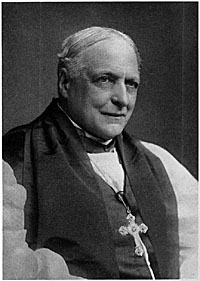
Bp. Charles G. Grafton was a lion of the faith, an ecumenist, and a mission-building bishop. He was a notable figure in early American Anglo-Catholicism (a turn toward the pre-Reformation faith that lived in England from 600-1400), leaving a serious body of works in letters and addresses.
He was the second Bishop of the Diocese of Fond du Lac. Prior to his election as bishop, Grafton was Rector of Church of the Advent in Boston.
Grafton was consecrated on December 15, 1875 at St. Paul's Cathedral, Fond du Lac by William E. McLaren of Chicago, Alexander Burgess of Quincy, and George F. Seymour of Springfield. Grafton founded the Anglican religious order Sisterhood of the Holy Nativity and was a founding member of the Society of St. John the Evangelist.
He is forever memorialized in a tune bearing his name which has been set to numerous hymns. However, I believe the most poignant is to "Sing my ton" the words of which are reproduced alone. Use this as your office hymn, or as thanksgiving for receiving the precious gift of the Lord's most precious body and blood in the Holy Communion.
| Clyde McLennan - Now my tongue the mystery telling .mp3 | ||
 | ||
 | Found at bee mp3 search engine |  |

Readings:
Preface of a Saint (1)
PRAYER
Loving God, who didst call Charles Chapman Grafton to be a bishop in thy Church, endowing him with a burning zeal for souls: Grant that, following his example, we may ever live for the extension of thy kingdom, that thy glory may be the chief end of our lives, thy will the law of our conduct, thy love the motive of our actions, and Christ’s life the model and mold of our own; through the same Jesus Christ, who livest and reignest with thee and the Holy Spirit, one God, throughout all ages. Amen.
Humble Hospitality
Sermon Proper17C Humble Hospitality, Fr Chris Larimer from Fr. Chris Larimer.
A sermon on Luke 14 & Hebrews 13, preached at Holy Apostles Anglican Church in Elizabethtown, KY.
2010-08-26
2010-08-25
Magnificat Hymnic setting

One of the greatest canticles of the Church is the Magnificat, or the Canticle of Mary. It is traditionally sung every evening at Vespers or Evening Prayer. The settings of it are plethora, as is fitting for a song sung every night throughout the year. However, I've recently come upon one I wanted to share. It's set to the familiar tune UFFINGHAM (LM) by Brian Penney. You can listen to it in parts or in full choir here.
And of course if you're going to do this in a Solemn Evensong setting, don't forget the incense!

2010-08-24
Feast of St. Bartholomew, Apostle

The name "Bartholomew" appears in the New Testament only on lists of the names of the twelve apostles. This list normally is given as six pairs, and the third pair in each of the Synoptics is "Philip and Bartholomew" (M 10:3; P 3:18; L 6:14; but A 1:15).
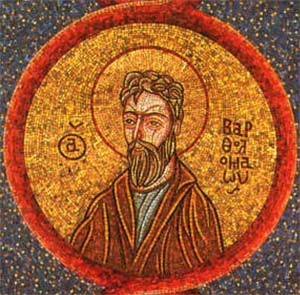 John gives no list of the Twelve, but refers to more of them individually than the Synoptists. He does not name Bartholomew, but early in his account (John 1:43-50) he tells of the call to discipleship of a Nathaniel who is often supposed to be the same person. The reasoning is as follows: John's Nathanael is introduced as one of the earliest followers of Jesus, and in terms which suggest that he became one of the Twelve. He is clearly not the same as Peter, Andrew, James, John, Philip, Thomas, Judas Iscariot, Judas (not Iscariot, also called Lebbaeus or Thaddeus), all of whom John names separately. He is not Matthew, whose call is described differently (M 9:9). This leaves Bartholomew, James the son of Alpheus, and Simon Zelotes. Of these, Bartholomew is the leading candidate for two reasons:
(1) "Bar-tholomew" is a patronymic, meaning "son of Tolmai (or Talmai)." It is therefore likely that he had another name. (A historical novel which may not be well researched informs me that a first-century Jew would be likely to use the patronymic instead of the forename as a mark of respect in speaking to a significantly older Jew.) "Nathanael son of Tolmai" seems more likely than "Nathanael also called James (or Simon)."
(2) Nathanael is introduced in John's narrative as a friend of Philip. Since Bartholomew is paired with Philip on three of our four lists of Apostles, it seems likely that they were associated.
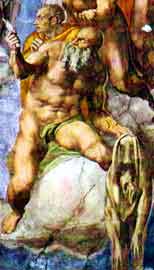
We have no certain information about Bartholomew's later life. Some writers, including the historian Eusebius of Caesarea (now Har Qesari, 32:30 N 34:54 E, near Sedot Yam), say that he preached in India. The majority tradition, with varying details, is that Bartholomew preached in Armenia, and was finally skinned alive and beheaded to Albanus or Albanopolis (now Derbent, 42:03 N 48:18 E) on the Caspian Sea. His emblem in art is a flaying knife. The flayed Bartholomew can be seen in Michelangelo's Sistine painting of the Last Judgement. He is holding his skin. The face on the skin is generally considered to be a self-portrait of Michelangelo.
Readings:
Psalm 91 or 91:1-4
Deuteronomy 18:15-18
1 Corinthians 4:9-15
Luke 22:24-30
Preface of Apostles

PRAYER (traditional language)
Almighty and everlasting God, who didst give to thine apostle Bartholomew grace truly to believe and to preach thy Word: Grant that thy Church may love what he believed and preach what he taught; through Jesus Christ our Lord, who liveth and reigneth with thee and the Holy Ghost, one God for ever and ever.
PRAYER (contemporary language)
Almighty and everlasting God, who gave to your apostle Bartholomew grace truly to believe and to preach your Word: Grant that your Church may love what he believed and preach what he taught; through Jesus Christ our Lord, who lives and reigns with you and the Holy Spirit, one God for ever and ever.
2010-08-23
A New Prayer Book

I have a feeling that some of the AC-NA folks are going to be really upset no matter what form the prayer book revision takes. Let's hope it's received better than the BCP was received in Scotland!
2010-08-11
Lighting the Way

Church lights (candles) symbolize God’s Presence in the sanctuary and the spiritual enlightenment His Gospel brings our lives. Roman practice differs slightly, but in the main carries the same symbolism. Looking at the chancel (by the communion rails) in most churches, we see two major lights. First on the Gospel (left side) we see a small red light mounted on the wall.  This is the Altar Lamp that burns in honor of the constant Real Presence in the reserve Sacrament (consecrated wine and host) kept in the tabernacle / aumbry - a small, ornate box centered on the back portion of the Holy Table. or on a wall nearby.
 The other major lights are the candles on the Holy Table, divided into two groups, signifying Jesus in both His divine and human natures. At many parishes, you’ll see two groups of three each on the back of the Table, called “Office Lights,” lit when conducting the offices of the Church, such as Morning/Evening Prayer, Holy Matrimony, or Funeral services. In other parishes, there will simply be two larger pillar candles beside the Holy Table which are lit for the same purpose.
 The two lights in front of these - or directly on the table - are the Communion Lights, used during the Eucharist. All the lights echo Christ’s words, when He said, “I am the Light of the World” (St. John 8:12) and other passages referring to God’s light, such as St. Matt. 4:16 and St. Luke 2:32.
This is the Altar Lamp that burns in honor of the constant Real Presence in the reserve Sacrament (consecrated wine and host) kept in the tabernacle / aumbry - a small, ornate box centered on the back portion of the Holy Table. or on a wall nearby.The other major lights are the candles on the Holy Table, divided into two groups, signifying Jesus in both His divine and human natures. At many parishes, you’ll see two groups of three each on the back of the Table, called “Office Lights,” lit when conducting the offices of the Church, such as Morning/Evening Prayer, Holy Matrimony, or Funeral services. In other parishes, there will simply be two larger pillar candles beside the Holy Table which are lit for the same purpose.The two lights in front of these - or directly on the table - are the Communion Lights, used during the Eucharist. All the lights echo Christ’s words, when He said, “I am the Light of the World” (St. John 8:12) and other passages referring to God’s light, such as St. Matt. 4:16 and St. Luke 2:32.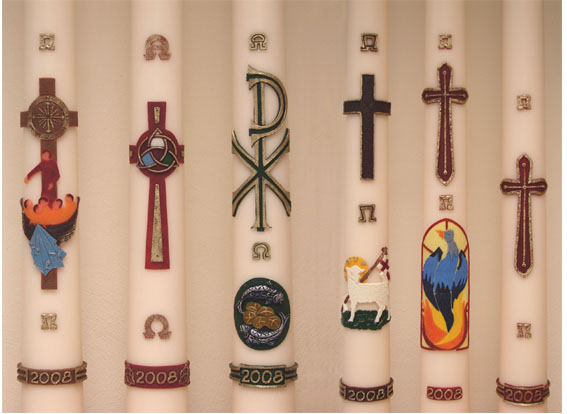 The last light in many churches is the Paschal Candle. This is a large white candle normally kept our of sight, or next to the baptismal font. The candle is blessed every year at the Easter Vigil service, having the year inscribed on it and (traditionally) five grains of incense inserted into in in the shape of a cross. It is often decorated with other signs of the resurrection as well. Some parishes - especially those with elaborate Holy Saturday / Easter Vigil services - have special rituals surrounding the entrance of the Paschal candle. These rituals can include chanting the Exultet (normally done by a deacon), dipping the base of the candle in the baptismal font, and using this candle to light the tapers that will ignite the rest of the office and communion lights. (This practice is especially important in parishes that light a Paschal fire near the entrance of the church door for the vigil.) The candle is brought to the front of the church from Easter until the Ascension (when its removal visually symbolizes Christ's immediate light being taken from our presence). Then the candle is either stored or kept near the font. However, for baptisms and funerals (which, for Christians, is the completion of our baptismal death into Christ), the candle returns to a prominent place. I should also note that this is a Western / Latin Rite practice. The East uses a different type of candle. However, this practice antedates Jerome - and was clearly a common practice long before the Council of Nicea.
The candles recall times when ancient Christians met at night to avoid discovery and needed the lights to worship, but are retained to remind us of those days and to focus us on our Heavenly Father of Lights. Scriptural authority is solid for their use—found in Ex 25:31 & 40:25, Lev 24:2 & II Chron 13:11— and reminds us—we carry the Light of Christ!
2010-08-06
Yes we can

But should we?
From politics to science to economics to religion, the ability to do something doesn't mean that it is right for us to do something. To often, drunk with our own power, we rush to do something simply because we can - rather than thinking through why the limitation was there in the first place. Chesterton put it this way:
California, I'm looking at you."In the matter of reforming things, as distinct from deforming them, there is one plain and simple principle; a principle which will probably be called a paradox. There exists in such a case a certain institution or law; let us say, for the sake of simplicity, a fence or gate erected across a road. The more modern type of reformer goes gaily up to it and says, "I don't see the use of this; let us clear it away." To which the more intelligent type of reformer will do well to answer: "If you don't see the use of it, I certainly won't let you clear it away. Go away and think. Then, when you can come back and tell me that you do see the use of it, I may allow you to destroy it."-- The Thing, in "The Drift from Domesticity" (1929)
2010-08-05
The American Dream
From Salon.com
Read it all here...For a generation, most Americans have been told by left, right and center that they would be failures if they ended their educations with high school, worked hard, saved cash for emergencies and bought modest homes they could afford. They have been told that to succeed in life they need to ape the lifestyles of the upper middle class that provides most of America’s politicians, pundits and scholars.
The result has been an experiment in social engineering that has gone horribly wrong: the creation of a faux mass upper middle class. Millions of Americans who by objective standards belong to the working class or lower middle class have persuaded themselves that they are part of the professional-investor elite, because they have worthless degrees from diploma mills, negligible amounts invested in stocks, and suburban trophy houses they cannot afford. For the college graduates at Starbucks working to pay off student loans for degrees that they will never use, as for the millions of Americans who are now "underwater," owing more on their mortgages than their houses are worth, the American dream has turned into a nightmare.
2010-08-02
Why we need vouchers
I'm a homeschooler. Our current tax code doesn't let me deduct a single penny for educational expenses; nor is there a penny of help. (And obviously, we don't get a child care deduction or credit because my wife is home.)
How much education could YOU buy in your area if you had even $5000 to spend per child?e
2010-08-01
Happy Lammas Day!
Today is either Lammas Day, the Feast of St. Peter's Chains, or the commemoration of Joseph of Arimathea...depending on your churchmanship and culture. Whatever else it is, today is the Lord's Day. Rejoice and be glad in it! (Psalm 2)
2010-07-30

2010-07-26
Sermon for Proper12C
Proper12C Knowing God, Pleading with God from Fr. Chris Larimer on Vimeo.
A sermon preached at Holy Apostles in Elizabethtown, KY. The texts are Genesis 18, Colossians 2, and Luke 11. It begins with a 2 minute childrens message. The sermon is 26 minutes long (there's some unnecessary space at the end).
2010-07-24

Subscribe to:
Posts (Atom)