Showing posts with label saints. Show all posts

2010-12-06

Happy St. Nicholas Day!

FRIEND OF CHILDREN, GIVER OF GIFTS, CLIMBER OF CHIMNEYS, ETC. (6 DEC 326)

The story of St. Nicholas offers a possible way of dealing with the "Santa Claus" problem, to parents who do not want to lie to their children, even in fun, but do not want to say simply: "Bah, humbug! There is no such thing as Santa. Forget about him."

Nicholas was a native of the western part of what is now Asiatic Turkey. He became Bishop of Myra in the fourth century, and there are many stories of his love for God and for his neighbor.

The best-known story involves a man with three unmarried daughters, and not enough money to provide them with suitable dowries. This meant that they could not marry, and were likely to end up as prostitutes. Nicholas walked by the man's house on three successive nights, and each time threw a bag of gold in through a window (or, when the story came to be told in colder climates, down the chimney). Thus, the daughters were saved from a life of shame, and all got married and lived happily ever after.

Because of this and similar stories, Nicholas became a symbol of anonymous gift-giving. Hence, if we give a gift to someone today without saying whom it is from, it can be called "a present from Saint Nicholas (or Santa Claus)." Some parents explain this to their children and invite the child to join them in wrapping a toy (either something purchased for that purpose, at least partly with the child's allowance, or else a toy that the child has outgrown but that is still serviceable) or an outgrown but not shabby item of the child's clothing, or a package of food, and then going along to donate it to a suitable shelter that will give it to someone who will welcome it. This gift is then called "a present from Santa," so that the child understands that this is another name for an anonymous gift given to someone whom we do not know, but whom we love anyway because God does. (Presents within the family can be "From Santa" or "From Santa and...")

Pictures of Nicholas often show three bags of gold next to him, and often these bags have become simply three disks or balls. Nicholas became the patron of an Italian city (I think Bari, which is where his body is now buried) that was a center of the pawnbroking business, and hence a pawnbroking shop traditionally advertises by displaying three gold balls over its front. It is thought that some persons looking at pictures of Nicholas confused the three round objects with human heads.

Hence there is a story of a wicked innkeeper who murdered three boys and salted their bodies to serve to his guests, to save on the butcher's bill. Nicholas visited the inn and confronted the innkeeper, who confessed his crime, whereupon Nicholas prayed over the brine-tub and the three boys leaped out unharmed. Other stories have him saving the lives of three innocent men who had been condemned to death. Still other stories have him coming to the rescue of drowning sailors (could this be related to the brine-tub incident?). Nicholas has always been popular with children, mariners, pawnbrokers, the Dutch, the Russians, and recently, the department-store owners. (American readers may remember the story of the brine-tub through reading it as children in the book The Dutch Twins, by Lucy Fitch Perkins, author of The Spanish Twins, The Italian Twins, and many similar books, all children's favorites in the middle of this century. They may now be banned as politically incorrect -- I have no idea. If your children know the brine-tub story, from this book or elsewhere, they may be interested to know how it may have originated.)

In many countries, Nicholas visits children on his feast day, 6 December, and brings them gifts then. In these countries, there is usually no exchange of Christmas presents, but there may be gifts again on January 6, the feast of the coming of the Wise Men, who brought gifts to the Holy Child of gold, frankincense, and myrrh. In America, it may be thought necessary to yield to outside pressure and let Nicholas distribute gifts on December 25.

If you want to show your children (or yourself) how Nicholas is remembered by Christians with a background different from your own (unless, of course, this IS your background), you might want to attend an East Orthodox service at this time. Many Eastern Orthodox congregations have services on the evening before 6 December that feature "visits from Saint Nicholas." He appears as a bishop, with no red suit. The faithful leave their shoes outside the church door, and find in them afterwards gold coins (actually chocolate wrapped in gold foil) representing the gold dowries of the three daughters. To find a service and inquire what it is likely to be like, look up CHURCHES, ORTHODOX in the Yellow Pages. For an English-language service, "Orthodox Church in America" or "Antiochan Orthodox" parishes are likely choices, but do not overlook other possibilities. There are also wonderful ideas for celebrating this day, especially with children, at the St. Nicholas Center.

We are told, but it is uncertain, that Nicholas was imprisoned for his faith before the accession of Constantine, and that he was present at the Council of Nicea in 325. We may note in passing that the picture of him as roly-poly is a late development. Early stories indicate that he was generous to others, but not given to self-indulgence. Indeed, even as an unweaned infant, he fasted regularly on Wednesdays and Fridays.

by James Kiefer


Readings:

Preface of a Saint (1)

PRAYER (traditional language)

Almighty God, who in thy love didst give to thy servant Nicholas of Myra a perpetual name for deeds of kindness on land and sea: Grant, we pray thee, that thy Church may never cease to work for the happiness of children, the safety of sailors, the relief of the poor, and the help of those tossed by tempests of doubt or grief; through Jesus Christ our Lord, who liveth and reigneth with thee and the Holy Spirit, one God, for ever and ever.

PRAYER (contemporary language)

Almighty God, who in your love gave to your servant Nicholas of Myra a perpetual name for deeds of kindness on land and sea: Grant, we pray, that your Church may never cease to work for the happiness of children, the safety of sailors, the relief of the poor, and the help of those tossed by tempests of doubt or grief; through Jesus Christ our Lord, who lives and reigns with you and the Holy Spirit, one God, for ever and ever.

2010-11-30

Happy St. Andrews Day!

Readings:

Psalm 19 or 19:1-6
Deuteronomy 30:11-14
Romans 10:8b-18
Matthew 4:18-22

Preface of Apostles

Collect: Almighty God, who gave such grace to your apostle Andrew that he readily obeyed the call of your Son Jesus Christ, and brought his brother with him: Give unto us, who are called by your Word, grace to follow him without delay, and to bring those near to us into his gracious presence; who lives and reigns with you and the Holy Spirit, one God, now and for ever.

Icon of St. AndrewMost references to Andrew in the New Testament simply include him on a list of the Twelve Apostles, or group him with his brother, Simon Peter. But he appears acting as an individual three times in the Gospel of John. When a number of Greeks (perhaps simply Greek-speaking Jews) wish to speak with Jesus, they approach Philip, who tells Andrew, and the two of them tell Jesus (Jn 12:20-22). (It may be relevant here that both "Philip" and "Andrew" are Greek names.) Before Jesus feeds the Five Thousand, it is Andrew who says, "Here is a lad with five barley loaves and two fish." (Jn 6:8f) And the first two disciples whom John reports as attaching themselves to Jesus (Jn 1:35-42) are Andrew and another disciple (whom John does not name, but who is commonly supposed to be John himself -- John never mentions himself by name, a widespread literary convention). Having met Jesus, Andrew then finds his brother Simon and brings him to Jesus. Thus, on each occasion when he is mentioned as an individual, it is because he is instrumental in bringing others to meet the Saviour. In the Episcopal Church, the Fellowship of Saint Andrew is devoted to encouraging personal evangelism, and the bringing of one's friends and colleagues to a knowledge of the Gospel of Christ.

Just as Andrew was the first of the Apostles, so his feast is taken in the West to be the beginning of the Church Year. (Eastern Christians begin their Church Year on 1 September.) The First Sunday of Advent is defined to be the Sunday on or nearest his feast (although it could equivalently be defined as the fourth Sunday before Christmas Day).

Several centuries after the death of Andrew, some of his relics were brought by a missionary named Rule to Scotland, to a place then known as Fife, but now known as St. Andrew's, and best known as the site of a world-famous golf course and club. For this reason, Andrew is the patron of Scotland.

When the Emperor Constantine established the city of Byzantium, or Constantinople, as the new capital of the Roman Empire, replacing Rome, the bishop of Byzantium became very prominent. Five sees (bishoprics) came to be known as patriarchates: Rome, Alexandria, Antioch, Jerusalem, and Byzantium. Now, the congregation at Rome claimed the two most famous apostles, Peter and Paul, as founders. Antioch could also claim both Peter and Paul, on the explicit testimony of Scripture, and of course Jerusalem had all the apostles. Alexandria claimed that Mark, who had been Peter's "interpreter" and assistant, and had written down the Gospel of Mark on the basis of what he had heard from Peter, had after Peter's death gone to Alexandria and founded the church there. Byzantium was scorned by the other patriarchates as a new-comer, a church with the political prestige of being located at the capital of the Empire, but with no apostles in its history. Byzantium responded with the claim that its founder and first bishop had been Andrew the brother of Peter. They pointed out that Andrew had been the first of all the apostles to follow Jesus (John 1:40-41), and that he had brought his brother to Jesus. Andrew was thus, in the words of John Chrysostom, "the Peter before Peter." As Russia was Christianized by missionaries from Byzantium, Andrew became the patron not only of Byzantium but also of Russia.

Andrew is the national saint of Scotland (thus appreciated, even by Presbyterians! - Ed.). George (23 Apr) is the national saint of England, Patrick (17 Mar) of Ireland, and Dewi = David (1 Mar) of Wales. George, who was a soldier, is customarily pictured as a knight with a shield that bears a red cross on a white background. This design is therefore the national flag of England. It is said that Andrew was crucified on a Cross Saltire -- an 'X' -shaped cross. His symbol is a Cross Saltire, white on a blue background. This is accordingly the national flag of Scotland. A symbol of Patrick is a red cross saltire on a white background. The crosses of George and Andrew were combined to form the Union Jack, or flag of Great Britain, and later the cross of Patrick was added to form the present Union Jack. Wales does not appear as such (sorry!). Whether there is a design known as the cross of David, I have no idea.

by James Kiefer

2010-10-26

Alfred the Great

When the Gospel was first preached in Britain, the island was inhabited by Celtic peoples. In the 400's, pagan Germanic tribes, the Angles, Saxons, and Jutes, invaded Britain and drove the Christian Celts out of what is now England into Wales, Scotland, and Ireland. The new arrivals (called collectively the Anglo-Saxons) were then converted by Celtic missionaries moving in from the one side and Roman missionaries moving in from the other. (They then sent missionaries of their own, such as Boniface, to their pagan relatives on the Continent.)

In the 800's the cycle partly repeated itself, as the Christian Anglo-Saxons were invaded by the Danes, pagan raiders, who rapidly conquered the northeast portion of England. They seemed about to conquer the entire country and eliminate all resistance when they were turned back by Alfred, King of the West Saxons.

Alfred was born in 849 at Wantage, Berkshire, youngest of five sons of King Aethelwulf. He wished to become a monk, but after the deaths (all in battle, I think) of his father and his four older brothers, he was made king in 871. He proved to be skilled at military tactics, and devised a defensive formation which the Danish charge was unable to break. After a decisive victory at Edington in 878, he reached an agreement with the Danish leader Guthrum, by which the Danes would retain a portion of northeastern England and be given other concessions in return for their agreement to accept baptism and Christian instruction.

From a later point of view, it seems obvious that such a promise could not involve a genuine change of heart, and was therefore meaningless (and indeed, one Dane complained that the white robe that he was given after his baptism was not nearly so fine as the two that he had received after the two previous times that he had been defeated and baptized). However, Alfred's judgement proved sound. Guthrum, from his point of view, agreed to become a vassal of Christ. His nobles and chief warriors, being his vassals, were thereby obligated to give their feudal allegiance to Christ as well. They accepted baptism and the presence among them of Christian priests and missionaries to instruct them. The door was opened for conversions on a more personal level in that and succeeding generations.

In his later years, having secured a large degree of military security for his people, Alfred devoted his energies to repairing the damage that war had done to the cultural life of his people. He translated Boethius' Consolations of Philosophy into Old English, and brought in scholars from Wales and the Continent with whose help various writings of Bede, Augustine of Canterbury, and Gregory the Great were likewise translated. He was much impressed by the provisions in the Law of Moses for the protection of the rights of ordinary citizens, and gave order that similar provisions should be made part of English law. He promoted the education of the parish clergy. In one of his treatises, he wrote:


"He seems to me a very foolish man, and very wretched, who will not increase his
understanding while he is in the world, and ever wish and long to reach that
endless life where all shall be made clear."

He died on 26 October 899, and was buried in the Old Minster at Winchester. Alone among English monarchs, he is known as "the Great."

The writer G K Chesterton has written a long narrative poem about Alfred, called, "The Ballad of the White Horse." In my view, it would be improved by abridgement (I would, for example, terminate the prologue after the line "And laid peace on the sea"), but I think it well worth reading as it stands, both for the history and (with minor reservations) for the theology.


by James Kiefer


Collect and propers here.

2010-10-13

Translation of Edward the Confessor

Edward was born in 1003. He was the last Saxon king to rule (for more than a few months) in England. He is called "Edward the Confessor" to distinguish him from another King of England, Edward the Martyr (c962-979), who was assassinated (presumably by someone who wished to place Edward's younger half-brother on the throne), and who came to be regarded, on doubtful grounds, as a martyr for the faith. In Christian biographies, the term "confessor" is often used to denote someone who has born witness to the faith by his life, but who did not die as a martyr. Edward was the son of King Æthelred the Unready. This does not mean that he was unprepared, but rather that he was stubborn and willful, and would not accept "rede," meaning advice or counsel.

Æthelred was followed by several Danish kings of England, during whose rule young Edward and his mother took refuge in Normandy. But the last Danish king named Edward as his successor, and he was crowned in 1042. Opinions on his success as a king vary. Some historians consider him weak and indecisive, and say that his reign paved the way for the Norman Conquest. Others say that his prudent management gave England more than twenty years of peace and prosperity, with freedom from foreign domination, at a time when powerful neighbors might well have dominated a less adroit ruler. He was diligent in public and private worship, generous to the poor, and accessible to subjects who sought redress of grievances.

While in exile, he had vowed to make a pilgrimage to Rome if his family fortunes mended. However, his council told him that it was not expedient for him to be so long out of the country. Accordingly, he spent his pilgrimage money instead on the relief of the poor and the building of the Collegiate Church of St Peter at Westminster, better known as Westminster Abbey, which stands today (rebuilt in the thirteenth century) as one of the great churches of England, burial place of her kings and others deemed worthy of special honor. He is buried there as well.

He died on 5 January 1066, leaving no offspring; and after his death, the throne was claimed by his wife's brother, Harold the Saxon, and by William, Duke of Normandy. William defeated and slew Harold at the Battle of Hastings (14 October 1066), and thereafter the kings and upper classes of England were Norman-French rather than Anglo-Saxon. Edward is remembered, not on the day of his death, but on the anniversary of the moving ("translation") of his corpse to a new tomb, a date which is also the anniversary of the eve of the Battle of Hastings, the end of Saxon England.


Clyde McLennan - Round the Lord in glory seated .mp3


Found at bee mp3 search engine

PRAYER:
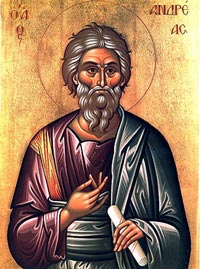
O God, who called your servant Edward to an an earthly throne That he might advance your heavenly kingdom, and gave him zeal for your Church and love for your people: Mercifully grant that we who commemorate him this day may be fruitful in good works, and attain to the glorious crown of your saints; through Jesus Christ our Lord, who lives and reigns with you and the Holy Spirit, one God, for ever and ever.
2010-10-09

Foley Beach and Robert Grosseteste

I'm in Atlanta for the consecration of Dr. Foley Beach to the holy episcopate. It's an exciting day for me because this is also the Feast of St. Robert Grosseteste. Grosseteste was an Oxford scholar and pastor before he was appointed bishop of Lincoln. After his episcopal consecration, he surprised his diocese by actually taking the lead in caring for the priests and parishioners under his care. He visited the rural deaneries (way out in the country) and taught the clergy at diocesan synods. Instead of simply making decrees from his episcopal seat and hoping they would be carried out, he visited parishes and told the clergy why certain decisions were made. He refused to admit men to livings (pastoral appointments with a certain income) if he knew they would be sub-letting their cure (paying a poor curate to perform their pastoral duties). That form of abuse was rampant in the medieval church, but Grosseteste even refused to admit a nephew of the pope to a living when he saw that the man was unfit.

Auspiciously, today the Anglican Church is again being given a bishop who is a faithful pastor, a stalwart defender of the faith, a capable teacher, and a true pastor to pastors in raising Foley Beach to the Sacred Order of Bishops. He is surrounded by people who can testify to his commitment to see people's lives changed for the sake of the Gospel. He maintains a full teaching / speaking role even while serving as rector of a growing church. And he has discipled so many young men in their role as presbyters in the Church of God. I couldn't be happier to be here. I couldn't be happier to be part of this movement.

Let all faithful Anglicans thank God for the example of Robert Grosseteste, and his spiritual heir, Foley Beach.

Holy God, our greatest treasure, you blessed Hugh and Robert, Bishops of Lincoln, with wise and cheerful boldness for the proclamation of your Word to rich and poor alike: Grant that all who minister in your Name may serve with diligence, discipline and humility, fearing nothing but the loss of you and drawing all to you through Jesus Christ our Savior; who lives and reigns with you in the communion of the Holy Spirit, one God, now and for ever. Amen.

2010-09-11

Paphnutius the Confessor

St. Paphnutius was an Egyptian bishop, of a city in the Upper Thebaid in the early fourth century, and one of the most interesting members of the Council of Nicæa (325). He suffered mutilation of the left knee (was hamstrung) and the loss of his right eye for the Faith under the Emperor Maximinus (308-13), and was subsequently condemned to the mines. At Nicæa he was greatly honoured by Constantine the Great, who, according to Socrates (Church History I.11), used often to send for the good old confessor and kiss the place whence the eye had been torn out.

He took a prominent, perhaps a decisive, part in the debate at the First Œcumenical Council on the subject of the celibacy of the clergy. It seems that most of the bishops present were disposed to follow the precedent of the Council of Elvira (can. xxxiii) prohibiting conjugal relations to those bishops, priests, deacons, and, according to Sozomen, sub-deacons, who were married before ordination. Paphnutius earnestly entreated his fellow-bishops not to impose this obligation on the orders of the clergy concerned. He proposed, in accordance "with the ancient tradition of the Church", that only those who were celibates at the time of ordination should continue to observe continence, but, on the other hand, that "none should be separated from her, to whom, while yet unordained, he had been united". The great veneration in which he was held, and the well known fact that he had himself observed the strictest chastity all his life, gave weight to his proposal, which was unanimously adopted. The council left it to the discretion of the married clergy to continue or discontinue their marital relations. Paphnutius was present at the Synod of Tyre (335) with St. Athanasius.

See more at Wikipedia.

2010-08-24

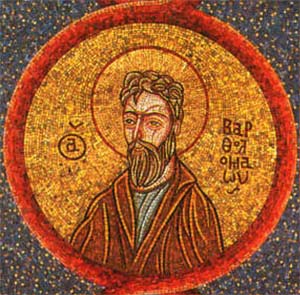
Feast of St. Bartholomew, Apostle

The name "Bartholomew" appears in the New Testament only on lists of the names of the twelve apostles. This list normally is given as six pairs, and the third pair in each of the Synoptics is "Philip and Bartholomew" (M 10:3; P 3:18; L 6:14; but A 1:15).


John gives no list of the Twelve, but refers to more of them individually than the Synoptists. He does not name Bartholomew, but early in his account (John 1:43-50) he tells of the call to discipleship of a Nathaniel who is often supposed to be the same person. The reasoning is as follows: John's Nathanael is introduced as one of the earliest followers of Jesus, and in terms which suggest that he became one of the Twelve. He is clearly not the same as Peter, Andrew, James, John, Philip, Thomas, Judas Iscariot, Judas (not Iscariot, also called Lebbaeus or Thaddeus), all of whom John names separately. He is not Matthew, whose call is described differently (M 9:9). This leaves Bartholomew, James the son of Alpheus, and Simon Zelotes. Of these, Bartholomew is the leading candidate for two reasons:

(1) "Bar-tholomew" is a patronymic, meaning "son of Tolmai (or Talmai)." It is therefore likely that he had another name. (A historical novel which may not be well researched informs me that a first-century Jew would be likely to use the patronymic instead of the forename as a mark of respect in speaking to a significantly older Jew.) "Nathanael son of Tolmai" seems more likely than "Nathanael also called James (or Simon)."
(2) Nathanael is introduced in John's narrative as a friend of Philip. Since Bartholomew is paired with Philip on three of our four lists of Apostles, it seems likely that they were associated.

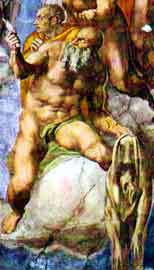
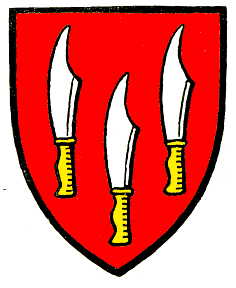
We have no certain information about Bartholomew's later life. Some writers, including the historian Eusebius of Caesarea (now Har Qesari, 32:30 N 34:54 E, near Sedot Yam), say that he preached in India. The majority tradition, with varying details, is that Bartholomew preached in Armenia, and was finally skinned alive and beheaded to Albanus or Albanopolis (now Derbent, 42:03 N 48:18 E) on the Caspian Sea. His emblem in art is a flaying knife. The flayed Bartholomew can be seen in Michelangelo's Sistine painting of the Last Judgement. He is holding his skin. The face on the skin is generally considered to be a self-portrait of Michelangelo.

Readings:

Psalm 91 or 91:1-4
Deuteronomy 18:15-18
1 Corinthians 4:9-15
Luke 22:24-30

Preface of Apostles

PRAYER (traditional language)

Almighty and everlasting God, who didst give to thine apostle Bartholomew grace truly to believe and to preach thy Word: Grant that thy Church may love what he believed and preach what he taught; through Jesus Christ our Lord, who liveth and reigneth with thee and the Holy Ghost, one God for ever and ever.

PRAYER (contemporary language)
Almighty and everlasting God, who gave to your apostle Bartholomew grace truly to believe and to preach your Word: Grant that your Church may love what he believed and preach what he taught; through Jesus Christ our Lord, who lives and reigns with you and the Holy Spirit, one God for ever and ever.

2010-08-01

Happy Lammas Day!

Today is either Lammas Day, the Feast of St. Peter's Chains, or the commemoration of Joseph of Arimathea...depending on your churchmanship and culture. Whatever else it is, today is the Lord's Day. Rejoice and be glad in it! (Psalm 2)

2010-06-29

Feast of Ss. Peter & Paul

These two have been on my mind as I've been working through Galatians (where Paul recounts setting Peter back on the path from the Judaizing heresy). I'm thankful for both of them: Peter gave the Church a pastoral and confessional interest, Paul gave the Church her rigorous theology. Thanks be to God for both of these wonderful men!

The Confession of Peter ("Thou art the Christ, the Son of the Living God") is commemorated on 18 January, and the Conversion of Paul (on the approach to Damascus) a week later on 25 January. On 29 June we commemorate the martyrdoms of both apostles. The date is the anniversary of a day around 258, under the Valerian persecution, when what were believed to be the remains of the two apostles were both moved temporarily to prevent them from falling into the hands of the persecutors.

Statue of St.  Peter, in St. Peter's SquareStatue of St.  Paul, in St. Peter's Square

The Scriptures do not record the deaths of Peter or Paul, or indeed any of the Apostles except for James the son of Zebedee (Acts 12:2), but they are clearly anticipated (see the readings below), and from an early date it has been said that they were martyred at Rome at the command of the Emperor Nero, and buried there. As a Roman citizen, Paul would probably have been beheaded with a sword. It is said of Peter that he was crucified head downward. The present Church of St Peter in Rome replaces earlier churches built on the same site going back to the time of the Emperor Constantine, in whose reign a church was built there on what was believed to be the burial site of Peter. Excavations under the church suggest that the belief is older than Constantine.

St. Augustine writes (Sermon 295):
Both apostles share the same feast day, for these two were one; and even though they suffered on different days, they were as one. Peter went first, and Paul followed. And so we celebrate this day made holy for us by the apostles' blood. Let us embrace what they believed, their life, their labors, their sufferings, their preaching, and their confession of faith.

The Crucifixion of St. Peter, by CaravaggioFIRST READING: Ezekiel 34:11-16
(The LORD God will be a shepherd to Israel, and they shall be His flock.)

PSALM 87
(The foundations of Zion, the city of God, rest upon the holy hills. Of many nations it shall be said: In Zion were they born.)

EPISTLE: 2 Timothy 4:1-8
(Paul writes: "I am now ready to be offered, and the time of my departure is at hand. I have fought a good fight, I have finished the course, I have kept the faith.")

THE HOLY GOSPEL: John 21:15-19
(Jesus, after rising from the dead, said to Peter: "When you were young, you went where you would, but when you are old, you will go where you are taken." And by these words, He foretold Peter's death. He then said, "Follow me.")


Almighty God, whose blessed apostles Peter and Paul glorified thee by their martyrdom: Grant that thy Church, instructed by their teaching and example, and knit together in unity by thy Spirit, may ever stand firm upon the one foundation, which is Jesus Christ our Lord; who liveth and reigneth with thee, in the unity of the same Spirit, one God, for ever and ever.

2010-05-25

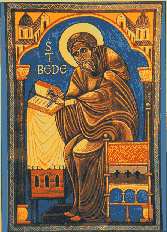
The Venerable Bede

Bede was a monk at the English monastery of Wearmouth and Jarrow, in Northumbria. From the age of seven, he spent all his life at that monastery except for a few brief visits to nearby sites. He says of himself: "I have devoted my energies to a study of the Scriptures, observing monastic discipline, and singing the daily services in church; study, teaching, and writing have always been my delight."

He was the first person to write scholarly works in the English language, although unfortunately only fragments of his English writings have survived. He translated the Gospel of John into Old English, completing the work on the very day of his death. He also wrote extensively in Latin. He wrote commentaries on the Pentateuch and other portions of Holy Scripture. His best-known work is his History of the English Church and People, a classic which has frequently been translated and is available in Penguin Paperbacks. It gives a history of Britain up to 729, speaking of the Celtic peoples who were converted to Christianity during the first three centuries of the Christian era, and the invasion of the Anglo-Saxon pagans in the fifth and sixth centuries, and their subsequent conversion by Celtic missionaries from the north and west, and Roman missionaries from the south and east. His work is our chief source for the history of the British Isles during this period. Fortunately, Bede was careful to sort fact from hearsay, and to tell us the sources of his information.

He also wrote hymns and other verse, the first martyrology with historical notes, letters and homilies, works on grammar, on chronology and astronomy -- he was aware that the earth is a sphere, and he is the first historian to date events ANNO DOMINI, and the earliest known writer to state that the solar year is not exactly 365 and a quarter days long, so that the Julian calendar (one leap year every four years) requires some adjusting if the months are not to get out of step with the seasons.

His hymns include one for the Ascension. Suggested tune is Agincourt, also called Deo Gratias (or Gracias), which follows:


Clyde McLennan - Creator of the earth and skies .mp3


Found at bee mp3 search engine

A hymn of glory let us sing;
New songs throughout the world shall ring:
Christ, by a road before untrod,
Now rises to the throne of God.

The holy apostolic band
Upon the Mount of Olives stand;
And with his followers they see
Their Lord's ascending majesty.

To them the angels drawing nigh,
"Why stand and gaze upon the sky?
This is the Savior," thus they say;
"This is his glorious triumph day.

"Again shall ye behold him so
As ye today have seen him go,
In glorious pomp ascending high,
Up to the portals of the sky."

O risen Christ, ascended Lord,
All praise to thee let earth accord,
Who art, while endless ages run,
With Father and with Spirit one.

Readings:

PRAYER (traditional wording)
Heavenly Father, who didst call thy servant Bede, while still a child, to devote his life to thy service in the disciplines of religion and scholarship: Grant that as he labored in the Spirit to bring the riches of thy truth to his generation, so we, in our various vocations, may strive to make thee known in all the world; through Jesus Christ our Lord, who liveth and reigneth with thee and the Holy Spirit, one God, for ever and ever.

PRAYER (contemporary wording)

Heavenly Father, who called your servant Bede, while still a child, to devote his life to your service in the disciplines of religion and scholarship: Grant that as he labored in the Spirit to bring the riches of your truth to his generation, so we, in our various vocations, may strive to make you known in all the world; through Jesus Christ our Lord, who lives and reigns with you and the Holy Spirit, one God, for ever and ever.

h/t Satucket

2010-01-25

Conversion of St. Paul

Lately, I've been dealing with some folks on another blog that, by their defense of a heresiarch and their own indifference to doctrine while holding office in a church, have become enemies of Christ and His gospel. My first, human reaction was to get angry. But God has been dealing with me - breaking my heart for those who find themselves breaking upon the Law of God.

And today, in my Daily Office recitation, I come upon the story of Paul's conversion on this its feast. And in singing the office hymn, God reminded me that I should never give up hope for those who are now enemies of the Gospel. God may yet make them His greatest messengers. That's hope and change you can believe in!

Lord God of our fathers, who in reconciling the world to yourself have made friends of your enemies, forgive me when I forget how I was your avowed enemy before you won my heart. Use me to reach those who are set against you, through the love and grace of Our Lord Jesus Christ, who lives and reigns with you and the Holy Spirit in everlasting unity. Amen.

Clyde McLennan - We sing the glorious conquest .mp3


Found at bee mp3 search engine

We sing the glorious conquest,
Before Damascus’ gate,
When Saul, the Church’s spoiler,
Came breathing threats and hate;
The rav’ning wolf rushed forward
Full early to the prey;
But lo! the Shepherd met him,
And bound him fast today.

O glory most excelling
That smote across his path!
O light that pierced and blinded
The zealot in his wrath!
O voice that spake within him
The calm, reproving word!
O love that sought and held him
The bondman of his Lord!

O Wisdom ord’ring all things
In order strong and sweet,
What nobler spoil was ever
Cast at the Victor’s feet?
What wiser master builder
E’er wrought at Thine employ
Than he, till now so furious
Thy building to destroy?

Lord, teach thy Church the lesson,
Still in her darkest hour
Of weakness and of danger,
To trust Thy hidden power;
Thy grace by ways mysterious
The wrath of man can bind,
And in Thy boldest foeman
Thy chosen saint can find.

2010-01-18

Upon this Rock

Petros, Peter, which means “rock” made a rock-solid confession, when asked by Christ whom men say that he is, “You are the Christ, the Son of the Living God!” This is divine revelation, not given to us by flesh and blood, but by God the Holy Spirit.

And our Lord said to Peter, “Upon this rock [petra], I will build my church and the gates of hell shall not prevail against it” [Matt. 16]. But shortly thereafter Christ was rebuking the rock-man when he wanted to resist, with all good intentions, the very rock upon which the church is built: Christ and Him crucified!

It is an interesting paradox here portrayed for us in Matt. 16, a very wholesome and worthy lesson for us all. The rock of offense, is the rock upon which the church is built: a bloody, suffering and dying Jesus, scorned and rejected, cross and suffering, not some glorious triumph, at least not in the eyes of the world. Through the deepest and lowliest and most disdainful shame and suffering is how our Lord builds His church.

And He uses weak, human vessels, like St. Peter, and the words of His confession. He used a man who would betray him in public, and denounce him through cussing like a sailor! And yet that man's mouth, through preaching, would later open the kingdom to the Gentiles.

Upon the preaching of the confession of Peter, our Lord continues to call, gather, enlighten and sanctify the whole Christian Church on earth, and He promises, to the very end, to keep it with Jesus Christ, our head and master, in the one true faith.

Praise God for the confession of St. Peter! Glory to Christ for the rock upon which the church is built and for the “rock-men” and “rock-women” who proclaim and share and teach and spread the Word abroad into all the world, in all the wonderful and various vocations given among us! Praise be to God for the confession of St. Peter, the confession of the church throughout all the world.

The readings appointed for today are:
First lesson: Acts 4:8-13
Psalm: Psalm 23
Epistle: 1 Pet. 5:1-4
Gospel: Mark 8:27-9:1

Let us pray:

Almighty Father, who inspired Simon Peter, first among the apostles, to confess Jesus as Messiah and Son of the Living God: Keep your Church steadfast upon the rock of this faith, that in unity and peace we may proclaim the one truth and follow the one Lord, our Savior Jesus Christ; who lives and reigns with you and the Holy Spirit, one God, now and for ever.

For a Roman perspective, look here.

For an evangelical's perspective, see here (or this online master's thesis which provides patristic as well as exegetical support).

2009-12-30

Santa's got a knife!

From the BBC News.

A Turkish archaeologist has called on his government to demand that Italy return the bones of St Nicholas to their original resting place.

The 3rd Century saint - on whom Santa Claus was modelled - was buried in the modern-day town of Demre in Turkey.

But in the Middle Ages his bones were taken by Italian sailors and re-interred in the port of Bari.

The Turkish government said it was considering making a request to Rome for the return of the saint's remains.

While Christmas is by and large not celebrated in Muslim Turkey, the Christmas figure of Santa Claus certainly is, in the Mediterranean town of his birth.

He was born in what was then the Greek city of Myra in the third century, and went on to become the local bishop, with a reputation for performing miracles and secretly giving gold to the needy - on one occasion being forced to climb down a chimney to leave his donation.

After his death he was canonised as Saint Nicholas, and venerated in much of the Christian world. But when Myra was occupied by Arab forces in the 11th Century, Italian sailors came and took the saint's bones to the port of Bari, where they remain interred to this day.

Prof Nevzat Cevik, head of archaeological research in Demre, says Saint Nicholas had made it clear during his life that he wanted to be buried in his home town.

Even without the bones, the town of Demre has not been shy about cashing in on its most famous native son - today visitors to the Byzantine church there are greeted by a large, plastic Santa statue, complete with beard and red snow-suit.

2009-11-30

Feast of St. Andrew

Readings:

Psalm 19 or 19:1-6
Deuteronomy 30:11-14
Romans 10:8b-18
Matthew 4:18-22

Preface of Apostles

Collect: Almighty God, who gave such grace to your apostle Andrew that he readily obeyed the call of your Son Jesus Christ, and brought his brother with him: Give unto us, who are called by your Word, grace to follow him without delay, and to bring those near to us into his gracious presence; who lives and reigns with you and the Holy Spirit, one God, now and for ever.

Icon of St. AndrewMost references to Andrew in the New Testament simply include him on a list of the Twelve Apostles, or group him with his brother, Simon Peter. But he appears acting as an individual three times in the Gospel of John. When a number of Greeks (perhaps simply Greek-speaking Jews) wish to speak with Jesus, they approach Philip, who tells Andrew, and the two of them tell Jesus (Jn 12:20-22). (It may be relevant here that both "Philip" and "Andrew" are Greek names.) Before Jesus feeds the Five Thousand, it is Andrew who says, "Here is a lad with five barley loaves and two fish." (Jn 6:8f) And the first two disciples whom John reports as attaching themselves to Jesus (Jn 1:35-42) are Andrew and another disciple (whom John does not name, but who is commonly supposed to be John himself -- John never mentions himself by name, a widespread literary convention). Having met Jesus, Andrew then finds his brother Simon and brings him to Jesus. Thus, on each occasion when he is mentioned as an individual, it is because he is instrumental in bringing others to meet the Saviour. In the Episcopal Church, the Fellowship of Saint Andrew is devoted to encouraging personal evangelism, and the bringing of one's friends and colleagues to a knowledge of the Gospel of Christ.

Just as Andrew was the first of the Apostles, so his feast is taken in the West to be the beginning of the Church Year. (Eastern Christians begin their Church Year on 1 September.) The First Sunday of Advent is defined to be the Sunday on or nearest his feast (although it could equivalently be defined as the fourth Sunday before Christmas Day).

Several centuries after the death of Andrew, some of his relics were brought by a missionary named Rule to Scotland, to a place then known as Fife, but now known as St. Andrew's, and best known as the site of a world-famous golf course and club. For this reason, Andrew is the patron of Scotland.

When the Emperor Constantine established the city of Byzantium, or Constantinople, as the new capital of the Roman Empire, replacing Rome, the bishop of Byzantium became very prominent. Five sees (bishoprics) came to be known as patriarchates: Rome, Alexandria, Antioch, Jerusalem, and Byzantium. Now, the congregation at Rome claimed the two most famous apostles, Peter and Paul, as founders. Antioch could also claim both Peter and Paul, on the explicit testimony of Scripture, and of course Jerusalem had all the apostles. Alexandria claimed that Mark, who had been Peter's "interpreter" and assistant, and had written down the Gospel of Mark on the basis of what he had heard from Peter, had after Peter's death gone to Alexandria and founded the church there. Byzantium was scorned by the other patriarchates as a new-comer, a church with the political prestige of being located at the capital of the Empire, but with no apostles in its history. Byzantium responded with the claim that its founder and first bishop had been Andrew the brother of Peter. They pointed out that Andrew had been the first of all the apostles to follow Jesus (John 1:40-41), and that he had brought his brother to Jesus. Andrew was thus, in the words of John Chrysostom, "the Peter before Peter." As Russia was Christianized by missionaries from Byzantium, Andrew became the patron not only of Byzantium but also of Russia.

Andrew is the national saint of Scotland (thus appreciated, even by Presbyterians! - Ed.). George (23 Apr) is the national saint of England, Patrick (17 Mar) of Ireland, and Dewi = David (1 Mar) of Wales. George, who was a soldier, is customarily pictured as a knight with a shield that bears a red cross on a white background. This design is therefore the national flag of England. It is said that Andrew was crucified on a Cross Saltire -- an 'X' -shaped cross. His symbol is a Cross Saltire, white on a blue background. This is accordingly the national flag of Scotland. A symbol of Patrick is a red cross saltire on a white background. The crosses of George and Andrew were combined to form the Union Jack, or flag of Great Britain, and later the cross of Patrick was added to form the present Union Jack. Wales does not appear as such (sorry!). Whether there is a design known as the cross of David, I have no idea.

by James Kiefer

2009-10-08

THE VENERATION OF HOLY IMAGES

LIGHTING A CANDLE.

In English cathedrals these days it is common to find stands of lighted candles. In York Minster there is just such a stand.On a table nearby there is a notice saying that it is a nice idea to light a candle and pray. The use of candles has become very popular, not only as a symbol of prayer, but to mark various kinds of aspirations-for the freedom of hostages, to emphasize all manner of political and social issues, and as a mark of public sorrow. Lights of various kinds are used in a number of world religions. and Christians are heirs, to a certain extent, of ancient Jewish customs. Is there, then, a specific Christian use of candles and lamps?

THE LIGHT OF CHRIST.

Beyond the obvious practical need to give light in dark buiIdings, there are two uses which have special Christian significance. The first is the symbolic use, representing Christ as the Light of the world. The gift of a lighted candle at Baptism, the blessing of candles at Candlemass and the ceremonies of the New Fire and the Easter Candle are all examples of this use of lights.

LIGHTS OF HONOUR.

The second use is that of candles and lamps in the sanctuaries of churches and those which are placed in front of statues and pictorial images (icons). It is thought that this custom originated in the ancient Roman manner of honouring their chief magistrates, the Consuls, by carrying lighted candles or torches before them in public. This honorific custom was adopted by the Roman emperors, and then passed over into the ceremonies of the Church. The candIes which now stand on our altars are permanent versions of the candles carried in procession at the beginning of Mass and in full ceremonial, the solemn reading of the Gospel is still attended by portable lights. This second use is intended to mark out with honour objects and actions of special sacredness-for this reason we keep a light burning permanently before the Blessed Sacrament when it is reserved.

LIGHTS BEFORE THE IMAGES.

The same idea of paying honour is attached to the lighting of candles or lamps before the images which depict Our Lord and His Holy Mother, and the Saints. Such acts have a special significance and history attached to them.

THE THREAT TO THE GOSPEL.

We are only too familiar with the unhappy fact that most Churches are sliding toward secularism. Faith in the living Christ becomes a mere philosophy. The joy of the Holy Spirit is replaced by the dullness of humanistic moralism. This is not the first time the Gospel has been threatened in this way-although, in our day, it may have been taken to greater lengths than before.

THE ATTACK ON THE IMAGES.

The threat appeared clearly for the first time some twelve hundred years ago and the distance in time makes no difference to the effect. A Byzantine Emperor, Leo Ill, unleashed an attack on the use of images in the worship of the Church. Leo and his followers accused orthodox Christians of idolatry, and demanded that, in obedience to the Second of the Ten Commandments, the use of the images should cease. Many people agreed with Leo-his message seemed simple, honest, and pious too. It was true that there were people who acted as though the images had some supernatural power of their own. The supporters of Leo's movement became known as "The Destroyers of the images (icons)" or 'Iconoclasts'. Few realised that Iconoclasm was actually an attack on the True Faith. For one thing it put the clock back to the Old Testament-making Christianity a religion of rules and not of salvation through grace. Again it made Christianity out to be either a coldly intellectual thing, or a mere matter of emotional response.

HONOUR NOT WORSHIP.

Those who wished to honour the images knew that they had centuries of Christian tradition to support them. They knew also that the honour they paid to the icons was quite different from their worship of the Holy Trinity (they even had distinct words to make sure that there was no confusion). There was, though, need for someone to point out to orthodox believers the deeper significance of honouring the icons. The man who did this was a Christian monk who had at one time been a high government official representing the Christian subjects of the Caliph of Damascus.

ST. JOHN OF DAMASCUS.

St John of Damascus pointed out that the Incarnation of the Son of God as Jesus of Nazareth changed completely our understanding of God's relationship with His creation and of the Second Commandment against idolatry. "In earlier times, he wrote, "God, who is without form or body, could never be depicted. But now, when God is seen in the flesh conversing with men, I make an image of the God I see. I do not worship matter: I worship the Creator of matter Who became matter for my sake. Who willed to take His abode in matter: Who worked out my salvation through matter. Never will I cease honouring the matter which wrought my salvation. I honour it, but not as God ... Because of this I salute all remaining matter with reverence, because God has filled it with grace and power." St John could see that the attack on the images concealed a denial of the reality of the Incarnation of Christ and a rejection of the sacramental way in which the new life in Christ is received by us. At the Seventh Ecumenical Council, which restored the place of images in the life of the Church, a senior bishop exclaimed of Iconoclasm. "This is the worst of heresies because it includes them all."

THE REVIVAL OF ICONOCLASM.

The calling of the Seventh Ecumenical Council proved a turning point in the struggle against Iconoclasm-a battle which, nevertheless, still had many years to run. In the later Middle Ages when the true significance and use of the images tended to be obscured by superstition, there was a revival of Iconoclasm and this attitude became part of the Reformation programme. In consequence the older formularies of post-Reformation Anglicanism are definitely Iconoclastic in character and this is why Anglicanism has never accepted officially the decisions of the Seventh Council.

MODERN ICONOCLASM.

The modern influence of Iconoclasm is not to be seen in church buildings with plain walls and clear glass, but in a reducing of the Faith to 'rational' principles, an emphasis on secular issues at the expense of spiritual need. The lighting of a candle in a cathedral becomes an expression of the human need to pray, not an acknowledgement of the Christ to Whom we pray. In an Anglican Catholic Church we find should always find an opportunity provided to light a candle before an image of Christ, His Holy Mother, or one of the Saints. Here we have prayer meaningfully directed and honour rightly bestowed. Such shrines are a practical fulfilment of the decrees of the Seventh Council which the ACC has never hesitated to accept.

A WINDOW ON HEAVEN.

An image is never an invitation to idolatry. It may depict Our Lord. or His Holy Mother. It may represent Our Lady with the Child Jesus, again it may represent one of the Saints, a scene from the Scriptures. or an incident in the subsequent life of the Church. In all cases the image is a window upon the realities of the Heavenly Kingdom, never an object of adoration in itself. St. Basil the Great said that the honour paid to the image passes to the original. So when we light candle in front of an image we are honouring Christ Himself, recalling his Incarnation and the way in which, through His Death and Resurrection, He lives, by the power of the Holy Spirit, in the lives of His Saints. Our prayers through or to the Saints are prayers to Christ Himself and, in Christ, to the Holy Trinity.

THE FULLNESS OF THE GOSPEL.

When we honour the images we are honouring the fullness of the Gospel Faith. The proclaiming of this Gospel, in word and deed, is our task as members of the Body of Christ. It is to the fullness of the Gospel that, as members of the ACC in fellowship with all Catholic believers, we have a joyful commitment-a commitment we renew every time we light a candle before the holy images.


h/t The Allentown Tracts

2009-09-29

Iconography for Michaelmas

Today is Michaelmas (the feast of Michael and the Holy Angels). It's pronounced "MICK-el-mus" and is a traditional starting time for school. In God's providence, it also falls immediately after Yom Kippur this year.

Collect: Everlasting God, who have ordained and constituted in a wonderful Order the ministries of angels and mortals: Mercifully grant that, as your holy angels always serve and worship you in heaven, so by your appointment they may help and defend us here on earth; through Jesus Christ our Lord, who lives and reigns with you and the Holy Spirit, one God, for ever and ever.

Readings: Psalm 103; Genesis 28:10-17; Revelation 12:7-12; John 1:47-51
Cathedral Choral Society, Washington National Cathedral - Ye watchers and ye holy ones 17c


Found at bee mp3 search engine
Ye watchers and ye holy ones,
bright seraphs, cherubim, and thrones,
raise the glad strain,
Alleluia!
Cry out, dominions, princedoms, powers,
virtues, archangels, angels' choirs,
Refrain:
Alleluia! alleluia! alleluia!
Alleluia! alleluia!


O higher than the cherubim,
more glorious than the seraphim,
lead their praises,
Alleluia!
Thou bearer of the eternal Word,
most gracious, magnify the Lord, Refrain

Respond, ye souls in endless rest,
ye patriarchs and prophets blest,
Alleluia,
alleluia!
Ye holy twelve, ye martyrs strong,
all saints triumphant, raise the song, Refrain

O friends, in gladness let us sing,
supernal anthems echoing,
Alleluia,
alleluia!
To God the Father, God the Son,
and God the Spirit, Three in One, Refrain

In the days before widespread literacy, the Church taught with images. Cultural commentators tell us that images are making a come-back (TV, YouTube, etc.) as the power of the written word seems to diminish among the hoi polloi. While this is to be lamented, all is not lost. Again - the Church taught the faith this way for over a millenium.

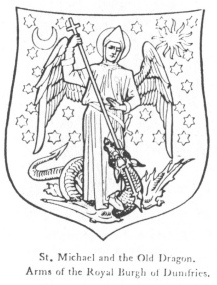
Today, as I reflect on the Feast of St. Michael and All Angels, I'm struck by what the iconography teaches about our spiritual warfare. Look at these pictures and tell me what you notice.


Seeing a common theme, yet?

Try noticing where the spear is placed.

Do you see it?

ALWAYS AT THE MOUTH.

(The same is true in the iconography of St. George, Patron protector of England, whose shield has been adopted as the symbol for the Anglican Church in North America.)
Why?

Because Satan's greatest tool is deception!

Our spiritual warfare consists of being sanctified in the truth and casting down arguments that hold themselves up against the truth of Christ. It's not easy - and in an age that appreciates the appearance of substance rather than substance itself - it can get you labeled as "mean" or "intolerant" or "narrow-minded."

But remember that the highest messenger of God (literal translation of archangel) is so because he constantly destroys the lies of the devil, robbing him of power in the world.

Go and do likewise.

(Here's some help.)

Holy Michael, the Archangel, defend us in battle. Be our safeguard against the wickedness and snares of the devil. May God rebuke him, we humbly pray; and do you, O Prince of the heavenly host, by the power of God cast into hell Satan and all the evil spirits who wander through the world seeking the ruin of souls. Amen.
The Prayer of Leo XIII
to be said after Mass