From 6dollarshirts...how can you go wrong?
2009-07-24


Reading Habits?
The BBC believes most people will have only read 6 of the 100 books here. How do your reading habits stack up?
Instructions:
Copy this into your Blog or FB NOTES. Look at the list and put an 'x' after those you have read. Tag other "Book Nerds."
1 Pride and Prejudice - Jane Austen X
2 The Lord of the Rings - JRR Tolkien X
3 Jane Eyre - Charlotte Bronte
4 Harry Potter series - JK Rowling
5 To Kill a Mockingbird - Harper Lee X
6 The Bible X
7 Wuthering Heights - Emily Bronte
8 Nineteen Eighty Four - George Orwell X
9 His Dark Materials - Philip Pullman
10 Great Expectations - Charles Dickens
Total: 5
11 Little Women - Louisa M Alcott X
12 Tess of the D’Urbervilles - Thomas Hardy
13 Catch 22 - Joseph Heller X
14 Complete Works of Shakespeare X
15 Rebecca - Daphne Du Maurier
16 The Hobbit - JRR Tolkien X
17 Birdsong - Sebastian Faulk
18 Catcher in the Rye - JD Salinger X
19 The Time Traveler’s Wife - Audrey Niffenegger
20 Middlemarch - George Eliot
Running Total: 10
21 Gone With The Wind - Margaret Mitchell
22 The Great Gatsby - F Scott Fitzgerald X
23 Bleak House - Charles Dickens
24 War and Peace - Leo Tolstoy
25 The Hitch Hiker’s Guide to the Galaxy - Douglas Adams
26 Brideshead Revisited - Evelyn Waugh
27 Crime and Punishment - Fyodor Dostoyevsky X
28 Grapes of Wrath - John Steinbeck X
29 Alice in Wonderland - Lewis Carroll X
30 The Wind in the Willows - Kenneth Grahame X
running total: 15
31 Anna Karenina - Leo Tolstoy
32 David Copperfield - Charles Dickens
33 Chronicles of Narnia - CS Lewis X
34 Emma-Jane Austen
35 Persuasion - Jane Austen
36 The Lion, The Witch and The Wardrobe - CS Lewis X
37 The Kite Runner - Khaled Hosseini
38 Captain Corelli’s Mandolin - Louis De Bernieres
39 Memoirs of a Geisha - Arthur Golden
40 Winnie the Pooh - AA Milne X
Running total: 18
41 Animal Farm - George Orwell X
42 The Da Vinci Code - Dan Brown X
43 One Hundred Years of Solitude - Gabriel Garcia Marquez
44 A Prayer for Owen Meaney - John Irving X
45 The Woman in White - Wilkie Collins
46 Anne of Green Gables - LM Montgomery X
47 Far From The Madding Crowd - Thomas Hardy
48 The Handmaid’s Tale - Margaret Atwood X
49 Lord of the Flies - William Golding X
50 Atonement - Ian McEwan
Running total: 24
51 Life of Pi - Yann Martel
52 Dune - Frank Herbert X
53 Cold Comfort Farm - Stella Gibbons
54 Sense and Sensibility - Jane Austen
55 A Suitable Boy - Vikram Seth
56 The Shadow of the Wind - Carlos Ruiz Zafon
57 A Tale Of Two Cities - Charles Dickens
58 Brave New World - Aldous Huxley X
59 The Curious Incident of the Dog in the Night - Mark Haddon
60 Love In The Time Of Cholera - Gabriel Garcia Marquez X
Running total: 27
61 Of Mice and Men - John Steinbeck X
62 Lolita - Vladimir Nabokov X
63 The Secret History - Donna Tartt
64 The Lovely Bones - Alice Sebold
65 Count of Monte Cristo - Alexandre Dumas
66 On The Road - Jack Kerouac X
67 Jude the Obscure - Thomas Hardy X
68 Bridget Jones’s Diary - Helen Fielding
69 Midnight’s Children - Salman Rushdie
70 Moby Dick - Herman Melville X
Running total: 32
71 Oliver Twist - Charles Dickens
72 Dracula - Bram Stoker X
73 The Secret Garden - Frances Hodgson Burnett X
74 Notes From A Small Island - Bill Bryson
75 Ulysses - James Joyce
76 The Inferno – Dante X
77 Swallows and Amazons - Arthur Ransome
78 Germinal - Emile Zola
79 Vanity Fair - William Makepeace Thackeray
Running total: 35
80 Possession - AS Byatt
81 A Christmas Carol - Charles Dickens X
82 Cloud Atlas - David Mitchell
83 The Color Purple - Alice Walker X
84 The Remains of the Day - Kazuo Ishiguro
85 Madame Bovary - Gustave Flaubert
86 A Fine Balance - Rohinton Mistry
87 Charlotte’s Web - EB White X
88 The Five People You Meet In Heaven - Mitch Albom
89 Adventures of Sherlock Holmes - Sir Arthur Conan Doyle X
90 The Faraway Tree Collection - Enid Blyton
Running total: 39
91 Heart of Darkness - Joseph Conrad X
92 The Little Prince - Antoine De Saint Exeupery X
93 The Wasp Factory - Iain Banks
x94 Watership Down - Richard Adamson X
95 A Confederacy of Dunces - John Kennedy Toole X
96 A Town Like Alice - Nevil Shute
97 The Three Musketeers - Alexandre Dumas X
98 Hamlet - William Shakespeare X
99 Charlie and the Chocolate Factory - Roald Dahl X
100 Les Miserables - Victor Hugo X
TOTAL: 47
To be fair, some of these are reduplications. Shakespeare's complete works are inclusive of Hamlet, as Lewis' Chronicles are of the L,W,&W.
And if you haven't read A Confederacy of Dunces...do. A friend once introduced it in an essay as "What if Holden Caufield grew up?"
PS - It's only fair to mention that my BA is in English Lit....so some of these weren't by choice.
PPS - If Pride & Prejudice seems too much to handle, check out the zombie version!
2009-07-23
2009-07-20
2009-07-17
Camping Fun Fail
Behold the abomination that is the  Microwave S'mores Maker brings the fun of a campfire to your kitchen! Microwaveable dish makes two s'mores treats in just 30 seconds, allowing you to heat graham crackers, marshmallows and chocolate evenly at the same time. Just add water, lift arms and assemble s'mores, lower arms, microwave and enjoy! Dishwasher-safe plastic. Includes instructions. 7 1/2" W x 6 1/4" D x 4" H.
Hey Harriet Carter...you're doing it wrong.
Microwave S'Mores Maker
Microwave S'mores Maker brings the fun of a campfire to your kitchen! Microwaveable dish makes two s'mores treats in just 30 seconds, allowing you to heat graham crackers, marshmallows and chocolate evenly at the same time. Just add water, lift arms and assemble s'mores, lower arms, microwave and enjoy! Dishwasher-safe plastic. Includes instructions. 7 1/2" W x 6 1/4" D x 4" H.Hey Harriet Carter...you're doing it wrong.
2009-07-16
Hetero or not?
Online dictionaries define the adjectives "autological" and "heterological" as follows:
- A word is autological if and only if it describes itself. For example "short" is autological, since the word "short" is short. "Sophisticated" and "polysyllabic" are also autological.
- A word is heterological if and only if it does not describe itself. Hence "long" is a heterological word, as is "monosyllabic".
Since autological and heterological are opposites, all words are members of either the set of "autological" words, or the set of "heterological" words.
The paradox is this: is the word "heterological" heterological?
There is no consistent answer: if it is, then it isn't; if it isn't, then it is.
2009-07-14
2009-07-13
Psalm 2 for the Christians of Iraq
For the persecuted Christians of Iraq, who have had seven churches bombed in the last three days. Christians...they don't hate you; they hate Christ.
From Archbishop Parker's Psalter, set to music by Thomas Tallis.
From Archbishop Parker's Psalter, set to music by Thomas Tallis.

 | Thomas Tallis - Third Mode Melody |  |
 | ||
 | Found at bee mp3 search engine |  |
Psalme. II.
The Argument. Psalme. II.
Of Christ ye see
A Prophecie
Thus Dauid spake with vs:
As merueiling
That earthly king
Should rage against him thus
Quare fremuerunt.
1. Why fumeth in sight: the Gentils spite,
In fury raging stout?
Why taketh in hond: the people fond,
Uayne thinges to bring about?
2. The kinges arise: the lordes deuise,
in counsayles mett therto:
Agaynst the Lord: with false accord,
against his Christ they go.
3. Let vs they say: breake downe their ray,
of all their bondes and cordes:
We will renounce: that they pronounce,
their loores as stately lordes.
4. But God of might: in heauen so bright,
Shall laugh them all to scorne:
The Lord on hie: shall them defie,
they shall be once forlorne.
5. Then shall his ire: speake all in fire,
to them agayne therfore:
He shall with threate: their malice beate,
in his displeasure sore.
6. Yet am I set: a king so great,
on Sion hill full fast:
Though me they kill: yet will that hill,
my lawe and worde outcast.
7. Gods wordes decreed: I (Christ) wil sprede
for God thus sayd to me/e:
My sonne I say: thou art, this day,
I haue begotten the/e.
8. Aske thou of me/e: I will geue the/e,
to rule all Gentils londes:
Thou shalt possesse: in suernesse,
the world how wide it stondes.
9. With iron rod: as mighty God,
all rebels shalt thou bruse:
And breake them all: in pieces small,
as sherdes the potters vse.
10. Be wise therfore: ye kinges the more,
Receyue ye wisdomes lore:
Ye iudges strong: of right and wrong,
aduise you now before.
11. The Lorde in feare: your seruice beare,
with dread to him reioyce:
Let rages be: resist not ye,
him serue with ioyfull voyce.
12. The sonne kisse ye: lest wroth he be,
lose not the way of rest:
For when his ire: is set on fire,
who trust in hym be blest.
And this is how it sounds in their native liturgical Syriac.
Hobbit House
My wife thinks I'm crazy for wanting to live under the earth. But I think it makes a lot of sense, ecologically and from a security standpoint. Now that I've seen this, I also have the aesthetic argument wrapped up!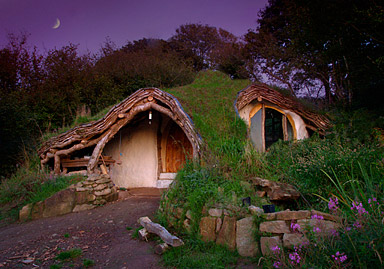 Some key points of the design and construction:


Some key points of the design and construction: - Dug into hillside for low visual impact and shelter
- Stone and mud from diggings used for retaining walls, foundations etc.
- Frame of oak thinnings (spare wood) from surrounding woodland
- Reciprocal roof rafters are structurally and aesthaetically fantastic and very easy to do
- Straw bales in floor, walls and roof for super-insulation and easy building
- Plastic sheet and mud/turf roof for low impact and ease
- Lime plaster on walls is breathable and low energy to manufacture (compared to cement)
- Reclaimed (scrap) wood for floors and fittings
- Anything you could possibly want is in a rubbish pile somewhere (windows, burner, plumbing, wiring...)
- Woodburner for heating - renewable and locally plentiful
- Flue goes through big stone/plaster lump to retain and slowly release heat
- Fridge is cooled by air coming underground through foundations
- Skylight in roof lets in natural feeling light
- Solar panels for lighting, music and computing
- Water by gravity from nearby spring
- Compost toilet
- Roof water collects in pond for garden etc.
2009-07-10
Calvin on the Lord's Supper

Originally published in The Churchman, Matt Mason's articulation of evangelical Anglican appropriation of Calvin's eucharistic theology makes me proud to stand in both the Presbyterian and Anglican stream of the reform of the Church.
This'll whet your appetite:
Before considering his view of the Supper, it will be helpful to grasp his theology of the sacraments generally. For Calvin, sacraments arean aid to our faith related to the preaching of the gospel…an outward sign by which the Lord seals on our consciences the promises of his goodwill toward us in order to sustain the weakness of our faith; and we in turn attest our piety towards him in the presence of the Lord and of his angels and before men.[30]
Three things are noteworthy. Firstly, sacraments are related to the preaching of the gospel: ‘a sacrament is never without a preceding promise but is joined to it as a sort of appendix.’[31] But, when joined to the Word, they ‘have the same office as the Word of God: to offer and set forth Christ to us, and in him the treasures of heavenly grace.’[32] Their primary direction is therefore God to us, not us to God, in contrast to the Roman Mass. Secondly, as an outward sign and seal the sacraments assure us that God’s promises are reliable. It is not that the Word is insufficient; nevertheless we are weak, and so God in his grace provides seals, like those on government documents, to assure us of the truth of his promises.[33]
The sacraments do what the Word does, but better, because they also contain a visible component:[34] ‘The sacraments bring the clearest promises; and they have this characteristic over and above the word because they represent them for us as painted in a picture from life.’[35] Thus, they make the Word ‘more vivid and sure.’[36] Thirdly, sacraments do not, contra Rome, work ex opere operato. They must be received by faith: this is the God-ward movement as, in response to his promises, we attest our piety.[37] However, even this God-ward movement is dependent on God’s prior, gracious activity. The Spirit must work through the sacraments to confirm our faith. They
properly fulfil their office only when the Spirit…comes to them, by whose power alone hearts are penetrated and affections moved and our soul opened for the sacraments to enter in.[38]
Within this context, Calvin views the Supper as a banquet, whereby we feed on Christ.[39] Christ himself is ‘the only true food of our soul,’[40] but God gives ‘visible signs best adapted to our small capacity.’[41] The Supper is thus a covenant sign and seal, annexed to God’s Word.[42] Hence, Calvin agrees with Luther and Zwingli, against Rome, that the Word of God is indispensable to right administration.
Tongue-in-Cheek Hymns for Calvin's Birthday
 "Jesus Loves Me, This I Think"
Jesus loves me, this I think,
If I’m wrong, to Hell I’ll sink.
Little ones to Him belong
To save or damn, for He is strong.
Yes, He may love me,
And has elected
Or else rejected
Me ere the world began.
"Arminian 'Grace'"
Arminian “grace!” How strange the sound,
Salvation hinged on me.
I once was lost then turned around,
Was blind then chose to see.
What “grace” is it that calls for choice,
Made from some good within?
That part that wills to heed God’s voice,
Proved stronger than my sin.
Through many ardent gospel pleas,
I sat with heart of stone.
But then some hidden good in me,
Propelled me toward my home.
When we’ve been there ten thousand years,
Because of what we’ve done,
We’ve no less days to sing our praise,
Than when we first begun.
Shamelessly ganked from fellow-presbyter Drew Collins. Image from Cruciality.
Calvin on Confession
 Now let us cast ourselves down before the majesty of our good God, conscious of our faults, praying that he may not only forgive us but may daily cleanse us of them. May he remove them far from us. so that we are no longer captive and imprisoned by them. Rather, led and controlled by his Holy Spirit, may we walk in such holiness of life that we may seek above all to yield to his will. And since we know ourselves to be such weak and feeble creatures, may he support us in all our imperfections, until he has rid us of them and fully clothes us with his righteousness.
Happy Birthday John Calvin!

500 years ago, God gave a great gift to the Church. While he's so well remembered as a theologian, we do him a great disservice in forgetting that he was a pastor. His most especial duty as a pastor was the preaching of the word, which he did a minimum of five days a week (often six). Calvin's sermons deserve to be read. Moreover, his dedication to the pure preaching of the word deserves to be emulated in the deadened pulpits of our day. T. H. L. Parker’s 1975 biography tells why:
And so we trace him preaching on Sundays with one hundred and eighty-nine sermons on the Acts between 1549 and 1554, a shorter series on some of the Pauline letters between 1554 and 1558, and the sixty-five on the Harmony of the Gospels between 1559 and 1564. During this time the weekdays saw series on Jeremiah and Lamentations (up to 1550), on the Minor Prophets and Daniel (1550-2), the one hundred and seventy-four on Ezekiel (1552-4), the one hundred and fifty-nine on Job (1554-5), the two hundred on Deuteronomy (1555-6), the three hundred and forty-two on Isaiah (1556-9), then one hundred twenty-three on Genesis (1559-61), a short set on Judges (1561), one hundred and seven on 1 Samuel and eighty-seven on 2 Samuel (1561-3) and a set on 1 Kings (1563-4).
Before he smiles at such unusual activity of the pulpit, the reader would do well to ask himself whether he would prefer to listen to the second-hand views on a religion of social ethics, or the ill-digested piety, delivered in slipshod English, that he will hear today in most churches of whatever denomination he may enter, or three hundred and forty-two sermons on the Book of the Prophet Isaiah, sermons born of an infinite passion of faith and a burning sincerity, sermons luminous with theological sense, lively with wit and imagery, showing depths of compassion and the unquenchable joyousness of hope. Those in Geneva who listened Sunday after Sunday, day after day, and did not shut their ears, but were “instructed, admonished, exhorted, and censured,” received a training in Christianity such as had been given to few congregations in Europe since the days of the fathers. (92)
Thank you, John Calvin, for believing in the majesty of the word and for demonstrating by your life the glory of preaching the Bible.
And for making it look easy!
2009-07-09

John MacArthur on Intolerable Christianity
In these postmodern times, tolerance is the supreme virtue of the public square. Tolerant people can be broad thinkers, open-minded, and charitable to every worldview—every worldview, that is, except biblical Christianity. The authoritative demands of Jesus Christ are beyond the threshold of postmodern tolerance.
In this postmodern era, one virtue is esteemed above all others: tolerance. As a matter of fact, tolerance may soon be the only virtue secular society will embrace. Many traditional virtues (including humility, self-control, and chastity) have already fallen out of public favor and in some quarters are openly scorned or even regarded as transgressions.
Instead, with the beatification of tolerance, what was once forbidden is now encouraged. What was once universally deemed immoral is now celebrated. Marital infidelity and divorce have been normalized. Profanity is commonplace. Abortion, homosexuality, and moral perversions of all kinds are championed by large advocacy groups and tacitly encouraged by the popular media. The modern notion of “tolerance” is systematically turning morality on its head.
Just about the only remaining taboo is the naive and politically incorrect notion that another person’s “alternative lifestyle,” religion, or different perspective is wrong.
One major exception to that rule stands out starkly: it is OK to be intolerant of biblical Christianity. In fact, those who fancy themselves the leading advocates of religious tolerance today are often the most outspoken opponents of evangelical Christianity. A classic example of this is the Web site at religioustolerance.org. Page after page at that Web site lambastes Bible-based Christianity. It is one of the most bitterly anti-Christian sites on the World Wide Web.
Why is that? Why does authentic biblical Christianity find such ferocious opposition among today’s self-styled champions of “religious tolerance”?
It is because Christianity is diametrically opposed to the postmodern ideas that have made this an age of “tolerance.” Here are six key concepts that set Christianity in opposition to the very spirit of our age:
1. Objectivity
True Christianity starts from the premise that there is a source of truth outside of us. God’s Word is truth (Psalm 119:160; John 17:17). It is objectively true—meaning it is true whether it speaks subjectively to any given individual or not; it is true regardless of how anyone feels about it; it is true in an absolute sense.
Of course this existential generation finds such a view utterly distasteful. People prefer to seek truth inside themselves. If they contemplate the meaning of Scripture at all, it is usually only in terms of “what this verse means to me”—as if the message of Scripture were unique to every individual.
But authentic Christianity regards Scripture as the objective revelation of God’s truth. It is God’s Word to humanity, and its true meaning is determined by God; it is not something that can be shaped according to the preferences of individual hearers.
2. Rationality
Biblical Christianity is also based on the conviction that the objective revelation of Scripture is rational. The Bible makes good sense. It contains no contradictions, no errors, and no unsound principles. Anything that does contradict Scripture is untrue.
That sort of rationality is antithetical to the whole gist of postmodern thought. People today are taught to glorify contradiction, embrace that which is absurd, prefer that which is subjective, and let feelings (rather than intellect) determine what they believe. But such irrationality is nothing less than an overt rejection of the very concept of truth.
As Christians, we know that God cannot lie (Titus 1:2). He does not contradict Himself. His truth is perfectly self-consistent. That sort of black-and-white rationality is one of the main reasons biblical Christianity is intolerable in a generation that rejects reason.
3. Veracity
Authentic Christianity is based on the conviction that God’s objective revelation (the Bible) approached rationally yields divine truth in perfectly sufficient measure. Everything we need to know for life and godliness is there for us in Scripture. We don’t need to seek principles for godly or successful living through any other source. Scripture is not only wholly truth; it is also the highest standard of all truth—the rule by which all truth-claims must be measured.
Such a conviction is the very antithesis of the postmodern notion of “tolerance.” And that is another major reason why Christianity has been targeted by the proponents of postmodern “tolerance.”
4. Authority
Because Christians believe Scripture is true, they teach its precepts with authority and without apology.
The Bible makes bold claims, and faithful Christians affirm it boldly and without compromise. That, too, is a profound threat to the “tolerance” of a society that loves its sin and thinks of compromise as a good thing.
5. Incompatibility
Scripture says, “No lie is of the truth” (1 John 2:21). As Christians, we know that whatever contradicts truth is by definition false. In other words, truth is incompatible with error.
Jesus Himself affirmed the utter exclusivity of Christianity. He said, “I am the way, the truth, and the life. No one comes to the Father except through Me” (John 14:6). “Nor is there salvation in any other, for there is no other name under heaven given among men by which we must be saved” (Acts 4:12). That sort of exclusivity is utterly incompatible with postmodern notions of “tolerance.”
Moreover, as Christians we understand that whatever opposes God’s Word or departs from it in any way is a danger to the very cause of truth. Genuine Christians therefore eschew passivity toward known error—and that too has set the postmodern defenders of “tolerance” against us.
6. Integrity
Since all of the above is true, genuine Christianity sees integrity as an essential virtue and hypocrisy as a horrible vice. Such a mind-set is virtually the antithesis of postmodern “tolerance,” and it is yet another reason our society despises our faith.
Unfortunately, the church in our generation is drifting from these fundamental convictions and has already begun to embrace postmodern ideas uncritically. Evangelicalism is quickly losing its footing, and the church is becoming more and more like the world. Fewer and fewer Christians are willing to stand against the trends, and the effects have been disastrous. Subjectivity, irrationality, worldliness, uncertainty, compromise, and hypocrisy have already become commonplace among churches and organizations that once constituted the evangelical mainstream.
The only cure, I am convinced, is a conscious, wholesale rejection of postmodern values and a return to these six distinctives of biblical Christianity. We must be faithful to guard the treasure of truth that has been entrusted to us (2 Timothy 1:14). If we do not, who will?
2009-07-08
Proud to be from Tennessee!
Some of you may have figured out that I feel blessed to be an American, and specifically from the South. And even though I'm dangerously close to being a midwesterner by location, in my heart I'm still a Volunteer. So I was excited to read how late last month, Tennessee Governor Phil Bredesen signed House Joint Resolution 108 (HJR0108), authored by State Rep. Susan Lynn. The resolution “Urges Congress to recognize Tennessee’s sovereignty under the tenth amendment to the Constitution.”
The House passed the resolution on 05/26 by a vote of 85-2 and the Senate passed it on 06/12 by a vote of 31-0. The text is below.
WHEREAS, the Tenth Amendment to the Constitution of the United States reads as follows: “The powers not delegated to the United States by the Constitution, nor prohibited by it to the States, are reserved to the States respectively, or to the people”; and
WHEREAS, the Tenth Amendment defines the total scope of federal power as being that specifically granted by the Constitution of the United States and no more; and
WHEREAS, the scope of power defined by the Tenth Amendment means that the federal government was created by the states specifically to be an agent of the states; and
WHEREAS, today, in 2009, the states are demonstrably treated as agents of the federal government; and
WHEREAS, the United States Supreme Court has ruled in New York v. United States, 112 S. Ct. 2408 (1992), that Congress may not simply commandeer the legislative and regulatory processes of the states; now, therefore,
BE IT RESOLVED BY THE HOUSE OF REPRESENTATIVES OF THE ONE HUNDRED SIXTH GENERAL ASSEMBLY OF THE STATE OF TENNESSEE, THE SENATE
CONCURRING, that we hereby affirm Tennessee’s sovereignty under the Tenth Amendment to the Constitution of the United States over all powers not otherwise enumerated and granted to the federal government by the Constitution of the United States.
BE IT FURTHER RESOLVED, that a committee of conference and correspondence be appointed by the Speaker of the House and of the Senate, which shall have as its charge to communicate the preceding resolution to the legislatures of the several states, to assure them that this State continues in the same esteem of their friendship and to call for a joint working group between the states to enumerate the abuses of authority by the federal government and to seek repeal of the assumption of powers and the imposed mandates.
BE IT FURTHER RESOLVED, that a certified copy of this resolution be transmitted to the President of the United States, the President of the United States Senate, the Speaker and the Clerk of the United States House of Representatives, and to each member of Tennessee’s Congressional delegation.

2009-07-07
I invoke Godwin's Law
Okay...I know I'm starting to sound like a broken record, but...
 The Goracle has tripped to the ridiculous...he's now saying that global warming (or, more properly, skeptics of anthropogenic global warming) is the Nazism of our time.
So, I guess he's using Godwin's Law to shut down the argument since - despite his constant crowing - the science is still unsettled.
P.S. - Hey sunspots, welcome back!
The Goracle has tripped to the ridiculous...he's now saying that global warming (or, more properly, skeptics of anthropogenic global warming) is the Nazism of our time.So, I guess he's using Godwin's Law to shut down the argument since - despite his constant crowing - the science is still unsettled.
P.S. - Hey sunspots, welcome back!
4th C. Manuscript seeks 21st C. Scanner for Textual Healing

Codex Sinaiticus is finally online.
Now I feel bad for sneaking those non-flash pictures in the British Library...

(source)
2009-07-06
Zombies on TAP
I'm not normally a reader of The American Prospect, but this article drew my attention. 
Granted, I disagree with his conclusion about the nature of the genre (i.e., being essentially progressive, read American liberalism). But it is true that the genre is fundamentally concerned with challenging status quo and seeking to understand what is essential to human civilization.
However, I think that the disintegration and ineffectiveness of government is a key element of the genre. Also, the rugged independence / self-reliance that is key to both short and long-term survival in the genre. These are values generally regarded as the domain of the "right"...so I'm not sure the genre has a particularly political bent (unless you want to take a libertarian view of things...).
Subscribe to:
Posts (Atom)