2010-08-25

Magnificat Hymnic setting


One of the greatest canticles of the Church is the Magnificat, or the Canticle of Mary. It is traditionally sung every evening at Vespers or Evening Prayer. The settings of it are plethora, as is fitting for a song sung every night throughout the year. However, I've recently come upon one I wanted to share. It's set to the familiar tune UFFINGHAM (LM) by Brian Penney. You can listen to it in parts or in full choir here.


And of course if you're going to do this in a Solemn Evensong setting, don't forget the incense!

2010-08-24

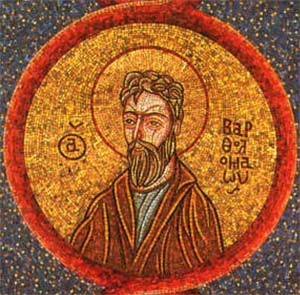
Feast of St. Bartholomew, Apostle

The name "Bartholomew" appears in the New Testament only on lists of the names of the twelve apostles. This list normally is given as six pairs, and the third pair in each of the Synoptics is "Philip and Bartholomew" (M 10:3; P 3:18; L 6:14; but A 1:15).


John gives no list of the Twelve, but refers to more of them individually than the Synoptists. He does not name Bartholomew, but early in his account (John 1:43-50) he tells of the call to discipleship of a Nathaniel who is often supposed to be the same person. The reasoning is as follows: John's Nathanael is introduced as one of the earliest followers of Jesus, and in terms which suggest that he became one of the Twelve. He is clearly not the same as Peter, Andrew, James, John, Philip, Thomas, Judas Iscariot, Judas (not Iscariot, also called Lebbaeus or Thaddeus), all of whom John names separately. He is not Matthew, whose call is described differently (M 9:9). This leaves Bartholomew, James the son of Alpheus, and Simon Zelotes. Of these, Bartholomew is the leading candidate for two reasons:

(1) "Bar-tholomew" is a patronymic, meaning "son of Tolmai (or Talmai)." It is therefore likely that he had another name. (A historical novel which may not be well researched informs me that a first-century Jew would be likely to use the patronymic instead of the forename as a mark of respect in speaking to a significantly older Jew.) "Nathanael son of Tolmai" seems more likely than "Nathanael also called James (or Simon)."
(2) Nathanael is introduced in John's narrative as a friend of Philip. Since Bartholomew is paired with Philip on three of our four lists of Apostles, it seems likely that they were associated.

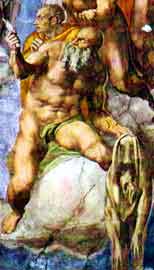
We have no certain information about Bartholomew's later life. Some writers, including the historian Eusebius of Caesarea (now Har Qesari, 32:30 N 34:54 E, near Sedot Yam), say that he preached in India. The majority tradition, with varying details, is that Bartholomew preached in Armenia, and was finally skinned alive and beheaded to Albanus or Albanopolis (now Derbent, 42:03 N 48:18 E) on the Caspian Sea. His emblem in art is a flaying knife. The flayed Bartholomew can be seen in Michelangelo's Sistine painting of the Last Judgement. He is holding his skin. The face on the skin is generally considered to be a self-portrait of Michelangelo.

Readings:

Psalm 91 or 91:1-4
Deuteronomy 18:15-18
1 Corinthians 4:9-15
Luke 22:24-30

Preface of Apostles

PRAYER (traditional language)

Almighty and everlasting God, who didst give to thine apostle Bartholomew grace truly to believe and to preach thy Word: Grant that thy Church may love what he believed and preach what he taught; through Jesus Christ our Lord, who liveth and reigneth with thee and the Holy Ghost, one God for ever and ever.

PRAYER (contemporary language)
Almighty and everlasting God, who gave to your apostle Bartholomew grace truly to believe and to preach your Word: Grant that your Church may love what he believed and preach what he taught; through Jesus Christ our Lord, who lives and reigns with you and the Holy Spirit, one God for ever and ever.

2010-08-23

A New Prayer Book


I have a feeling that some of the AC-NA folks are going to be really upset no matter what form the prayer book revision takes. Let's hope it's received better than the BCP was received in Scotland!

2010-08-11

Lighting the Way

Church lights (candles) symbolize God’s Presence in the sanctuary and the spiritual enlightenment His Gospel brings our lives. Roman practice differs slightly, but in the main carries the same symbolism. Looking at the chancel (by the communion rails) in most churches, we see two major lights. First on the Gospel (left side) we see a small red light mounted on the wall. This is the Altar Lamp that burns in honor of the constant Real Presence in the reserve Sacrament (consecrated wine and host) kept in the tabernacle / aumbry - a small, ornate box centered on the back portion of the Holy Table. or on a wall nearby.


The other major lights are the candles on the Holy Table, divided into two groups, signifying Jesus in both His divine and human natures. At many parishes, you’ll see two groups of three each on the back of the Table, called “Office Lights,” lit when conducting the offices of the Church, such as Morning/Evening Prayer, Holy Matrimony, or Funeral services. In other parishes, there will simply be two larger pillar candles beside the Holy Table which are lit for the same purpose.


The two lights in front of these - or directly on the table - are the Communion Lights, used during the Eucharist. All the lights echo Christ’s words, when He said, “I am the Light of the World” (St. John 8:12) and other passages referring to God’s light, such as St. Matt. 4:16 and St. Luke 2:32.


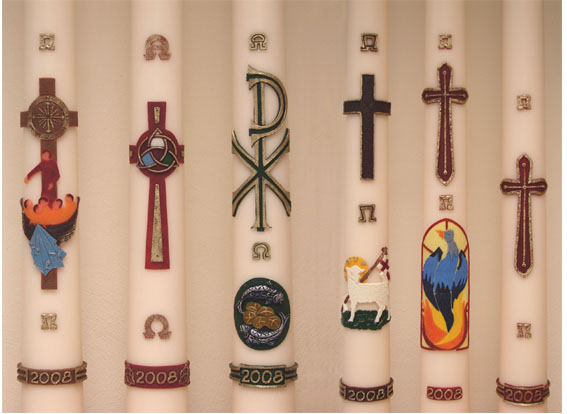
The last light in many churches is the Paschal Candle. This is a large white candle normally kept our of sight, or next to the baptismal font. The candle is blessed every year at the Easter Vigil service, having the year inscribed on it and (traditionally) five grains of incense inserted into in in the shape of a cross. It is often decorated with other signs of the resurrection as well. Some parishes - especially those with elaborate Holy Saturday / Easter Vigil services - have special rituals surrounding the entrance of the Paschal candle. These rituals can include chanting the Exultet (normally done by a deacon), dipping the base of the candle in the baptismal font, and using this candle to light the tapers that will ignite the rest of the office and communion lights. (This practice is especially important in parishes that light a Paschal fire near the entrance of the church door for the vigil.) The candle is brought to the front of the church from Easter until the Ascension (when its removal visually symbolizes Christ's immediate light being taken from our presence). Then the candle is either stored or kept near the font. However, for baptisms and funerals (which, for Christians, is the completion of our baptismal death into Christ), the candle returns to a prominent place. I should also note that this is a Western / Latin Rite practice. The East uses a different type of candle. However, this practice antedates Jerome - and was clearly a common practice long before the Council of Nicea.


The candles recall times when ancient Christians met at night to avoid discovery and needed the lights to worship, but are retained to remind us of those days and to focus us on our Heavenly Father of Lights. Scriptural authority is solid for their use—found in Ex 25:31 & 40:25, Lev 24:2 & II Chron 13:11— and reminds us—we carry the Light of Christ!

2010-08-06

Eat it Chopra!


It's always fun to watch a relativist hoisted on his own petard.

Yes we can


But should we?

From politics to science to economics to religion, the ability to do something doesn't mean that it is right for us to do something. To often, drunk with our own power, we rush to do something simply because we can - rather than thinking through why the limitation was there in the first place. Chesterton put it this way:
"In the matter of reforming things, as distinct from deforming them, there is one plain and simple principle; a principle which will probably be called a paradox. There exists in such a case a certain institution or law; let us say, for the sake of simplicity, a fence or gate erected across a road. The more modern type of reformer goes gaily up to it and says, "I don't see the use of this; let us clear it away." To which the more intelligent type of reformer will do well to answer: "If you don't see the use of it, I certainly won't let you clear it away. Go away and think. Then, when you can come back and tell me that you do see the use of it, I may allow you to destroy it."

-- The Thing, in "The Drift from Domesticity" (1929)
California, I'm looking at you.

2010-08-05

The American Dream

From Salon.com

For a generation, most Americans have been told by left, right and center that they would be failures if they ended their educations with high school, worked hard, saved cash for emergencies and bought modest homes they could afford. They have been told that to succeed in life they need to ape the lifestyles of the upper middle class that provides most of America’s politicians, pundits and scholars.

The result has been an experiment in social engineering that has gone horribly wrong: the creation of a faux mass upper middle class. Millions of Americans who by objective standards belong to the working class or lower middle class have persuaded themselves that they are part of the professional-investor elite, because they have worthless degrees from diploma mills, negligible amounts invested in stocks, and suburban trophy houses they cannot afford. For the college graduates at Starbucks working to pay off student loans for degrees that they will never use, as for the millions of Americans who are now "underwater," owing more on their mortgages than their houses are worth, the American dream has turned into a nightmare.

Read it all here...

2010-08-02

Why we need vouchers


I'm a homeschooler. Our current tax code doesn't let me deduct a single penny for educational expenses; nor is there a penny of help. (And obviously, we don't get a child care deduction or credit because my wife is home.)

How much education could YOU buy in your area if you had even $5000 to spend per child?e

2010-08-01

Happy Lammas Day!

Today is either Lammas Day, the Feast of St. Peter's Chains, or the commemoration of Joseph of Arimathea...depending on your churchmanship and culture. Whatever else it is, today is the Lord's Day. Rejoice and be glad in it! (Psalm 2)

2010-07-26

Sermon for Proper12C

Proper12C Knowing God, Pleading with God from Fr. Chris Larimer on Vimeo.

A sermon preached at Holy Apostles in Elizabethtown, KY. The texts are Genesis 18, Colossians 2, and Luke 11. It begins with a 2 minute childrens message. The sermon is 26 minutes long (there's some unnecessary space at the end).

2010-07-24

2010-07-02

It must be GA time again!


This is what happens when the PCUSA's General Assembly commissioners get together and pray for a sign about what to do on TEH GAY.

If they'd just quit asking themselves what their members want, and instead listen to what God commands there would be a much simpler answer.

2010-06-29

Feast of Ss. Peter & Paul

These two have been on my mind as I've been working through Galatians (where Paul recounts setting Peter back on the path from the Judaizing heresy). I'm thankful for both of them: Peter gave the Church a pastoral and confessional interest, Paul gave the Church her rigorous theology. Thanks be to God for both of these wonderful men!

The Confession of Peter ("Thou art the Christ, the Son of the Living God") is commemorated on 18 January, and the Conversion of Paul (on the approach to Damascus) a week later on 25 January. On 29 June we commemorate the martyrdoms of both apostles. The date is the anniversary of a day around 258, under the Valerian persecution, when what were believed to be the remains of the two apostles were both moved temporarily to prevent them from falling into the hands of the persecutors.

Statue of St.  Peter, in St. Peter's SquareStatue of St.  Paul, in St. Peter's Square

The Scriptures do not record the deaths of Peter or Paul, or indeed any of the Apostles except for James the son of Zebedee (Acts 12:2), but they are clearly anticipated (see the readings below), and from an early date it has been said that they were martyred at Rome at the command of the Emperor Nero, and buried there. As a Roman citizen, Paul would probably have been beheaded with a sword. It is said of Peter that he was crucified head downward. The present Church of St Peter in Rome replaces earlier churches built on the same site going back to the time of the Emperor Constantine, in whose reign a church was built there on what was believed to be the burial site of Peter. Excavations under the church suggest that the belief is older than Constantine.

St. Augustine writes (Sermon 295):
Both apostles share the same feast day, for these two were one; and even though they suffered on different days, they were as one. Peter went first, and Paul followed. And so we celebrate this day made holy for us by the apostles' blood. Let us embrace what they believed, their life, their labors, their sufferings, their preaching, and their confession of faith.

The Crucifixion of St. Peter, by CaravaggioFIRST READING: Ezekiel 34:11-16
(The LORD God will be a shepherd to Israel, and they shall be His flock.)

PSALM 87
(The foundations of Zion, the city of God, rest upon the holy hills. Of many nations it shall be said: In Zion were they born.)

EPISTLE: 2 Timothy 4:1-8
(Paul writes: "I am now ready to be offered, and the time of my departure is at hand. I have fought a good fight, I have finished the course, I have kept the faith.")

THE HOLY GOSPEL: John 21:15-19
(Jesus, after rising from the dead, said to Peter: "When you were young, you went where you would, but when you are old, you will go where you are taken." And by these words, He foretold Peter's death. He then said, "Follow me.")


Almighty God, whose blessed apostles Peter and Paul glorified thee by their martyrdom: Grant that thy Church, instructed by their teaching and example, and knit together in unity by thy Spirit, may ever stand firm upon the one foundation, which is Jesus Christ our Lord; who liveth and reigneth with thee, in the unity of the same Spirit, one God, for ever and ever.

2010-06-27

Getting weary yet?

5"If you have raced with men on foot, and they have wearied you,
how will you compete with horses?
And if in a safe land you are so trusting,
what will you do in the thicket of the Jordan?
6For even your brothers and the house of your father,
even they have dealt treacherously with you;
they are in full cry after you;
do not believe them,
though they speak friendly words to you."

Jeremiah 12:5-6

2010-06-24

Who is in your parish?

I would much rather attend a church with a high percentage of un-churched gays who are honestly seeking to live according to the Gospel than one with a high percentage of straight cradle-Anglicans who are not. And I don’t think that this would necessarily be unappealing to a gay or straight non-Christian. To say, “we believe in trying to live according to Biblical principles, even though we all may fail to varying degrees” has, I suspect, a more honest ring than the note of desperation in, “come to our church and do or believe what you want”.

2010-06-21

The Fatherhood of God

The Fatherhood of God

The Very Rev’d Canon Robert S. Munday, Ph.D.

Why do Christians call God “Father?” There are those who would say that using masculine language for God is only the result of a patriarchal conception of God that we need to move beyond. But the significance of calling God Father goes much deeper than that. It is worth noting that no other religion calls God “Father.” Even in Old Testament Judaism, they never addressed God as Father. They might say metaphorically, that God is like a Father. But they never called God “Father” in the way that Jesus does.

Jesus brings something entirely new to the realm of human existence. He calls God “Father,” because God is his Father, and he teaches his disciples, “When you pray, pray like this: “Our Father, who art in heaven…” Jesus could not call God “mother,” because he had a mother, and she wasn’t God. As we are “in Christ”—that powerful reality that the Apostle Paul deals with again and again in the New Testament—as we are in Christ, his Father becomes our Father.

But I hear the objection, “What about those who have had bad relationships with their fathers or who have had abusive fathers? It isn’t helpful for them to think of God as Father.” The problem is that naming God according to our conception of what is helpful relegates God to the level of a human construct. We don’t think of God as Father because it is a helpful analogy. We call God Father, because it is a reality—indeed the most precious reality that human beings can know—that if we are in Christ, his Father becomes our Father.

Those who may have had hurtful relationships with their earthly fathers can find healing and fulfillment in the true and perfect Fatherhood of God. God's love and care for us, through Christ, is a precious and powerful truth of which we must not lose sight amid the changing religious landscape that surrounds us.

------------------

Another wrong conception is the notion that God is everyone’s Father. Jesus, addressing the Pharisees, told them:

If God were your Father, you would love me, for I came from God and now am here. I have not come on my own; but he sent me. Why is my language not clear to you? Because you are unable to hear what I say. You belong to your father, the devil, and you want to carry out your father's desire” (John 8:42-44).

Clearly, the Pharisees to whom Jesus is speaking were not the children of God. Jesus’ Father was not their Father, because they did not receive the One whom God had sent—Jesus himself.

While God is the Creator of every human being, he is not everyone’s Father. The Apostle John makes the distinction:

He (Jesus) was in the world, and though the world was made through him, the world did not recognize him. He came to that which was his own, but his own did not receive him. Yet to all who received him, to those who believed in his name, he gave the right to become children of God— children born not of natural descent, nor of human decision or a husband's will, but born of God (John 1:10-13).

Even though Jesus, the Word, the Son of the Eternal Father, is the one through whom the world was made, when Jesus came into the world, his own—the people he had made—did not receive him.

But to those who did receive him, who believed in his name (i.e., received him by faith, confessed his name) he gave the power to become children of God. And Jesus refers to those people as being children born, not of natural descent—that is, they are not born children of God by their natural birth, rather they are those who are “born of God.”

Jesus makes the same point in John, chapter 3, when he tells Nicodemus: “"I tell you the truth, no one can see the kingdom of God unless he is born again (or born from above).”

How can a man be born when he is old?” Nicodemus asked. "Surely he cannot enter a second time into his mother's womb to be born!” Jesus answered, “I tell you the truth, no one can enter the kingdom of God unless he is born of water and the Spirit. Flesh gives birth to flesh, but the Spirit gives birth to spirit. You should not be surprised at my saying, ‘You must be born again’ (John 3:5-7).

So, in the very clear words of Jesus, only those who are born again or born from above—not merely born physically, but “born of the Spirit” (John 3:8)—are the children of God who will see and inherit the kingdom.

We do the truth as well as our fellow human beings an injustice when we speak of the fatherhood of God as though it were universal. Those who have not believed in Christ’s name are not children of God. But every Christian ought to be ready and willing to tell them how they can be!

First, we have to get over the idea that sharing the Gospel of Jesus Christ with someone will offend them—that it is some kind of presumption to share our faith. We have a precious truth to share—how everyone can become a child of God through believing in Christ. That is why the word Gospel means Good News!

So let us share the Good News: “God so loved the world that he gave his only Son, so that everyone who believes in him will not perish but have eternal life” (John 3:16).


The Very Rev’d Canon Robert S. Munday, Ph.D., is Dean and President of Nashotah House Theological Seminary and Canon Theologian of the Diocese of Quincy.

2010-06-17

Santification by Grace or through Works

I've been preaching through Galatians, the premier text when it comes to defending the gospel of justification by grace through faith. The practical theologian in me has wrestled with what that means after we've come to salvation...what about sanctification?

Thankfully, the Purtians were full of spiritual wisdom on practical Christianity. In the article below, we learn the distinction between increasing in holiness because we're increasing in grace and increasing in outward righteousness because we're obsessed with the law (instead of the lawgiver). I hope it proves edifying to you as well.

The Difference Between Legal and Gospel Mortification[1]


By Ralph Erskine

Mr Ralph Erskine (1685-1752) was the son of a Covenanter, a Scottish Presbyterian minister who was imprisoned for field-preaching and refusing to countenance the official episcopalian church. A younger brother of the famous preacher Ebenezer Erskine, Ralph was an evangelical pastor with a love for the truth of God’s Word and the doctrines of the Lord Jesus Christ. He is still well known for his “gospel sonnets”, a collection of evangelical poems intended to press home particular Gospel truths. The Erskine brothers were “Marrow Men”, supporting Mr Thomas Boston’s reprinting of the “Marrow of Modern Divinity”, a Puritan book which distinguishes the Covenant of Works from the Covenant of Grace.


1. Gospel and legal mortification differ in their principles from which they proceed. Gospel mortification is from gospel principles, viz. the Spirit of God [Rom. 8. 13], 'If ye through the Spirit mortify the deeds of the body, ye shall live'; Faith in Christ [Acts 15. 9], 'Purifying their hearts by faith'; The love of Christ constraining [2 Cor. 5. 14], 'The love of Christ constraineth us.' But legal mortification is from legal principles such as, from the applause and praise of men, as in the Pharisees; from pride of self-righteousness, as in Paul before his conversion; from the fear of hell; from a natural conscience; from the example of others; from some common motions of the Spirit; and many times from the power of sin itself, while one sin is set up to wrestle with another, as when sensuality and self-righteousness wrestle with one another. The man, perhaps, will not drink and swear. Why? Because he is setting up and establishing a righteousness of his own, whereby to obtain the favour of God here is but one sin wrestling with another.

2. They differ in their weapons with which they fight against sin. The gospel believer fights with grace's weapons, namely, the blood of Christ, the word of God, the promises of the covenant, and the virtue of Christ's death and cross [Gal. 6. 14] 'God forbid that I should glory, save in the cross of the Lord Jesus Christ, by whom [or, as it may be read, 'whereby,' viz. by the cross of Christ,] the world is crucified to me, and I to the world.' But now the man under the law fights against sin by the promises and threatenings of the law; by its promises, saying, I will obtain life; and win to heaven, I hope, if I do so and so; by its threatenings, saying, I will go to hell and be damned, if I do not so and so. Sometimes he fights with the weapons of his own vows and resolutions, which are his strong tower, to which he runs and thinks himself safe.

3. They differ in the object of their mortification. They both, indeed, seek to mortify sin, but the legalist's quarrel is more especially with the sins of his conversation, whereas the true believer should desire to fight as the Syrians got orders, that is, neither against great nor small, so much as against the King himself, even against original corruption. A body of sin and death troubles him more than any other sin in the world; 'O wretched man that I am! who shall deliver me from this body of death?' [Rom. 7. 24]. His great exercise is to have the seed of the woman to bruise this head of the serpent.

4. They differ in the reasons of the contest. The believer, whom grace teaches to deny all ungodliness, he fights against sin because it dishonours God, opposes Christ, grieves the Spirit, and separates between his Lord and him; but the legalist fights against sin, because it breaks his peace, and troubles his conscience, and hurts him, by bringing wrath and judgment on him. As children will not play in the dust, not because it sullies their clothes, but flies into their eyes, and hurts them, so the legalist will not meddle with sin, not because it sullies the perfections of God, and defiles their souls, but only because it hurts them. I deny not, but there is too much of this legal temper even amongst the godly.

5. They differ in their motives and ends. The believer will not serve sin, because he is alive to God, and dead to sin [Rom. 6. 6]. The legalist forsakes sin, not because he is alive, but that he may live. The believer mortifies sin, because God loves him; but the legalist, that God may love him. The believer mortifies, because God is pacified towards him; the legalist mortifies, that he may pacify God by his mortification. He may go a great length, but it is still that he may have whereof to glory, making his own doing all the foundation of his hope and comfort.

6. They differ in the nature of their mortification. The legalist does not oppose sin violently, seeking the utter destruction of it. If he can get sin put down, he does not seek it to be thrust out; but the believer, having a nature and principle contrary to sin, he seeks not only to have it weakened, but extirpated. The quarrel is irreconcileable; no terms of accommodation or agreement; no league with sin is allowed, as it is with hypocrites.

7. They differ in the extent of the warfare, not only objectively, the believer hating every false way; but also subjectively, all the faculties of the believer's soul, the whole regenerate part being against sin. It is not so with the hypocrite or legalist; for as he spares some sin or other, so his opposition to sin is only seated in his conscience; his light and conscience oppose such a thing, while his heart approves of it. There is an extent also as to time; the legalist's opposition to sin is of a short duration, but in the believer it is to the end; grace and corruption still opposing one another.

8. They differ in the success. There is no believer, but as he fights against sin, so first or last he prevails, though not always to his discerning; and though he lose many battles, yet he gains the war. But the legalist, for all the work he makes, yet he never truly comes speed; though he cut off some actual sin, yet the corrupt nature is never changed; he never gets a new heart; the iron sinew in his neck, which opposes God, is never broken; and when he gets one sin mortified, sometimes another and more dangerous sin lifts up the head. Hence all the sins and pollutions that ever the Pharisees forsook, and all the good duties that ever they performed, made them but more proud, and strengthened their unbelieving prejudices against Christ, which was the greater and more dangerous sin.

Thus you may see the difference between legal and gospel mortification, and try yourselves thereby.


[1] Mortification: putting to death (of sin)


2010-06-16

Sermonating

If you're the least bit interested, I post my sermons online (in video format). You can access them here.

2010-06-14

Missional Monday

I teach a Saturday morning bible study for men at my old field placement. We've finally come to the Acts of the Apostles. As I've been focusing on that first chapter, I noticed something about Luke's focus. He spends 5 vv. telling about how Jesus prepared the disciples by teaching them commands & about the Kingdom of God. Then 5 vv. are given to His ascension and correcting their misplaced hopes (either that they would see a utopia through political power in vv. 6Æ’ or by pietistic hope in v. 11).

In the remainder of the chapter, 14 verses, we see the disciples groping about for how to advance the mission by the appointment of another apostle. Dr. Luke directs our attention to the active witness-seeking and preparation the disciples undertake. It's a process undergirded by prayer and an earnest desire that God raise up witnesses to Jesus' life, death, and resurrection.

Let me ask you this: is your church focused only on teaching those that have come in the door? Are they hoping for a repristinated past where Christianity had a certain cultural cache? Or are they standing around looking up at the sky waiting for something to happen?

The replacement of Judas by St. Matthias gives us an example. Power had been promised for the task of witness...but it hadn't shown up yet. Nevertheless, the disciples were praying earnestly for that power and making all the provisions necessary to be witnesses immediately. Is that what your church is doing? If not...why?

2010-06-10

Council of Nicea as Theological Rorschach

rt from Pursiful

I’ve become convinced that you can tell a lot about somebody’s religious beliefs if you know what they think about the Council of Nicea in AD 325.

How would you complete this sentence? “The Council of Nicea…”

1. “…was a genuine work of the Holy Spirit, codifying for all time the true apostolic teaching on the person and nature of Christ.”

You are a conservative Catholic or Orthodox Christian. Not that there’s anything wrong with that.

2. “…was a good thing, and it may even be said that the Holy Spirit was in it, leading the church to affirm Christ’s full divinity and humanity in terms that have stood the test of time. Shame about those anathemas at the end.”

You are a run-of-the-mill conservative Christian. If you’re Protestant, you can probably recite the Four Spiritual Laws. If you’re Catholic or Orthodox, I bet you’ve had some interesting discussions with some of your fellow parishioners.

3. “…contextualized the Christian message for a Greco-Roman audience. In those terms, I have no problems with it, although I do cross my fingers at certain points when (if) I recite the Creed in church.”

You are a centrist or liberal Christian in a mainline denomination. You probably subscribe to The Christian Century and wear a jacket with elbow patches.

4. “…is irrelevant to my faith. It was just some bunch of Catholic bigwigs asserting their authority over plain, Bible-believing Christians like me. Of course I believe in the Trinity, why do you ask?”

You are a fundamentalist Christian. And you need to take a church history course.

5. “…is irrelevant to my faith. It was just some bunch of Catholic bigwigs asserting their authority over plain, Bible-believing Christians like me. Of course I deny the Trinity, why do you ask?”

You are a Mormon, Jehovah’s Witness, or similar. And you need to take a church history course.

6. “…was the final nail in the coffin of the inclusive spirituality of Jesus, replacing theological diversity and egalitarianism with patriarchal regimentation and the silencing of all dissent. Oh, and they wrote the New Testament.”

You are a pagan or Gnostic who appreciates the teachings of Jesus—at least the ones that conform to your religious presuppositions—although you distrust most traditional, institutional forms of Christianity. You need to take a church history course, and you need to quit reading Dan Brown books.

7. “…was the final nail in the coffin of the Judaic faith of Yeshua ha-Mashiach, replacing Torah-observance and traditional Jewish piety with syncretistic pagan mythology. Oh, and they wrote the New Testament.”

You are an Ebionite. You appreciate the teachings of JesusYashuaYehoshuaYeshua—at least the ones that conform to your religious presuppositions—but want nothing to do with Christianity or the New Testament as classically defined. The Greek language probably makes you break out in hives.

2010-06-06

Prayer for D-Day


“My Fellow Americans:

“Last night, when I spoke with you about the fall of Rome, I knew at that moment that troops of the United States and our Allies were crossing the Channel in another and greater operation. It has come to pass with success thus far.

“And so, in this poignant hour, I ask you to join with me in prayer:

“Almighty God: Our sons, pride of our nation, this day have set upon a mighty endeavor, a struggle to preserve our Republic, our religion, and our civilization, and to set free a suffering humanity.

“Lead them straight and true; give strength to their arms, stoutness to their hearts, steadfastness in their faith.

“They will need Thy blessings. Their road will be long and hard. For the enemy is strong. He may hurl back our forces. Success may not come with rushing speed, but we shall return again and again; and we know that by Thy grace, and by the righteousness of our cause, our sons will triumph.

“They will be sore tried, by night and by day, without rest -- until the victory is won. The darkness will be rent by noise and flame. Men's souls will be shaken with the violences of war.

“For these men are lately drawn from the ways of peace. They fight not for the lust of conquest. They fight to end conquest. They fight to liberate. They fight to let justice arise, and tolerance and goodwill among all Thy people. They yearn but for the end of battle, for their return to the haven of home.&

“Some will never return. Embrace these, Father, and receive them, Thy heroic servants, into Thy kingdom.

“And for us at home -- fathers, mothers, children, wives, sisters, and brothers of brave men overseas, whose thoughts and prayers are ever with them -- help us, Almighty God, to rededicate ourselves in renewed faith in Thee in this hour of great sacrifice.

“Many people have urged that I call the nation into a single day of special prayer. But because the road is long and the desire is great, I ask that our people devote themselves in a continuance of prayer. As we rise to each new day, and again when each day is spent, let words of prayer be on our lips, invoking Thy help to our efforts.

“Give us strength, too -- strength in our daily tasks, to redouble the contributions we make in the physical and the material support of our armed forces.

“And let our hearts be stout, to wait out the long travail, to bear sorrows that may come, to impart our courage unto our sons wheresoever they may be.

“And, O Lord, give us faith. Give us faith in Thee; faith in our sons; faith in each other; faith in our united crusade. Let not the keenness of our spirit ever be dulled. Let not the impacts of temporary events, of temporal matters of but fleeting moment -- let not these deter us in our unconquerable purpose.

“With Thy blessing, we shall prevail over the unholy forces of our enemy. Help us to conquer the apostles of greed and racial arrogances. Lead us to the saving of our country, and with our sister nations into a world unity that will spell a sure peace -- a peace invulnerable to the schemings of unworthy men. And a peace that will let all of men live in freedom, reaping the just rewards of their honest toil.

“Thy will be done, Almighty God.

“Amen.”

You can listen to the actual audio if you want here.

2010-06-04

2010-06-01

J C Ryle to the upcoming conventions

It's summer time, which means "mainline church synods." Believe me, I'm deeply grateful not to have to anticipate dealing with the fallout from these anymore. But since there are some coming up (especially for the PCUSA and TEC's House of Bishops), I thought I'd pass on the incomparable Ryle's advice about what makes (or unmakes) a barren church.

If ministers do not teach sound doctrine, and their members do not live holy lives, they are in imminent peril of destruction. God is every year observing them, and taking account of all their ways. They may abound in ceremonial religion. They may be covered with the leaves of forms, and services, and ordinances. But if they are destitute of the fruits of the Spirit, they are reckoned as useless clutter on the ground. Except they repent, they will be cut down.

+J. C. Ryle, D.D.

Expository Thoughts on the Gospels: Luke volume 2 , [Carlisle, PA:Banner of Truth, 1998], 114, 115.

2010-05-31

A Prayer for Memorial Day

O Lord God of Hosts, stretch forth, we pray thee, thine almighty arm to strengthen and protect the soldiers, sailors, airmen, marines and coast guardsmen of our country. Support them in the day of battle, and in the time of peace keep them safe from all evil; endue them with courage and loyalty; and grant that in all things they may serve without reproach; through Jesus Christ our Lord. Amen.

And don't forget the Feast of the Visitation of Mary today!

2010-05-28

Starlight Strawberry Festival tomorrow!


Come see these beauties and have a blast tomorrow at the Starlight Indiana strawberry festival, hosted by St. John the Baptist RCC.

2010-05-27

Anglican Adiaphora

The good Bishop of Durham discusses adiaphora in relationship to the problems of the American Episcopal corporation in the wider Anglican Communion.


And also internationally. We have for years in the Anglican Communion operated a tacit rule of agreeing to differ about many things but trying not to do or say things which will cause other Anglicans to stumble. The Lambeth Conference has been the main instrument of this process: broad agreement can be reached on major issues while the provinces retain autonomy in their own lives. Thus, for instance, the Lambeth Conference agreed that it was all right to admit children to Communion prior to Confirmation, which then opened up the question for any individual Province to discuss, as most now have. Our own General Synod repeated Lambeth’s point, so the issue was then passed down to dioceses. Our own Diocese in turn agreed, so the issue has now become a matter for individual parishes. That is a model of how you discern that something is adiaphora, and how you deal with the issue once that has been decided, respecting consciences all the way through. It highlights again this key point: the question of whether a particular issue is adiaphora or not cannot itself be adiaphora. It wouldn’t have done for the Parish of St-Muddy-by-the-Sea to decide independently that the question of unconfirmed children receiving Communion was adiaphora and then proceeding to take its own decision without reference to its diocese, its province, or the whole Communion.,

[SNIP]


The principle of adiaphora was itself, in fact, a matter of life and death. The doctrine that some things are adipahora, and some aren’t, is not itself adiaphora. The decision as to which things make a difference and which do not is itself a decision which makes a huge difference. Some of the early English Reformers claimed explicitly that they were dying precisely for the principle of adiaphora itself, for the right to disagree on certain points (not on everything). That for which you will give your life is hardly something which doesn’t make a difference.


Read the whole thing here.

2010-05-26

"Plug the damn hole"

Yes, Obama said it. What you don't know is that he was actually talking about Biden's mouth.

TRUTH!

Marburg redux? LCMS & ACNA explore relations

While it's no Colloquy of Marburg, an exciting turn of events is happening within the LCMS. In the context of exploring "altar and pulpit" fellowship with other confessional Lutheran bodies, the synod also explored similar overtures toward the Anglican Church in North America. I imagine that this will take some time, and be very carefully pursued given that some in ACNA ordain women (LCMS does not) and some in ACNA have a bare receptionist position on the Lord's Table (most don't) and then the Anglo-Catholics could make a big deal about the episcopate. So plenty to resolve...but I'm happy to see the stirrings toward evangelical unity. My sincere desire is that instead of seeking union with Rome, our communion moves steadily toward those who embraced reformed (i.e. Biblical) catholicism, then extend outward toward the children of the Reformation within the Latin Rite.

2010-05-25

Hell Town


After that intro, I'd love to see some of the series!

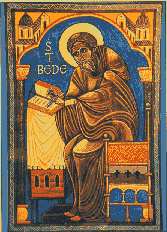
The Venerable Bede

Bede was a monk at the English monastery of Wearmouth and Jarrow, in Northumbria. From the age of seven, he spent all his life at that monastery except for a few brief visits to nearby sites. He says of himself: "I have devoted my energies to a study of the Scriptures, observing monastic discipline, and singing the daily services in church; study, teaching, and writing have always been my delight."

He was the first person to write scholarly works in the English language, although unfortunately only fragments of his English writings have survived. He translated the Gospel of John into Old English, completing the work on the very day of his death. He also wrote extensively in Latin. He wrote commentaries on the Pentateuch and other portions of Holy Scripture. His best-known work is his History of the English Church and People, a classic which has frequently been translated and is available in Penguin Paperbacks. It gives a history of Britain up to 729, speaking of the Celtic peoples who were converted to Christianity during the first three centuries of the Christian era, and the invasion of the Anglo-Saxon pagans in the fifth and sixth centuries, and their subsequent conversion by Celtic missionaries from the north and west, and Roman missionaries from the south and east. His work is our chief source for the history of the British Isles during this period. Fortunately, Bede was careful to sort fact from hearsay, and to tell us the sources of his information.

He also wrote hymns and other verse, the first martyrology with historical notes, letters and homilies, works on grammar, on chronology and astronomy -- he was aware that the earth is a sphere, and he is the first historian to date events ANNO DOMINI, and the earliest known writer to state that the solar year is not exactly 365 and a quarter days long, so that the Julian calendar (one leap year every four years) requires some adjusting if the months are not to get out of step with the seasons.

His hymns include one for the Ascension. Suggested tune is Agincourt, also called Deo Gratias (or Gracias), which follows:


Clyde McLennan - Creator of the earth and skies .mp3


Found at bee mp3 search engine

A hymn of glory let us sing;
New songs throughout the world shall ring:
Christ, by a road before untrod,
Now rises to the throne of God.

The holy apostolic band
Upon the Mount of Olives stand;
And with his followers they see
Their Lord's ascending majesty.

To them the angels drawing nigh,
"Why stand and gaze upon the sky?
This is the Savior," thus they say;
"This is his glorious triumph day.

"Again shall ye behold him so
As ye today have seen him go,
In glorious pomp ascending high,
Up to the portals of the sky."

O risen Christ, ascended Lord,
All praise to thee let earth accord,
Who art, while endless ages run,
With Father and with Spirit one.

Readings:

PRAYER (traditional wording)
Heavenly Father, who didst call thy servant Bede, while still a child, to devote his life to thy service in the disciplines of religion and scholarship: Grant that as he labored in the Spirit to bring the riches of thy truth to his generation, so we, in our various vocations, may strive to make thee known in all the world; through Jesus Christ our Lord, who liveth and reigneth with thee and the Holy Spirit, one God, for ever and ever.

PRAYER (contemporary wording)

Heavenly Father, who called your servant Bede, while still a child, to devote his life to your service in the disciplines of religion and scholarship: Grant that as he labored in the Spirit to bring the riches of your truth to his generation, so we, in our various vocations, may strive to make you known in all the world; through Jesus Christ our Lord, who lives and reigns with you and the Holy Spirit, one God, for ever and ever.

h/t Satucket

2010-05-19

Evangelism or Proselytism


Notice the method: 1) take the music the youngsters are interested in and then set your religious texts to them; 2) make sure to throw in some booze. And...BAZINGA! You've got religious young people!

No...you've just scratched itching ears. As soon as they mature past that phase, they'll be gone again.

How many churches are doing something similar - let the music set the tone for our words (rather than the other way around, cf. Gregorian Chant), then try to appear hip by doing "Theology on Tap" (God-talk at a bar).

You may make converts...but will you have made disciples?

2010-05-13

Evangelical Scholarship

"...theological scholarship should be done with the ultimate goal of building up the saints, confounding the opponents of the gospel, and encouraging the brethren. The highest achievement any evangelical theological scholar can attain is not membership of some elite guild but the knowledge that he or she has done work that strengthened the church and extended the kingdom of God through the local church."

Read more about the scandal of the evangelical mind at IX Marks blog!

2010-05-12

Wednesday of Rogationtide

Today continues Rogationtide. We also commemorate Simon of Cyrene.

Here's the Morning Prayer service.


The (Traditional) Collect.

ALMIGHTY God, Lord of heaven and earth; We beseech thee to pour forth thy blessing upon this land, and to give us a fruitful season; that we, constantly receiving thy bounty, may evermore give thanks unto thee in thy holy Church; through Jesus Christ our Lord. Amen.

And if you haven't already taken a trip to the bounds of the parish...


2010-05-10

Rogationtide


The minor Rogation Days are the Monday, Tuesday, and Wednesday before we commemorate our Lord’s Ascension to the Father in Heaven on Ascension Day. “Rogation” comes from the Latin “rogare”, meaning “to beseech.” Although the term “beseech” could be taken as a call for penitence, this is not the intention of the Easter season. Rather it is one of asking for God’s blessing on the works of our hands—industry and agriculture—the means of our livelihoods. A singularly Anglican holiday, it’s no longer observed in the Church of Rome, but, since the reign of Elizabeth I, it has been a decided observance of the English church.

While we no longer “beat the bounds of the parish,” there are ways to adapt this tradition to meet today's need for thankfulness. Rogation Days are an ideal time to remember—and rededicate our jobs, investments, and other economic activities to our Lord, in Whom we live and move and have our being, while invoking His Presence in all we do, committing our ways to Him, so that He, as promised in Scripture, guides our paths.

2010-05-06

For the National Day of Prayer

For Our Country.

ALMIGHTY God, who hast given us this good land for our heritage; We humbly beseech thee that we may always prove ourselves a people mindful of thy favour and glad to do thy will. Bless our land with honourable industry, sound learning, and pure manners. Save us from violence, discord, and confusion; from pride and arrogancy, and from every evil way. Defend our liberties, and fashion into one united people the multitudes brought hither out of many kindreds and tongues. Endue with the spirit of wisdom those to whom in thy Name we entrust the authority of government, that there may be justice and peace at home, and that, through obedience to thy law, we may show forth thy praise among the nations of the earth. In the time of prosperity, fill our hearts with thankfulness, and in the day of trouble, suffer not our trust in thee to fail; all which we ask through Jesus Christ our Lord. Amen.

1928 Book of Common Prayer

2010-05-04

The Jesus Prayer

This is a new article from Frederica Matthews-Green - a convert from liberal feminism to Episcopalianism to Orthodoxy!! She always has something thoughtful to say, and I hope that you'll get something out of this. Prayer is hard work - and we sometimes need something simple, yet profound, to latch onto. For some it's a form of the rosary, for others it's 40 Days of Purpose, but the important part is that we take time to open ourselves to God and ask him to claim the space we've made for him in our life.

The Jesus Prayer Monday, May 3, 2010 [Kyria; May, 2010]
Frederica in Christian Life, Orthodoxy

“Rejoice always, pray constantly, give thanks in all circumstances” (I Thess 5:17)

Have you ever wondered what St. Paul was talking about? How can a person pray constantly? Yet this wasn’t the only time St. Paul urged his hearers to constant prayer.

“Rejoice in your hope, be patient in tribulation, be constant in prayer” ( Romans 12:12).

“Pray at all times in the Spirit, with all prayer and supplication. To that end keep alert with all perseverance” (Eph 6:18).

“Continue steadfastly in prayer, being watchful in it with thanksgiving” Col 4:2.

If he took the trouble to say this to four different communities, he must have thought it was important. And he must have thought it was possible. He wouldn’t have kept urging his hearers to do something that was completely beyond their capability.

In the 2nd through 5th century, men and women began going out into the deserts of Palestine and Egypt to devote themselves wholly to prayer. They are known as the Desert Fathers and Mothers. They wanted to find a way to be in constant communion with God, as St. Paul had urged.

They soon discerned that the reason it’s hard to be in such communion is the ceaseless inner flow of wandering thoughts: old memories, desires, fears, criticism of others, any number of aimless thoughts that disrupt the mind and keep it unsettled. These are not the constructive thoughts used in problem-solving, but the wandering thoughts of a mind seeking something to “chew on.” Since the impediment came in the form of thoughts, the cure was a substitute thought—a single, simple thought of prayer. After experimenting with various short scriptures and petitions, this is the form that emerged: “Lord Jesus Christ, Son of God, have mercy on me.” It called the Jesus Prayer.

The prayer is drawn from Gospels, from passages where people called on Jesus for mercy: the ten lepers who cried, “Jesus, Master, have mercy on us” (Luke 17:13), the Canaanite woman who said , “have mercy on me, O Lord, son of David.” (Mt15:22), and blind Bartimaeus, who said, “Jesus, Son of David, have mercy on me!” (Mk 10:47). In Jesus’ parable, the publican “would not even lift his eyes to heaven but beat his breast, saying, ‘God be merciful to me a sinner!’” (Luke 18:13). These requests for mercy aren’t like a criminal begging a judge for lenience, but are stories of people in need asking for the Lord’s tender mercy.

I’ve been saying the Jesus Prayer for fifteen years now, and have found that it has greatly increased my ability to sense the presence and voice of the Lord. Mostly, it gets rid of the clutter. Instead of being blindsided by thoughts that carry me away into the past or future, I am able to size up the thought and decide whether or not I want to give it my time. The Jesus Prayer strengthens the part of your mind that observes your mind, building an entryway, as it were, where thoughts must prove their validity before being invited in. At all times, the inner you rests in the presence of our Lord, the light that drives away all darkness.

As we said, the goal is to pray constantly, but you can’t begin by doing anything all of the time; you have to begin by doing it some of the time, and gradually build up. The advice about acquiring the habit of this Prayer hasn’t changed for 1500 years. Set aside a bit of time each day when you will do nothing but say the Prayer—even just ten minutes a day. Sit quietly, close your eyes, and begin repeating the prayer inside. The ancient sources speak of “bringing the mind into the heart,” but you must keep in mind that “mind” and “heart” don’t mean “reason” and “emotion” in the ancient texts. (As best I can tell, the notion that we are divided into “head” and “heart” arose in the West in the Middle Ages. It’s not biblical and, I’ve become convinced, not true.) In the ancient writings about the Jesus Prayer, the “mind” is the receptive intelligence, the understanding or comprehension. It is always hungry for something to take in, and restless. During prayer practice, discipline that hungry mind to keep returning to gaze at the Lord. Deny it anything other than the words of the Prayer to think about. As St. Paul said, “Take every thought captive to obey Christ” (2 Cor 10:5). You will find this impossible at first, but very gradually you will make headway. Those who stick with it report that, over time, there is a nearly physical sensation of the prayer activity move from buzzing around the top of your head, to being lodged securely at your physical center, the chest or heart. (This has nothing to do with emotions; the Prayer is a mental exercise, but it does, of course, produce better control over negative emotions.)

I wondered at first how it was possible to be praying all the time when I had so many other things to think about and accomplish. I found that it works by utilizing a layer of your awareness, not your entire awareness. It is like having a friend along as you go through your day. The presence of your silent friend wouldn’t limit your ability to concentrate and handle the demands of daily life, but it would give them a different color or flavor. In this case, the best of Friends provides tranquility, perspective, love for the unlovely, patience, and good humor.

But the purpose of the Jesus Prayer is not tranquility or inner healing; the purpose is to bring you into the presence of Christ. He is all our joy. I think it is wise that the Prayer asks for mercy, to remind us of the necessity of humility, rather than the narcissism that can accompany the self-designation “spiritual.” So the Jesus Prayer is not an end in itself, but a way of training the mind to remain always in his presence, no matter what else life brings. As the anonymous pilgrim says, in the 19th century Russian text The Way of a Pilgrim, “Sometimes my heart would feel as if it were bursting with joy, so light was it and full of freedom and consolation. Sometimes I would feel a burning love towards Jesus Christ and all of God’s creatures…Sometimes, by invoking the name of Jesus, I was overcome with happiness, and from then on I knew the meaning of these words, ‘The Kingdom of God is within you.’”

2010-05-03

HECKonomics


Closer to the truth than it isn't.

h/t DeMotivational

2010-04-30

Friday Funny


Laughing at Star Trek and with Monty Python? Like shootin' fish in a barrel!