2010-09-11
Paphnutius the Confessor

Commination for 9-11
A Commination,
or Denouncing of God's Anger and Judgements against Sinners,
With certain Prayers, to be used on the first Day of Lent, and at other times, as the Ordinary shall appoint.Instead whereof, until the said discipline may be restored again, (which is much to be wished,) it is thought good, that at this time (in the presence of you all) should be read the general sentences of God's cursing against impenitent sinners, gathered out of the seven and twentieth Chapter of Deuteronomy, and other places of Scripture; and that ye should answer to every Sentence, Amen: To the intent that, being admonished of the great indignation of God against sinners, ye may the rather be moved to earnest and true repentance; and may walk more warily in these dangerous days; fleeing from such vices, for which ye affirm with your own mouths the curse of God to be due.
URSED is the man that maketh any carved or molten image, to worship it.
Answer. Amen.
Minister. Cursed is he that removeth his neighbour's landmark.
Answer. Amen.
Minister. Cursed is he that maketh the blind to go out of his way.
Answer. Amen.
Minister. Cursed is he that perverteth the judgement of the stranger, the fatherless, and widow.
Answer. Amen.
Minister. Cursed is he that smiteth his neighbour secretly.
Answer. Amen.
Minister. Cursed is he that lieth with his neighbour's wife.
Answer. Amen.
Minister. Cursed is he that taketh reward to slay the innocent.
Answer. Amen.
Minister. Cursed is he that putteth his trust in man, and taketh man for his defence, and in his heart goeth from the Lord.
Answer. Amen.
Minister. Cursed are the unmerciful, fornicators, and adulterers, covetous persons, idolaters, slanderers, drunkards, and extortioners.
Answer. Amen.
Then shall they all kneel upon their knees, and the Priest and Clerks kneeling (in the place where they are accustomed to say the Litany) shall say this Psalm.
Wash me thoroughly from my wickedness: and cleanse me from my sin.
For I acknowledge my faults: and my sin is ever before me.
Against thee only have I sinned, and done this evil in thy sight: that thou mightest be justified in thy saying, and clear when thou art judged.
Behold, I was shapen in wickedness: and in sin hath my mother conceived me.
But lo, thou requirest truth in the inward parts: and shalt make me to understand wisdom secretly.
Thou shalt purge me with hyssop, and I shall be clean: thou shalt wash me, and I shall be whiter than snow.
Thou shalt make me hear of joy and gladness: that the bones which thou hast broken may rejoice.
Turn thy face away from my sins: and put out all my misdeeds.
Make me a clean heart, O God: and renew a right spirit within me.
Cast me not away from thy presence: and take not thy Holy Spirit from me.
O give me the comfort of thy help again: and stablish me with thy free Spirit.
Then shall I teach thy ways unto the wicked: and sinners shall be converted unto thee.
Deliver me from blood guiltiness, O God, thou that art the God of my health: and my tongue shall sing of thy righteousness.
Thou shalt open my lips, O Lord: and my mouth shall shew thy praise.
For thou desirest no sacrifice, else would I give it thee: but thou delightest not in burnt-offerings.
The sacrifice of God is a troubled spirit: a broken and contrite heart, O God, shalt thou not despise.
O be favourable and gracious unto Sion: build thou the walls of Jerusalem.
Then shalt thou be pleased with the sacrifice of righteousness, with the burnt-offerings and ablations: then shall they offer young bullocks upon thine attar.
Glory be to the Father, and to the Son: and to the Holy Ghost;
Answer. As it was in the beginning, is now, and ever shall be: world without end. Amen.
Lord, have mercy upon us.
Christ, have mercy upon us.
Lord, have mercy upon us.
UR Father, which art in heaven, Hallowed be thy Name. Thy kingdom come. Thy will be done in earth, as it is in heaven. Give us this day our daily bread. And forgive us our trespasses, As we forgive them that trespass against us. And lead us not into temptation; But deliver us from evil. Amen.
Minister. O Lord, save thy servants;
Answer. That put their trust in thee.
Minister. Send unto them help from above.
Answer. And evermore mightily defend them.
Minister. Help us, O God our Saviour.
Answer. And for the glory of thy Name deliver us; be merciful to us sinners, for thy Name's sake.
Minister. O Lord, hear our prayer.
Answer. And let our cry come unto thee.
MOST mighty God, and merciful Father, who hast compassion upon all men, and hatest nothing that thou hast made; who wouldest not the death of a sinner, but that he should rather turn from his sin, and be saved: Mercifully forgive us our trespasses; receive and comfort us, who are grieved and wearied with the burden of our sins. Thy property is always to have mercy; to thee only it appertaineth to forgive sins. Spare us therefore, good Lord, spare thy people, whom thou hast redeemed; enter not into judgement with thy servants, who are vile earth, and miserable sinners; but so turn thine anger from us, who meekly acknowledge our vileness, and truly repent us of our faults, and so make haste to help us in this world, that we may ever live with thee in the world to come; through Jesus Christ our Lord. Amen.
A Prayer for 9-11
The following prayer was shared by Father John Troy Mashburn, pastor at St. John Orthodox Church in Memphis. Wherever you are, it's a great prayer to join with others in offering up to God on September 11.
O Lord our God, Who art Thyself, the Hope of the hopeless, the Help of the helpless, the Savior of the storm-tossed, the Haven of the voyager, the Physician of the sick; be all things to our land which nine years ago on this date was devastated by the cowardly and hateful acts of false martyrs; who imitated wicked Herod in his slaughter of 14,000 innocents, whose only crime was to be born at the time of Thine incarnation.
For those who lost loved ones, grant the comfort you imparted to the Mary and Martha before you raised Lazarus and care for them as Thou didst care for Thy Mother from the Cross, putting her in the care of the Apostle John.
For the survivors, grant them healing in every sense, as you strengthened and healed the confessors.
For those related to and aiding the survivors and the families of the fallen, grant the strength and compassion Thou didst instill in Thy foster father Joseph, who was Thy guardian in Thine earthly youth.
For those who died, grant them remission of their every sin in Thy great compassion; both those who like the wise servant and the wise virgins, constantly prepared themselves to enter the heavenly banquet at any hour; and those who emulated the Rich Fool, preferring to enjoy earthly pursuits and ignore heavenly ones.
To the rest of us, instill in us the knowledge that while the devil still manipulates our Divinely-given free will (sic) to his own ends in this world, his power is fleeting and ultimately void, as Thou hast already crushed his dominion, leaving to him only those who freely choose him. Remind us that, while evil at times seems to win, and the death of the innocent seems to signal the destruction of goodness, the innocent are at peace, and while the God-fearing will endure a period of torment; those who choose evil shall endure eternal torment.
For those who hate us, speak to their hearts as St. Procla sought to speak to her husband Pilate concerning Thee, and as Thou didst speak to Pharoah concerning the Hebrews, to soften the hearts of those who seek our destruction.
Spare us O Lord, from all hatred of the murderers, and from prejudice toward those whose only crime is to be of their ethnicity and/or religion.
Spare us, O Lord, from paranoia and rash acts by which we trample each other like rabid beasts.
Spare, O Lord, those who protect us, those who serve in our government, armed forces, law enforcement agencies and all first responders, from despondency, disillusionment, and all things which would undermine their righteous calling to protect us in the manner of our Guardian Angels, and care for us in the manner of the Good Samaritan.
All this we ask of Thee our all-powerful and all-loving Saviour, together with Thine unorginate Father, and Thine all-holy and good and life-giving Spirit, now and ever, and unto ages of ages. Amen
That's St Nicholas Orthodox Church right next to the towers. It's the one we're trying to get rebuilt at Ground Zero
2010-09-10
Progressive Church
Come in for a comparison quote today!
2010-09-07
Pop and the Pope
Here's the song he's chosen to reach out to the disco / dance club hipsters of England.
Ooberfüse - Heart's Cry by 360degreemusic
2010-09-06
Drinking to Your Health

One of the most contentious issues in the vast literature about alcohol consumption has been the consistent finding that those who don't drink tend to die sooner than those who do....a new paper in the journal Alcoholism: Clinical and Experimental Research suggests that — for reasons that aren't entirely clear — abstaining from alcohol does tend to increase one's risk of dying, even when you exclude former problem drinkers. The most shocking part? Abstainers' mortality rates are higher than those of heavy drinkers.Read the rest over at Time.
2010-09-03
Dunning-Kruger Effect and the Church
The Dunning–Kruger effect is a cognitive bias in which an unskilled person makes poor decisions and reaches erroneous conclusions, but their incompetence denies them the metacognitive ability to realize their mistakes. The unskilled therefore suffer from illusory superiority, rating their own ability as above average, much higher than it actually is, while the highly skilled underrate their abilities, suffering from illusory inferiority. This leads to the situation in which less competent people rate their own ability higher than more competent people. It also explains why actual competence may weaken self-confidence: because competent individuals falsely assume that others have an equivalent understanding. "Thus, the miscalibration of the incompetent stems from an error about the self, whereas the miscalibration of the highly competent stems from an error about others."
First, everybody knows that if you can't pass muster in the musical world, you can always get an audience at church. It seems we have even less standards for performers than we do for members.
Maybe it's not always that bad...but I'm willing to bet that most of you have sat through a painful offertory or two in your life.
And it's not just poor performance. The actual compositions these days are TERRIBLE. Theologically vapid. Poetically unsound. And intentionally unsingable. I tend to agree with C.S. Lewis, who thought that most (traditional English) hymns were "fifth-rate poetry set to sixth-rate music." However, those hymns have never made me want to burst into tears or write letters to the bishop. They have never made me worry about the children who were taught to sing them. Aesthetic quality isn't really the point, although God deserves the best -- at the very least we should not be forced to sing heresy. Our music should elevate us to assume God's perspective rather than reiterate our own. It should focus on on Christ and His Kingdom rather than moor us in our own experience. (Contrary to contemporary opinion, Latin chant is not only breathtakingly beautiful, it's pretty easy to learn. Certainly it's easier to sing than some of those showtunes that pass for praise and worship these days!)Secondly, the article proffers education as a means of addressing the problem. I couldn't agree more. I enjoy introducing people to good church music. I'm no music expert, but I have a good ear and a wide-ranging appreciation for it. (Yes, even the modern guitar-stuff can be well done on all accounts...for some reason, most just choose not to go through the effort.)
But this isn't just about music. What about PRAYER? Have you ever been stuck in a prayer group with someone who just has to use "just" just about every other word? (just)
“Lord, just hear us tonight. We just lift up our hands to you and pray that you will just send you love down to us in ways we just can’t understand. Take us just as we are Lord. Just, just. Just, just.”
I'm not advocating doing away with private, highly-personal prayers. But I'm trying to aim for a balance. Looking at high quality public prayers will help us to improve our own private prayer life. It will lift us beyond searching for words and aim us toward seeking God's face in prayer.
Lastly, many Christians settle for a poorly trained ministry. While roughly half of active full-time clergy have at least a bachelor's degree, the other half...doesn't. I don't want to fall into the trap of credentialism, but there is plenty to be said for having had a good bit of formalized training in the texts of Scripture, the theological and historical tradition of the church, and pastoral practice. I'm not so much concerned with post-nominals that come with that formation but rather with the habits and attitudes it fosters as well as the data conveyed.
I'm really concerned for a church that's led by someone who has no real sense of church history beyond hearsay from grandparents about the good ol'days. And someone who has only read the Scriptures for themselves and then teaches that as God's word is little more than a medieval pope mistaking his opinion for God's revelation. Reading Scripture together is necessary for the people of God so that we can come to a common understanding, at least on Scripture's principle teachings. (Col. 4:16; 1 Th. 5:27; cf. Neh. 8)
Those are just a few of my thoughts on this. Where else should we be looking?
2010-08-31
Confessional Anglicanism is our Future

Some people allege that the Anglican Church in North America is hopelessly theologically muddled, a mere 20-year reset button on TEc, and an overly-diverse group that will fly apart as soon as the common threat of pansexualism is absent.
Archbishop Duncan says PHOOEY on that...we're in this together to confess Christ together, and our vision is still the GAFCON Jerusalem Statement.
2010-08-30
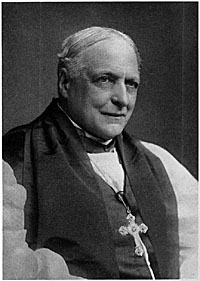
Remembering Bp. Grafton

| Clyde McLennan - Now my tongue the mystery telling .mp3 | ||
| ||
![]() | Found at bee mp3 search engine | ![]() |

Readings:
Preface of a Saint (1)
PRAYER
Loving God, who didst call Charles Chapman Grafton to be a bishop in thy Church, endowing him with a burning zeal for souls: Grant that, following his example, we may ever live for the extension of thy kingdom, that thy glory may be the chief end of our lives, thy will the law of our conduct, thy love the motive of our actions, and Christ’s life the model and mold of our own; through the same Jesus Christ, who livest and reignest with thee and the Holy Spirit, one God, throughout all ages. Amen.
Humble Hospitality
Sermon Proper17C Humble Hospitality, Fr Chris Larimer from Fr. Chris Larimer.
A sermon on Luke 14 & Hebrews 13, preached at Holy Apostles Anglican Church in Elizabethtown, KY.
2010-08-26
2010-08-25
Magnificat Hymnic setting

And of course if you're going to do this in a Solemn Evensong setting, don't forget the incense!
2010-08-24
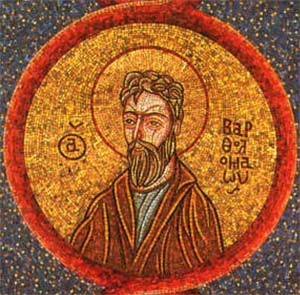
Feast of St. Bartholomew, Apostle
The name "Bartholomew" appears in the New Testament only on lists of the names of the twelve apostles. This list normally is given as six pairs, and the third pair in each of the Synoptics is "Philip and Bartholomew" (M 10:3; P 3:18; L 6:14; but A 1:15).
John gives no list of the Twelve, but refers to more of them individually than the Synoptists. He does not name Bartholomew, but early in his account (John 1:43-50) he tells of the call to discipleship of a Nathaniel who is often supposed to be the same person. The reasoning is as follows: John's Nathanael is introduced as one of the earliest followers of Jesus, and in terms which suggest that he became one of the Twelve. He is clearly not the same as Peter, Andrew, James, John, Philip, Thomas, Judas Iscariot, Judas (not Iscariot, also called Lebbaeus or Thaddeus), all of whom John names separately. He is not Matthew, whose call is described differently (M 9:9). This leaves Bartholomew, James the son of Alpheus, and Simon Zelotes. Of these, Bartholomew is the leading candidate for two reasons:(1) "Bar-tholomew" is a patronymic, meaning "son of Tolmai (or Talmai)." It is therefore likely that he had another name. (A historical novel which may not be well researched informs me that a first-century Jew would be likely to use the patronymic instead of the forename as a mark of respect in speaking to a significantly older Jew.) "Nathanael son of Tolmai" seems more likely than "Nathanael also called James (or Simon)."
(2) Nathanael is introduced in John's narrative as a friend of Philip. Since Bartholomew is paired with Philip on three of our four lists of Apostles, it seems likely that they were associated.

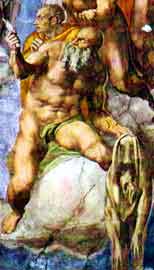
We have no certain information about Bartholomew's later life. Some writers, including the historian Eusebius of Caesarea (now Har Qesari, 32:30 N 34:54 E, near Sedot Yam), say that he preached in India. The majority tradition, with varying details, is that Bartholomew preached in Armenia, and was finally skinned alive and beheaded to Albanus or Albanopolis (now Derbent, 42:03 N 48:18 E) on the Caspian Sea. His emblem in art is a flaying knife. The flayed Bartholomew can be seen in Michelangelo's Sistine painting of the Last Judgement. He is holding his skin. The face on the skin is generally considered to be a self-portrait of Michelangelo.
Readings:
Psalm 91 or 91:1-4
Deuteronomy 18:15-18
1 Corinthians 4:9-15
Luke 22:24-30
Preface of Apostles
Almighty and everlasting God, who didst give to thine apostle Bartholomew grace truly to believe and to preach thy Word: Grant that thy Church may love what he believed and preach what he taught; through Jesus Christ our Lord, who liveth and reigneth with thee and the Holy Ghost, one God for ever and ever.
2010-08-23
A New Prayer Book
2010-08-11
Lighting the Way

This is the Altar Lamp that burns in honor of the constant Real Presence in the reserve Sacrament (consecrated wine and host) kept in the tabernacle / aumbry - a small, ornate box centered on the back portion of the Holy Table. or on a wall nearby.
The other major lights are the candles on the Holy Table, divided into two groups, signifying Jesus in both His divine and human natures. At many parishes, you’ll see two groups of three each on the back of the Table, called “Office Lights,” lit when conducting the offices of the Church, such as Morning/Evening Prayer, Holy Matrimony, or Funeral services. In other parishes, there will simply be two larger pillar candles beside the Holy Table which are lit for the same purpose.
The two lights in front of these - or directly on the table - are the Communion Lights, used during the Eucharist. All the lights echo Christ’s words, when He said, “I am the Light of the World” (St. John 8:12) and other passages referring to God’s light, such as St. Matt. 4:16 and St. Luke 2:32.
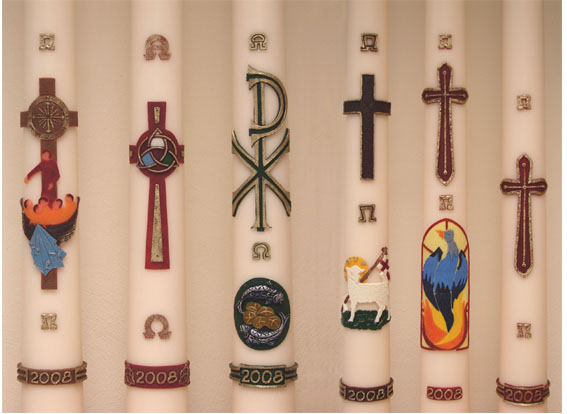
The last light in many churches is the Paschal Candle. This is a large white candle normally kept our of sight, or next to the baptismal font. The candle is blessed every year at the Easter Vigil service, having the year inscribed on it and (traditionally) five grains of incense inserted into in in the shape of a cross. It is often decorated with other signs of the resurrection as well. Some parishes - especially those with elaborate Holy Saturday / Easter Vigil services - have special rituals surrounding the entrance of the Paschal candle. These rituals can include chanting the Exultet (normally done by a deacon), dipping the base of the candle in the baptismal font, and using this candle to light the tapers that will ignite the rest of the office and communion lights. (This practice is especially important in parishes that light a Paschal fire near the entrance of the church door for the vigil.) The candle is brought to the front of the church from Easter until the Ascension (when its removal visually symbolizes Christ's immediate light being taken from our presence). Then the candle is either stored or kept near the font. However, for baptisms and funerals (which, for Christians, is the completion of our baptismal death into Christ), the candle returns to a prominent place. I should also note that this is a Western / Latin Rite practice. The East uses a different type of candle. However, this practice antedates Jerome - and was clearly a common practice long before the Council of Nicea.The candles recall times when ancient Christians met at night to avoid discovery and needed the lights to worship, but are retained to remind us of those days and to focus us on our Heavenly Father of Lights. Scriptural authority is solid for their use—found in Ex 25:31 & 40:25, Lev 24:2 & II Chron 13:11— and reminds us—we carry the Light of Christ!
2010-08-06
Eat it Chopra!
It's always fun to watch a relativist hoisted on his own petard.
Yes we can

But should we?
California, I'm looking at you."In the matter of reforming things, as distinct from deforming them, there is one plain and simple principle; a principle which will probably be called a paradox. There exists in such a case a certain institution or law; let us say, for the sake of simplicity, a fence or gate erected across a road. The more modern type of reformer goes gaily up to it and says, "I don't see the use of this; let us clear it away." To which the more intelligent type of reformer will do well to answer: "If you don't see the use of it, I certainly won't let you clear it away. Go away and think. Then, when you can come back and tell me that you do see the use of it, I may allow you to destroy it."-- The Thing, in "The Drift from Domesticity" (1929)
2010-08-05
The American Dream
Read it all here...For a generation, most Americans have been told by left, right and center that they would be failures if they ended their educations with high school, worked hard, saved cash for emergencies and bought modest homes they could afford. They have been told that to succeed in life they need to ape the lifestyles of the upper middle class that provides most of America’s politicians, pundits and scholars.
The result has been an experiment in social engineering that has gone horribly wrong: the creation of a faux mass upper middle class. Millions of Americans who by objective standards belong to the working class or lower middle class have persuaded themselves that they are part of the professional-investor elite, because they have worthless degrees from diploma mills, negligible amounts invested in stocks, and suburban trophy houses they cannot afford. For the college graduates at Starbucks working to pay off student loans for degrees that they will never use, as for the millions of Americans who are now "underwater," owing more on their mortgages than their houses are worth, the American dream has turned into a nightmare.
2010-08-02
Why we need vouchers
I'm a homeschooler. Our current tax code doesn't let me deduct a single penny for educational expenses; nor is there a penny of help. (And obviously, we don't get a child care deduction or credit because my wife is home.)
How much education could YOU buy in your area if you had even $5000 to spend per child?e