2009-11-04

Christian Burial

I present this excellent article by Dr. Long on what it means to have a good funeral. So much of what is done in funerals - as in marriage - represents more our modern twisting of life rather than a Christian expression of life lived before the face of God.


The Good Funeral: Recovering Christian practices, by Dr. Tom Long
(taken from the Christian Century)

When Elizabeth Janzen died in a Minneapolis nursing home, the staff immediately notified the closest relative, her daughter Sarah in St. Louis. Sarah, who had faithfully visited her mother once a month, arranged for Elizabeth to be cremated, for the ashes to be sent to St. Louis and for an obituary to be placed in the Minneapolis newspaper. A month later, Sarah took the ashes to a lake in rural Minnesota, where Elizabeth and her family had often vacationed, and scattered them on the water.

A week later, a memorial service was held in the chapel of the Minneapolis church where Elizabeth had kept her membership, though her health had prevented her from attending for a number of years. On a table at the entrance to the chapel were placed several photographs of Elizabeth at various stages in her life, her Bible, a ceramic vase she had made, and a few other personal mementos.

At the service, Sarah read one of her mother's favorite poems, Elizabeth's younger sister told an amusing story about their childhood, the chaplain from the nursing home read Psalm 23 and prayed a brief prayer giving thanks for Elizabeth's life, and two of Elizabeth's former students (she had taught high school for more than 30 years) read fond reminiscences of her as a teacher. After a time of quiet reflection, during which they listened to a recording of Judy Collins's rendition of "Amazing Grace" (one of Elizabeth's favorite hymns), the small group in the chapel silently dispersed.

Elizabeth Janzen is fictitious, but the rituals marking her death represent a rapidly emerging trend in Christian funeral practices. With surprising swiftness and dramatic results, a significant segment of American Christians has over the past 50 years abandoned previously established funeral customs in favor of an entirely new pattern of memorializing the dead. This new pattern is not firmly fixed (indeed, variations, improvisations and personal customizations are marks of the new rituals) but it generally includes the following characteristics:

• a memorial service instead of a funeral (i.e., a service focused on remembering the deceased, often held many days after the death, with the body or the cremated remains of the deceased not present)

• a brief, simple, highly personalized and customized service, often involving several speakers (as opposed to the standard church funeral liturgies presided over primarily by clergy)

• a focus on the life of the deceased (often aided by a physical display of photos and other mementos)

• an emphasis on joy rather than sadness, a celebration of life rather than an observance of the somber reality of death

• a private disposition of the body, often done before the memorial service, with an increasing preference for cremation

The shift toward this new pattern has not happened everywhere, of course. It is most pronounced among white, suburban Protestants, and the older customs often still prevail in rural areas, among nonwhites and in many Catholic parishes. But these differences seem more a matter of lag time than anything else. The trend lines are clear, and it is apparent that funeral practices for all Christians, as a part of the larger culture, are moving at various rates of speed toward this new pattern.

A significant number of Christian clergy, especially those who are more progressive and better educated, applaud many of these changes. While they may be troubled somewhat by the open-mike atmosphere of these new services or by the inevitable banalities of some of the poems, songs, readings and other elements imported into them, they nevertheless find them preferable to the older, often depersonalized and more somber rituals of the past—primarily for two reasons.

First, the preference for memorial services, the emphasis on joy or even on laughter, the de-emphasis on the body of the deceased, and the celebration of the personal aspects of the life of the one who has died all seem more commensurate with the Christian witness to the resurrection. Second, the valuing of simpler, less formal services provides leverage for people to break loose from the stranglehold of showy, expensive and burdensome funeral practices so prized by the funeral industry.

These clergy are unquestionably well intentioned, and they are right to find some encouraging signs here, but I want to raise some basic theological questions about this emerging pattern of death practices. I would like to suggest that these newer rituals, for all of their virtues of freedom, simplicity and seeming festivity, are finally expressions of a corrupted understanding of the Christian view of death. These newer practices are attractive mainly because they seem to offer relief from the cosmeticized, sentimental, impersonal and often costly funerals that developed in the 1950s, which were themselves parodies of authentic Christian rituals. Contemporary Christian funeral practices certainly need to be changed, but change should be more a matter of recovery and reformation than innovation and improvisation.

In the early years of the Christian movement, Christians developed distinct funeral practices that, while woven from local customs, still reflected Christian theology. At the beginning of the third century, Tertullian could already speak of an "appointed office" for Christian burial in North Africa, and certainly by the late fourth century the contours of a distinct Christian funeral rite began to appear. This rite was composed of three movements: preparation, processional and burial.

In the preparation movement, the body was washed, anointed and clothed in garments representing baptism. In the processional phase, the body was carried to the grave, and sometimes the procession entered the church on the way for prayer and the reading of scripture. The burial phase took place at graveside and included the commendation of the deceased to God and the actual burial of the body. During each movement, the church prayed, chanted psalms and sang hymns of joy. Often a Eucharist was held, either in the church or at the grave.

The theme of the service was the completion of baptism, and the church accompanied a brother or sister to the place of union with God through the resurrection of Christ. Taken as a whole, the early Christian funeral was based on the conviction that the deceased was a saint, a child of God and a sister or brother of Christ, worthy to be honored and embraced with tender affection. The funeral itself was deemed to be the last phase of a lifelong journey toward God, and the faithful carried the deceased along the way to the place of final departure with singing and a mixture of grief and joyful hope.

In subsequent centuries, this basic funeral pattern sometimes struggled for visibility against cultural and theological changes. For example, the joyful Easter motif of the early Christian funeral was nearly submerged by a gloomy "Day of Wrath" theology of the late Middle Ages, and the Puritans, offended by what they saw as excesses in Anglican funerals, tried, unsuccessfully as it turns out, to get rid of funeral ceremony altogether. Nevertheless, the basic pattern and practices of Christian burial managed to weather the storms and continued to exert a strong force on Christian funerals until the late 19th century.

This review of the development of classic Christian funeral practices should make it evident that the pattern for funerals now appearing is not simply a modernization and adaptation of traditional customs but a radical, and finally diminished, replacement of Christian ritual.

For example, the current shift to a memorial service with the body absent means that Christian death practices are no longer metaphorical expressions of the journey of a saint to be with God. The saint is not even present, except as a spiritualized memory, a backdrop for the real action, which happens in the psyches of the mourners. The mourners are the only actors left, and the ritual now is really about them. Funerals are "for the living," as we are prone to say. Instead of the grand cosmic drama of the church marching to the edge of eternity with a fellow saint, singing songs of resurrection victory and sneering in the face of the final enemy, we now have a much smaller, more privatized psychodrama, albeit often couched in Christian language. If we take the plot of the typical memorial service at face value, the dead are not migrating to God; the living are moving from sorrow to stability.

How did the church shift from the understanding of a funeral as the joyful accompanying of a saint on "the last mile of the way" to a reflective, disembodied, quasi-Gnostic cluster of customs and ceremonies? What happened in the latter part of the 19th century?

Because this is precisely the time that embalming became widespread and the modern funeral parlor developed, it is almost irresistible to blame the newly minted funeral professionals for all the mischief. As the argument goes, undertakers reinvented themselves as funeral directors and rode the technological advances in embalming all the way to the bank. They first took the dead away from us in order to embalm them, and then they took the funeral itself away and turned it from a worship service into a vulgar display of conspicuous consumption.

The truth, however, is that a guild of embalming technicians could never have become directors of any sacred Christian ritual, could never have taken the funeral away, had not church and culture been more than ready to hand it over. Almost every developed society, even ancient Rome, has had "undertakers" who assist with the preparation of the dead, but even if 19th-century undertakers had hatched a plot to hijack the Christian funeral, it would have failed if our death rituals had been healthy and full of meaning.

If Christian funerals today are impoverished, we must look primarily to the church's own history and not look with scorn at the funeral director. The fact is that many educated Christians in the late 19th century, the forebears of today's white suburban Protestants, lost their eschatological nerve and their vibrant faith in the afterlife, and we are their theological and liturgical heirs. It was not, of course, as if the whole of 19th-century Christian society woke up one morning and suddenly found that they no longer believed in eternal life. The loss of conviction about the otherworld came slowly and gradually.

In the decades after the Civil War, the quite literal views of many American Christians regarding heaven, hell, the end of the world, the resurrection of the body and the second coming of Jesus began to ebb away. A recent study by Drew Gilpin Faust points out that the sheer devastation of the Civil War itself, the staggering number of dead, the violence and loss of life out of all proportion to the ability of most people to make meaning from it, accelerated the 19th century's already growing crisis of faith. She writes:

Civil War carnage transformed the mid-nineteenth century's growing sense of religious doubt into a crisis of belief that propelled many Americans to redefine or even reject their faith in a benevolent and responsive deity. But Civil War death and devastation also planted seeds of a more profound doubt about human ability to know and understand. . . . The Civil War compelled Americans to ask with intensified urgency, "What is Death?" and in answering to find themselves wondering why is death, what is life, and can we ever hope to know? We have continued to wonder ever since.
Part of the crisis of faith was about eschatology. In the 1840s, some Christians confidently calculated the exact date of Jesus' return, only to have their hopes, and for many of them their naive faith, crushed when Jesus did not come—a time that came to be called the Great Disappointment. Even less advent-minded Christians of the time had to reckon with the impact of the rising sciences, of Darwinism, and of the new skeptical philosophies imported from Europe. Consequently, the literalisms of the past came under severe stress. Pictures of Jesus coming in the clouds, of the dead rising bodily from the graves, of the saints arrayed in glory, became less and less imaginable, less and less plausible.

The notion of heaven was not altogether abandoned. Instead, it was revised and domesticated. Heaven was reimagined as a place very much like the best of earth, sometimes not a place at all but simply an intensification of earthly delights, and the idea of the resurrection of the body yielded to the more gentle and continuous notion of the immortality of the soul. One late-19th-century member of the clergy characteristically said, "To me, heaven means only myself with larger opportunity. It means this earth-life grown into perfection." Lucy Larcom, in a devotional essay characteristic of the period, wrote:
Surprises doubtless await us all, across the boundaries of this earthly existence. But none, perhaps, will be more surprised than those humble, faithful, self-sacrificing souls who have often almost dreaded the strange splendors that might open upon them beyond the gates of pearl, when they find that it is the same familiar sunshine in which they have been walking all their days, only clearer and serener. They will wonder that they have no new language to learn, no new habits to form, almost no new acquaintances to make. They will at last discover what their humility hid from them here, that while on earth, without knowing it, they had already been living in heaven.
No wonder the metaphor of journeying to be with God began to break apart at the seams. If people had "already been living in heaven," then there was, after all, nowhere for the dead to travel, and without letting go of the vocabulary of the otherworld, mainline Protestants in the late 19th century, long before John Lennon, could well "imagine there's no heaven."

A second significant development was the creation of rural cemeteries located some distance away from towns and villages. At first, cemeteries were separated from the living because of the notion that putrefying bodies produced miasmas, noxious gases that caused disease, but by the end of the 19th century, rural cemeteries were less about avoiding pollution and more about aesthetics. They were landscaped, gardenlike environments designed to encourage quiet and restful contemplation of nature, immortality and the meaning of life.

The more practical effect of these remote cemeteries, as Susan J. White has pointed out, was the division of the previously unified funeral ritual into two discrete parts: the funeral in the church and the burial in the distant cemetery. It was not long before this separation in distance became a separation in liturgical fact and in theological symbolism. The funeral was no longer a journey to the place of burial; it became a stationary event completely contained within the church building. The graveside ritual became a mere optional afterword. As White observes, "The removal of the gravesite to a location far away from the precincts of the church depletes a fund of theological and communal images and severely reduces the sense . . . that the living and the dead are part of one 'holy communion.'" So, with heaven gone and with the cemetery miles away, neither the dead nor the living had anywhere to go, and the metaphor of the journey to God collapsed.

Surely the task before the church now is to retrace our steps and to recover the grand liturgical theater in which Christians embrace their dead with tender affection, lift up their voices in hymns of resurrection and accompany the saints to the edge of mystery. This will not involve a mere repristinating of funeral practices or a rejection of cremation, but a recovery in our time and in contemporary forms of the governing symbols of the communion of saints, the resurrection of the body, and the journey of Christian dead toward the life everlasting.

In the meantime, the seeds planted in the 19th century continue to bear weeds. Since literalistic views of heaven and the saintly journey are no longer plausible to us, and since we lack the theological imagination to grasp the poetic truth and power of these metaphors, dead Christians have nowhere to go but to evaporate into the spiritual ether and into our frail memory banks. With heaven domesticated, the soul morphed into an immortal gas, the corpse become a shell and the cemetery moved out of sight, it was almost inevitable that the dead with their embarrassing bodies would be banned from their own funerals and the living would be condemned to sit motionless, contemplating the meaning of it all and pretending to celebrate life as the nephew of the deceased sings "When Irish Eyes Are Smiling."

Surely our culture will eventually weary of such liturgical and spiritual thinness and be ready for more depth, for more truth—for our sake and for the sake of those we love. When we are, the great drama of the journey to God will be there, beckoning us to join the procession of the saints. We will travel toward eternity with those we have loved, singing as we go and calling out to the distant shore in words of confident hope, like these from an ancient Coptic funeral prayer:
Let the shadows of darkness be full of light. Let the angels of light walk before him.
Let the gate of righteousness be opened to him. Let him join the heavenly choir.
Bring him into the paradise of delight. Feed him from the tree of life.
Let him rest in the bosom of our ancestors, Abraham, Isaac and Jacob, in your kingdom.
This article is excerpted from Thomas G. Long's book Accompany Them with Singing: The Christian Funeral, just published by Westminster John Knox.
Thomas G. Long is professor of preaching at Emory University's Candler School of Theology in Atlanta and the author of Preaching from Memory to Hope (Westminster John Knox).

2009-11-03

The Only Thing Worse Than Liturgical Dance


...is a Christian Dance Routine. (Just epic.)

If you want some lasting renewing of your mind, I suggest going to something a little more meaty.

2009-10-31

95 Theses


Hey Rome...Read'em and weep.

Go ahead...indulge yourself.

Happy Reformation Day!

Because of the Pope's offer to bring Anglican's under his shadow, I thought it important to remind people why there was a Reformation in the first place.


It's not enough for Anglicans to get to continue using the Book of Common Prayer or have married priests. The issue is how are we made right with God! Until Rome repents of her pernicious errors, they will remain in impaired communion with us.

Don't forget that.

2009-10-30

HOWL-O-WEEN II

Now the VATICAN has gone the way of the charismaniacs. According to the Telegraph:

The Holy See has warned that parents should not allow their children to dress up as ghosts and ghouls on Saturday, calling Hallowe'en a pagan celebration of "terror, fear and death".

The Roman Catholic Church has become alarmed in recent years by the spread of Hallowe'en traditions from the US to other countries around the world.

I'd be more worried about the spread of clown masses and the proliferation of Marty Haugen / David Haas' tripe, tyvm.

Willikers - get with it. Pope JP-II (electric bugaloo) knew how to get with it.

Earlier this week the Catholic Church in Spain also condemned the growing popularity of Halloween, saying it threatened to overshadow the Christian festival of All Saints' Day.

The Bishop of Siguenza-Guadalajara, Jose Sanchez, said there was a risk that Halloween could "replace Christian customs like devotion to saints and praying for the dead."

Yeah...nothing overturns superstition like...more superstition. Ever been to El Día de los Muertos celebracíon? I'd hardly call it Christian. Ancestor worship comes to mind, though.
Just look at that.

Yessirree. Chock-full to brimmin' with Christianity.

HOWL-O-WEEN

Editor's Note: CBN - in a surprising display of good taste - has already taken the article down. (Either that, or the witches were able to knock it off the server through their orange & black magical debil-candy.) Nevertheless, you can still find the "article" posted at CharismaMag's blog - whence it originally came.

Kimberly Daniels, a guest writer for CBN Online, has written an article supposedly exposing the forces of evil and their use of the secularized All-Hallow's E'en celebration (Halloween). Unfortunately, the only not-so-hidden truth the article exposed was that this woman desperately needs to go to seminary before she ever speaks as a public Christian leader again. I don't mean to be mean, but she starts with error, and goes downhill from there.

First, she seems to think there's an unholy godhead - consisting of a perverse trinity:

Lucifer is a part of the demonic godhead. Remember, everything God has, the devil has a counterfeit. Halloween is a counterfeit holy day that is dedicated to celebrating the demonic trinity of : the Luciferian Spirit (the false father); the Antichrist Spirit (the false holy spirit); and the Spirit of Belial (the false son).
Didja get that? Yeah...me neither. The Trinity is oneness of being in three self-submitting persons. That's absolutely antithetical to the "me-first"-ness of the fallen one. I don't think Ms. Daniels knows what she's talking about - either on the trinity or on demonology.

She doesn't know candy-making any better:
During this period demons are assigned against those who participate in the rituals and festivities. These demons are automatically drawn to the fetishes that open doors for them to come into the lives of human beings. For example, most of the candy sold during this season has been dedicated and prayed over by witches.

I do not buy candy during the Halloween season. Curses are sent through the tricks and treats of the innocent whether they get it by going door to door or by purchasing it from the local grocery store. The demons cannot tell the difference.

Seriously? I mean...as a homeschooler, I've been to candy-making plants. A friend of mine grew up in the Presbyterian church that the owner of Spangler Candy (maker of Dum-Dum Pops) attended. I've seen plenty of ovens, but nary a coven in those places.

Even more ironic, these are the same folks that would tell the Roman Catholic Church that it's superstitious for believing in sacraments that work ex opere (even though they have the promise of Christ behind them). Nevertheless, you bring out the devil and all of a sudden he's got power over all of nature that God Almighty doesn't have? He's allowed to work wickedness through material things, but Jesus isn't allowed to work good?

Confused much?
Even the colors of Halloween (orange, brown and dark red) are dedicated. These colors are connected to the fall equinox, which is around the 20th or 21st of September each year and is sometimes called "Mabon." During this season witches are celebrating the changing of the seasons from summer to fall. They give praise to the gods for the demonic harvest.
Wait a sec. Thanksgiving is off limits too, now. What church does this lady belong to? Jehovah's Witnesses?

Oh...it's worse. She claims to be an apostle.
The gods of harvest that the witches worship during their fall festivals are the Corn King and the Harvest Lord.
Um...I think anyone who would publish this tripe deserves to be crowned Corn King.
Halloween is much more than a holiday filled with fun and tricks or treats. It is a time for the gathering of evil that masquerades behind the fictitious characters of Dracula, werewolves, mummies and witches on brooms. The truth is that these demons that have been presented as scary cartoons actually exist.
Okay...this takes the cake. I remember when I was a little kid being absolutely FASCINATED with monster books & movies. I fancied that one day I might grow up to be a special-effects makeup artist. Some senior church members thought my "obsession" was a gateway for the evil one to take control of me. (As if he needed something like that when there was plenty of lust, greed, pride, etc. to go around.) Anyway, they said I shouldn't be fixated on that kind of thing or the devil would take control of me.

Here's the problem - even as a seven year old, I knew all that stuff was FAKE. (Not the devil - he's a real being, but vampires and werewolves and zombies, etc.) I could get up from these eeeeVIL things and go on about my life. They would vanish into the idleness of childhood imagination and historical mythopoesis.

But for duh-postle Kim, they're still real.

Just let that sink in for a minute.
There is no doubt in my heart that God is not calling us to replace fall festivals and Halloween activities; rather, He wants us to utterly destroy the deeds of this season. If you or your family members have opened the door to any curses that are released during the demonic fall festivals, renounce them and repent.
Alright...let's get something straight. The harvest is God's. It is His open-handed blessing to all creatures, and a reminder of the Noahic covenant. And it's so foundational a picture of God's goodness that he instituted THREE FESTIVALS associated with it:
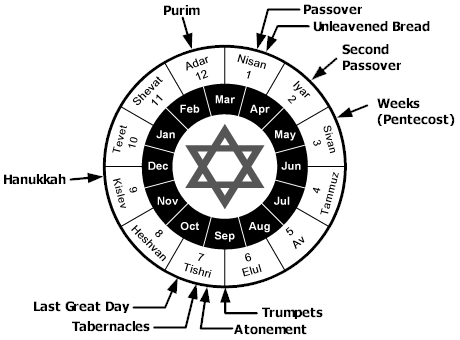
  • a seven-day springtime festival of Unleavened Bread, around the barley harvest (Passover/Unleavened Bread/Pesach/Mazzot);
  • an early summer festival of Harvest, when the wheat ripens (Pentecost/Weeks/Shavuot);
  • an autumn festival of Ingathering, when olives, grapes, and other fruits are harvested (Booths/Tabernacles/Sukkot).
Remember, this is God's inspired Word we're talking about. And He told His people to hold these festivals during times when the pagan Canaanites around them would be having similar harvest festivals. He even talks about the ingathering of humans to the Kingdom as a harvest.

I don't think this woman knows what she's talking about. She needs to re-read 1 Corinthians 8. Verses 1-6 tell us that there's no reality behind false idols, so that she'll realize these haints and boogers and witches she's conjuring up are just that - idols of her own overactive imagination. Secondly, she needs to repent for laying false burdens on Christians (vv. 7 et seq.).

There is a false Gospel out there that says that kingdom-living is a bunch of do's and do-not's. RUBBISH! While God demands holiness, that has already been met in the righteousness of Christ. We are free to transform cultural relics and natural life cycles into reminders of God's goodness and providence. The whole hoopla over Halloween as a pagan festival, rather than a time of remembering the faithful departed, became popular in the supernaturalism / medievalism of the late Victorian era (little of which was based in fact).

G. K. Chesterton said "Idolatry is committed, not merely by setting up false gods, but by setting up false devils; by making men afraid of war or alcohol or economic law, when they should be afraid of spiritual corruption and cowardice."

The fact of the matter is that morally lazy Christians love to get worked up over nothings so they can ignore the real travesties of our day. The "War on Christmas" is just such a turn. If Halloween has "gone bad," Christians are to blame. We forgot to take time to honor the saints (living and dead), and embrace God's covenant faithfulness. If we did that, we might remember that the devil doesn't need witches, haints, and boogers to corrupt us. A nice TV and comfortable position at our job and a gliding indifference towards others is plenty to lead us to the gates of Hell.

When I was training as a medico, there was an old saying: "When you hear hoofbeats, think horses - not zebras." One of the dangers of studying medicine is that you learn a fearful host of pathological conditions, and are eager to show off your knowledge by finding the most obscure diagnosis. (Think of the popularity of the medical drama, House.)

The same is true in the cure of souls. When someone is having trouble in their marriage, or their children are being rebellious, don't think "A-ha! Dad must be a Mason under Satanic oppression!" Instead, look for the regular old enemies: the world and the flesh.

So instead of exorcising candy...let's enjoy some, then go exercise.

2009-10-29

Comprehensiveness vs Liberalism

Here are some lightly edited extracts from J. I. Packer's Latimer Studies booklet "A Kind of Noah's Ark? The Anglican Commitment to Comprehensiveness."

Although this booklet reflects on the theological situation in the Church of England, and that at a particular time, some of the following observations hold good for more contemporary movements. For although there have been several historic forms of liberal theology there is also a liberal mood or mindset:

First, the basis of all forms of this position is the hypothesis that no universally right way of thinking about God is given in Christianity.

Unable to accept what might be called a Chalcedonian view of Scripture (i.e. that it is fully human as well as fully divine, and fully divine as well as fully human), they have doubted both the reality of the Chalcedonian Christ to whom the New Testament witnesses and the propriety of reading Scripture as more than a rag-bag of traditions, intuitions, fancies and mythology whereby good men celebrated and shared their sense of being in touch with God - a contact occasioned for New Testament writers by a uniquely godly man named Jesus.

That prophets and apostles no less than creeds and churches can all be wrong on questions of reality and truth, is plank one in the liberal platform. Scripture and the Christian literary heritage are certainly stimulating, inspiring and effective in communicating God, but that does not make them true.

So the constant endeavour of the liberal fraternity from the start has been to go behind and beyond biblical witness to reformulate the faith in terms which to them, as modern men, seem truer, clearer and less inadequate (whether evolutionist, idealist, panentheist, deist, existentialist, Marxist; sociological, psychological, syncretistic; or whatever).

Certainly, for today’s liberals there are no fixed fundamentals; everything, not excluding the doctrine of God - indeed, some say, that first - is regarded as in principle open to review and change.

...liberals have no united platform or policy, for they hold in common only...negations...plus the sifting, reshaping methodology which these negations entail. They agree only in what they are against; beyond this it is every man for himself.

Sykes notes that ‘a “liberal” theological proposal is always in the form of a challenge to an established authority, and thus necessarily implies a dispute about the appropriate norms or criteria for any theology whatsoever.’ He notes too that ‘it is impossible to be merely a “liberal” in theology one’s theology … will be liberal in as much as it is a modification of an already existing type’ - liberal catholic, liberal evangelical, or even liberal latitudinarian.

And he rightly stresses that any church in which liberals do their thing, querying the traditional and jettisoning the conventional, will have to endure real divergences of belief as some negate what others affirm and affirm what others cannot but negate.

[A]ll forms of liberalism are unstable. Being developed in each case by taking some secular fashion of thought as the fixed point (evolutionary optimism, historical scepticism, Marxist sociology, or whatever), and remodelling the Christian tradition to fit it, they are all doomed to die as soon as the fashion changes, according to Dean Inge’ s true saying that he who marries the spirit of the age today will be a widower tomorrow.

It is not always realised that the history of the past century and a half is littered with the wreckage of dead liberalisms. Though liberalism as an attitude of mind (going back at least to the Renaissance, if not indeed to the temptation of Eve) has persisted, and persists still, particular liberalisms have so far been relatively short-lived, and can be expected to continue so. Some liberals cheerfully acknowledge this and never treat their current opinions as more than provisional, anticipating that they may think differently next week.

h/t Against Heresies

2009-10-28

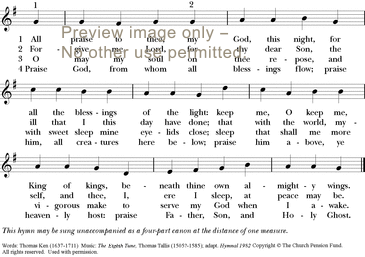
Tallis' Canon for Evensong


If you love this hymn, join us for Veterans Day Evensong on Nov. 11th at St. Stephen Anglican Church!


h/t to BettyLee for helping us wrap up the day with Libera!

Why I went into ministry


For the babes, of course.

Jubilate Deo!


Somehow I just cannot get enough of these boys' singing! The luscious scenery ain't hurting, either!

2009-10-23

Something Else to Sing About

In the last 3 months, forty more congregations have officially aligned with the ACNA, including another here in Kentucky! Details are at the parish blog.

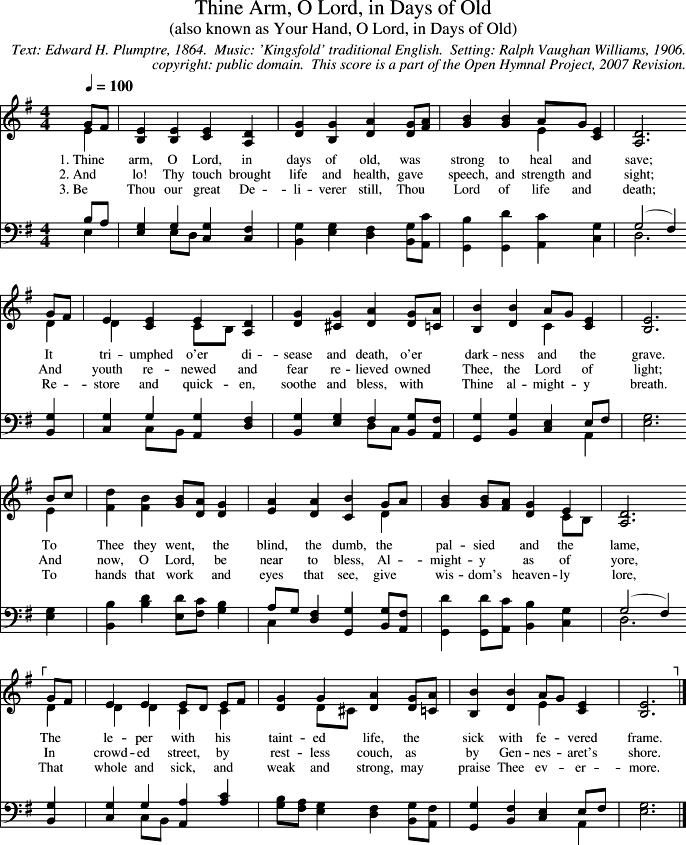
Thine Arm, O Lord

I needed to hear this song, and sing these truths, the past several days. I'm betting somebody else out there does to. Let's keep claiming Isaiah 53!

Kingsfold 3 vv. (Clyde McClendon, Organist)
Found at bee mp3 search engine


If you're of a different musical bent, you can enjoy Michael W. Smith's "Healing Rain."

Michael W. Smith - Healing Rain
Found at bee mp3 search engine

2009-10-22

My Response to the Recent Apostolic Constitution

Is best taken from Anglican Divine, Bp. Jeremy Taylor (sometimes known as the "Shakespeare of Divines" for his poetic style of expression):
"What can be supposed wanting in our Church in order to salvation? We have the Word of God, the Faith of the Apostles, the Creeds of the Primitive Church, the Articles of the four first General Councils, a holy liturgy, excellent prayers, perfect sacraments, faith and repentance, the Ten Commandments, and the sermons of Christ, and all the precepts and counsels of the Gospels. We … require and strictly exact the severity of a holy life. … We communicate often, our priests absolve the penitent. Our Bishops ordain priests, and confirm baptised persons, and bless their people and intercede for them. And what could here, be wanting to salvation?”

- Jeremy Taylor, Bp. of Down & Connor (1613-1667)

2009-10-21

Spong is Wrong

Recently, John Shelby Spong has shot his most recent salvo across the noses of those who continue to hold the catholic faith and ethic. He calls us the "b" word (bigot) and lumps us in with flat-earthers and slavery defenders (nice strawman). Just as he won't hold dialogue with flat-earthers or slavery defenders (which are where, again?) - so he won't discuss the ethics of same-sex erotic relationships with those who take the opposite side.
I have been part of this debate for years, but things do get settled and this issue is now settled for me. I do not debate any longer with members of the "Flat Earth Society" either.
In the Episcopal Church - of which he remains some sort of high-ranking ecclesial officer in good standing - this is called "openness" and indaba. (In other words, you need to be open to our innovations on the faith and discipline of the Church, and then listen while we tell you you're an oppressive, morally bankrupt simpleton.) Here are some more excerpts:
I have made a decision. I will no longer debate the issue of homosexuality in the church with anyone. I will no longer engage the biblical ignorance that emanates from so many right-wing Christians about how the Bible condemns homosexuality, as if that point of view still has any credibility....I have been part of this debate for years, but things do get settled and this issue is now settled for me. I do not debate any longer with members of the "Flat Earth Society" either.
Even advocates of the revisionist position* admit that the biblical evidence is on the side of the historic faith. But Mr. Spong cares little about the evidence, and even less about the authority of the Scriptures. (In spite of any vows he made to defend them as - some sort of high-ranking ecclesial officer in good standing.) Spong has already admitted that Scripture condemns homosexuality. You can watch it, but here's what he says:

Spong: But let me say that I do not disagree that homosexuality is condemned in Scripture. I do not agree with that.

Ankerberg: Yes, you’ve said that before.

Spong: I think that is obvious. It’s in Leviticus; it’s in the Sodom and Gomorrah story; it’s in the Pauline corpus at least, and probably some other places…

Ankerberg: All right, we’re…

Spong: The issue in my mind is not that. The issue is whether or not the people who lived at the time of the Bible and who wrote about homosexuality understood the scientific meaning of homosexuality.
But, as Jude warned us:
10 But these people blaspheme all that they do not understand, and they are destroyed by all that they, like unreasoning animals, understand instinctively. 11Woe to them! For they walked in the way of Cain and abandoned themselves for the sake of gain to Balaam’s error and perished in Korah’s rebellion. 12These are hidden reefs at your love feasts, as they feast with you without fear, shepherds feeding themselves; waterless clouds, swept along by winds; fruitless trees in late autumn, twice dead, uprooted; 13 wild waves of the sea, casting up the foam of their own shame; wandering stars, for whom the gloom of utter darkness has been reserved forever.
Speaking of casting up foam to their own shame...
I will no longer temper my understanding of truth in order to pretend that I have even a tiny smidgen of respect for the appalling negativity that continues to emanate from religious circles where the church has for centuries conveniently perfumed its ongoing prejudices against blacks, Jews, women and homosexual persons with what it assumes is "high-sounding, pious rhetoric."
Yeah...we conservative types are the sort that keep condemning the Jews with "high-sounding, pious rhetoric." Oh wait...that's the TEC revisionistas.

He even takes on Abp. Duncan, who has already responded to Mr. Spong's errors (begining with his 1998 12 Feces...er, Theses).**
I will dismiss as unworthy of any more of my attention the wild, false and uninformed opinions of such would-be religious leaders as Pat Robertson, James Dobson, Jerry Falwell, Jimmy Swaggart, Albert Mohler, and Robert Duncan.
Yeah...real nuanced. All of those guys are so practically alike as to make no distinction possible, much less desirable.

To be honest, Spong's problems go much deeper than his disregard for the Scripture's teaching on homosexual behavior. His big problem is with God Almighty. Spong casts scorn on the whole notion of theism, and has such an unnuanced fundamentalist materialist bent to his mindset that he's incapable of making any sense of the Resurrection or Ascension (much less the Incarnation).

And because of that, he is to be pitied. Because, one thing is sure - the striving is over. The battle is won, and there's no need to argue about it. Rather, it's time to simply proclaim the dogma and live into that truth. So here's some help to do just that.
Woodley Ensemble - The Strife is O'er (Palestrina)


Found at bee mp3 search engine


* Bailey, Homosexuality and the Western Christian Tradition, p. 30, and Spong himself during the “Martin/Spong Debate on Sexual Ethics,” transcript from The John Ankerberg Show.
cf. J. Gordon Melton, The Churches Speak On: Homosexuality; Official Statements from Religious Bodies and Ecumenical Organizations (Detroit: Gale Research, 1991), xxii.

**
John Spong: An apostle no longer

Beloved in the Lord,

It was with the most profound sorrow that I received and read the twelve theses of John Spong, recently published. At point after point these few sentences contain an explicit denial of the Christian faith. The incarnation and atoning sacrifice of Jesus Christ are denied; the efficacy of prayer and the work of the Holy Spirit are declared null; scripture and creeds are no longer trustworthy guides.

The man set aside as Bishop of Newark for the last twenty years has placed his theses before the Christian world and called for debate. The debate will be between those who profess the Christian faith and one who offers some other religion.

As I travel about our diocese, I see the pain and confusion which this shepherd-become-wolf is causing my people, not to mention that wider fellowship which is all the baptized in Christ Jesus. What this errant brother is doing must be named for what it is, not apostolate but apostasy.

What John Spong proposes as a reformed Christianity abandons every revealed essential. It is not Christianity. It is a counterfeit.

Everything I promised to do at my ordination requires that I speak clearly at this moment. Most especially pastoral compassion and gospel witness require a timely word both to the people of God and to the world at large.

We in the Episcopal Diocese of Pittsburgh -- like Christians in every age -- have our disagreements about how the boundaries of Christian response to the cultures and peoples among which we minister are to be shaped. When we disagree here, it is because of our deep conviction for and experience of the One God -- both transcendent and immanent -- revealed in Scripture, Tradition and Reason as Father, Son, and Holy Spirit. This is not the circumstance with which John Spong confronts us. We are confronted now by one who has become an outsider, one who by his philosophical, intellectual and credal shifts no longer reasons out of that bedrock of Christian faith that always shapes our local debates.

Pray for the Episcopal Church and for our Anglican Communion as the bishops prepare to gather at Lambeth. We are a worldwide fellowship of immense missionary faithfulness and of magnificent local diversity. Nevertheless, we must also be a communion that can recognize when an apostle is one no longer, or when a teaching must be declared utterly false

Faithfully your bishop,

+Robert VII Pittsburgh

2009-10-20

ReForm Responds re Rome

Reform Initial Response To ‘Apostolic Constitution’ Announcement

Revd Rod Thomas, chairman of Reform, makes four points as an initial response to today’s announcement from the Archbishops of Canterbury and Westminster:

“Anglicans concerned about protecting the basic Christian faith need not go to Rome, because we now have the Fellowship of Confessing Anglicans (FCA (UK)) which holds together those who want to stop the orthodox faith being eroded. We can remain Anglican. Furthermore, the FCA Primates have recognised that problems with episcopal oversight are arising here in the UK. They have expressed the hope that these will be solved locally, but if not, they are willing to step in.”

“This development highlights the need for robust legislative provision to cater for those who cannot agree to women bishops, such as that recently suggested by the Revision Committee.”

“If priests really are out of sympathy with the C of E’s doctrine (as opposed to the battles we are having over women’s ministry and sexuality), then perhaps it is better they make a clean break and go to Rome. However, when they do, they will have to accommodate themselves to Rome’s top-down approach to church life, whereas the C of E has always stressed the importance of decision making at the level of the local church.”

“It is illusory to pretend that this development is an outcome of ecumenical dialogue. It illustrates the difficulties the C of E faces and the need for stronger leadership, rather than the ‘softly softly’ approach so far taken to those holding liberal views who are splitting the church.”

No Place Like Rome

Big news from the See of Rome and the See of Canterbury. Details here.

2009-10-17

Bp. Ackerman and Suspicion of Deposition

Everytime I see this picture I'm more and more convinced that she's cackling "I'll get you my pretty! You and your little dog, too!"
Episcopal News Service reports that Dr. Katharine Jefferts Schori notified Bp. Keith Ackerman by mail and email October 16 that she has accepted the former Bishop of Quincy's voluntary renunciation of ordained ministry in the Episcopal Church.
In a statement released by the Presiding Bishop's office October 16, JeffertsSchori cited Title III, Section 7 of the Canons: "I have accepted the renunciation of the Ordained Ministry of this Church, made in writing to me in July 2009 by the Rt. Rev. Keith L. Ackerman, Bishop of Quincy, Resigned who is, therefore, removed from the Ordained Ministry of this Church and released from the obligations of all Ministerial offices, and is deprived of the right to exercise the gifts and spiritual authority as a Minister of God's Word and Sacraments conferred on him in Ordinations.”

According to the statement, Jefferts Schori had thanked Ackerman in an October 7 letter "for your follow up note regarding your plans to function as a bishop in the Diocese of Bolivia in the Province of the Southern Cone. As you know, there is no provision for transferring a bishop to another Province. I am therefore releasing you from the obligations of ordained ministry in this Church.”

The full text of the her October 7 letter may be read here.

From an Anglo-Catholic perspective, I've got to chuckle a bit. Since his firm conviction is that Dr. Schori cannot be a presbyter, much less a bishop in the Church of God, what effect can this possibly have? The only thing it means is that if someone catches him confirming or ordaining or otherwise acting episcopally or sacerdotally in a TEC-affiliated building, he might be escorted out by police (should locals be inclined to report it).

He had maintained his position as a retired TEC bishop specifically so that he could continue to provide confirmations, dedications, chrism masses, etc. for FiF churches in TEC (only at the invitation of the ordinary, of course). In case Dr. Schori isn't familiar with these functions, this is what bishops do in the church.

I think the most that can be said about her unilateral action is that Bp. Keith is no longer under any obligation to advocate for the Millenium Developmental Goals. Now he can get back to praying for God's reign, rather than trying to pretend.

2009-10-14

This is the Feast


New setting for "This is the Feast" from Alleluia! -- a brand new setting for the communion mass, performed by The Braeded Chord.

Alleluia! is filled with memorable melodies and beautiful instrumentation set to upbeat rhythms. While it is fully scored for acoustic instruments-- piano, guitar, flute, and violin, it easily translates to contemporary instruments like drum, bass, and electric guitar (lead sheets available), as this recording demonstrates. Alleluia! bridges the gap between ancient tradition and modern worship.

While I appreciate its upbeat tempo, I'd like to hear the whole service. Also, it strikes me that with the writing duo's natural harmonies, something might be lost in trying to sing this in unison. Since I haven't seen the lead, I don't know how well this is compensated for, but I try to eschew service music that can only be performed by skilled singers / harmonists.

(Nothing wrong with uber-complicated introits, sequences, offertories, etc., but I think the modern church music trend runs the danger of the Medieval & baroque choral tradition of taking singing away from the people through needless complexity.)

(I'm also unrepentantly satisfied with the two - count'em, TWO - settings of this hymn already in the 1982 Hymnal /1979 LBW.)

2009-10-12

Hurts, doesn't it?

Still think you're making sense railing against Israel?

2009-10-09

How to Win the Nobel Peace Prize In 12 Days

Cartoon source

I can hardly believe it took them that long. He'd already written an autobiography at 30...surely he already knew how great he was, right? After nominating Hitler and Tookie the Cop-Killah, and actually awarding this prize to Yassir (strap-a-bomb-to-a-kid) Arafat, I can hardly see how this award has any credibility left.

Editor's Note: Although President Obama had only been in office for 12 days before the nominations for this year's Nobel Peace prize closed the entire process actually takes a full year. According to the official Nobel Prize Web site invitation letters are sent out in September. Every year, the Norwegian Nobel Committee sends out thousands of letters inviting a qualified and select number of people to submit their nominations for the Nobel Peace Prize. The deadline to submit nominations is February 1. -- Two hundred five names were submitted for the 2009 Nobel Peace Prize, 33 of which are organizations. A short list of nominees is prepared in February and March. The short list is subject to adviser review from March until August. At the beginning of October, the Nobel Committee chooses the Nobel Peace Prize Laureates through a majority vote. The decision is final and without appeal. The names of the Nobel Peace Prize Laureates are then announced."

Barack Obama won the Nobel Peace Prize this morning. Over the last decade the only requirement to win the prize was that the nominee had to be critical of George W. Bush (see Al Gore, Mohamed El Baradei and Jimmy Carter).

President Obama has broken new ground here. Nominations for potential winners of the 2009 Nobel Peace Prize ended on February 1. The president took office only 12 days earlier on January 20.

Let’s take a look at the president’s first 12 days in the White House according to his public schedule to see what he did to deserve a Nobel Peace Prize:

January 20: Sworn in as president. Went to a parade. Partied.

January 21: Asked bureaucrats to re-write guidelines for information requests. Held an “open house” party at the White House.

January 22: Signed Executive Orders: Executive Branch workers to take ethics pledge; re-affirmed Army Field Manual techniques for interrogations; expressed desire to close Gitmo (how’s that working out?)

January 23: Ordered the release of federal funding to pay for abortions in foreign countries. Lunch with Joe Biden; met with Tim Geithner.

January 24: Budget meeting with economic team.

January 25: Skipped church.

January 26: Gave speech about jobs and energy. Met with Hillary Clinton. Attended Geithner's swearing in ceremony.

January 27: Met with Republicans. Spoke at a clock tower in Ohio.

January 28: Economic meetings in the morning, met with Defense secretary in the afternoon.

January 29: Signed Ledbetter Bill overturning Supreme Court decision on lawsuits over wages. Party in the State Room. Met with Biden.

January 30: Met economic advisers. Gave speech on Middle Class Working Families Task Force. Met with senior enlisted military officials.

January 31: Took the day off.

February 1: Skipped church. Threw a Super Bowl party.

So there you have it. The short path to the Nobel Peace Prize: Party, go to meetings, skip church, release federal funding to pay for abortions in foreign countries, party some more.

Good grief.

Read more Tommy De Seno at www.JustifiedRight.com.

h/t Bp. Chuck

Ready for Justice?


It's about time they got rid of that nebbish do-gooder, Kal-el.

UNINSURED

Some quarters are screaming because "44,789 Americans die every year because they have no health insurance."

How humanitarian of them.

Now, since that's 1/30th the number of Americans every year who are murdered in the womb, can we get some perspective on the moral opprobrium?

2009-10-08

From the Homily Against Idolatry

I want to give full vent to the breadth of Anglican experience, so in contrast to my post from the Allentown Tracts, I offer this selection from the Book of Homilies:
...Wee should not worship Images, and that we should not have Images in the Temple, for fear and occasion of worshiping them, though they be of themselves things indifferent: for the Christian is the holy Temple and lively Image of GOD, as the place well declareth, to such as will read and weigh it. And whereas all godly men did ever abhor that any kneeling and worshiping or offering should bee used to themselves when they were alive (for that it was the honour due to GOD only) as appeareth in the Acts of the Apostles by S. Peter forbidding it to Cornelius (Acts 10.25-26), and by S. Paul and Barnabas forbidding the same to the Citizens in Lystra (Acts 14.14-15): Yet wee like mad men fall down before the dead idols or images of Peter and Paul, and give that honour to sticks and stones, which they thought abominable to be given to themselves being alive.

...For they were then Preaching Bishops, and more often seen in Pulpits, than in Princes palaces, more often occupied in his legacy, who said, "Go ye into the whole world, and preach the Gospel to all men," than in Embassies and affairs of Princes of this world....

Now it remaineth for the conclusion of this Treatise, to declare as well the abuse of Churches and Temples, by too costly and sumptuous decking and adorning of them, as also the lewd painting, gilding, and clothing of Idols and Images, and so to conclude the whole treatise.

...True Religion then and pleasing of GOD, standeth not in making, setting up, painting, gilding, clothing and decking of dumb and dead images (which be but great puppets and babies for old fools in dotage, and wicked idolatry, to dally and play with) nor in kissing of them, capping, kneeling, offering to them, in sensing of them, setting up of candles, hanging up of legs, arms, or whole bodies of wax before them, or praying, and asking of them or of Saints, things belonging only to GOD to give. But all these things bee vain and abominable, and most damnable before GOD. Wherefore all such do not only bestow their money and labor in vain: but with their pains and cost purchase to themselves GODS wrath and utter indignation, and everlasting damnation both of body and soul. For ye have heard it evidently proved in these Homilies against idolatry, by GODS word, the Doctors of the Church, Ecclesiastical histories, reason, and experience, that Images have been and be worshiped, and so idolatry committed to them by infinite multitudes, to the great offense of GODS Majesty, and danger of infinite souls, and that idolatry can not possibly be separated from Images set up in Churches and Temples, gilded and decked gloriously, and that therefore our Images be indeed very Idols, and so all the prohibitions, laws, curses, threatenings of horrible plagues, as well temporal as eternal, contained in the holy Scripture, concerning idols, and the makers, and maintainers, and worshipers of them, appertain also to our Images set vp in Churches and Temples, and to the makers, maintainers, and worshipers of them.
The whole is available here.

I'm struck by several things. First, that the attack seems more on their use in public worship than on their use in private piety. Late medieval practice was replete with solemn processions of statues and images and icons - with flowers and food laid at their feet. You can still see this in some Latin American countries and in the Philippines. If that's what the homileticians had in mind, I agree that it binds mens consciences and corrupts true worship.

However, as St. John of Damascus was to defend, a properly formed conscience and intellect does not stumble at this and instead elevates the mind and spirit to God upon these reminders. (Much as the most iconoclastic Presbyterian would be wont to do upon seeing the rainbow, God's covenant - and material - reminder of his promised goodness.) These excesses are not seen in even the most 'anglo-catholic' parishes. Rarely is incense used with them (as it almost always is in the Eastern tradition); instead, you normally find a candle burning near them, but not in front of them. Similarly, perhaps the homily - removed from the excesses of late medieval piety - does not speak with similar comprehensiveness. For even God's own law against idolatry was couched in the very book that gave command to fashion images of angels and natural objects for use in the divinely-appointed Tabernacle / Temple.

Secondly, there is an undercurrent of populist scorn for opulence and wealth. The Roman Church had long meddled in the affairs of princes (sometimes a good thing, sometimes a bad thing). One of the abuses that caused a rift between England and Rome was the appointment of French or Italian clergy to wealthy benefices in England. Absentee clergy were paid well on the tithes of the land, but were not there to provide any pastoral care or preaching. Several episcopal sees were even thus abused. Thus, there is a concern in the homily for the clergy to be present as the chief preachers & teachers, rather than to let images instruct the unlearned (i.e. the illiterate). Moreover, wealth was not to be used in gilding buildings and images, but rather turned toward the glory of God by upbuilding his people - the true church, and habitation of the Most High.

Is this still a problem today? I'm sure it is in some places - whether it be a little catholic parish that insists on silvered images or a megachurch that cuts outreach budget in order to install the newest sound system and LCD screens. But by and large, I think Anglican churches of all stripes do their best to maintain a balance here between providing for the people a place of dignity to worship, and providing services that restore people to dignity. Sometimes a sound system could be just the thing. (A little lady in our parish can barely hear me because our mic system is messed up.) Sometimes a beautiful ambo to show the honor we give to the unadorned reading of the Word of God can serve that purpose.

Third, I want to point out that the reform of the English Church was at its best when handled synodically by her pastors - whether the presbytery or the episcopacy. Church reforms can be hijacked by small but influential cabals of persons, and thus the gradual transformation and growth in grace is tampered with. In TEC, you see this with a small, but vocal and well-placed minority pushing for a new religion to supplant Christianity. I think we also saw it too, in the English Reformation. While I admire Cranmer a great deal, I can't help but think that his proximity to the King made his (and his associates) voices disproportionately strong. It was a hard time, and maybe that's what it took, but history has to have a say as well regarding the natural (supernatural?) development of the Church.

I think the way that the church was rocked back and forth between positions for nearly 125 years is proof that the reform was not to be the work of one man - or one generation. Just as Reformed Scholasticism refined (and in some ways departed from) the positions of the first Reformers (Calvin, Luther, Zwingli), so also the succession of Elizabeth I (and her compromise), the reforms of Abp. Laud, and the patristic work of the Caroline divines had a necessary and definitive stamp to leave on the character of the Church of England as it grew into her recovered identity as a Reformed, Evangelical, Catholic, Apostolic Church. While I'm not necessarily a Tractarian, they also had a fundamental place in helping the Church recover her spiritual nature - and prepared her to counter the ugliness of modernized secular life with the comprehensive beauty of the catholic faith.

This is still a work in progress for me, as I get over my presbyterian allergy to "all things catholic" and avoid the excess enthusiasm of my pentecostal upbringing that says "just jump in head first and let God sort it all out!" I appreciate your patience with me.

THE VENERATION OF HOLY IMAGES

LIGHTING A CANDLE.

In English cathedrals these days it is common to find stands of lighted candles. In York Minster there is just such a stand.On a table nearby there is a notice saying that it is a nice idea to light a candle and pray. The use of candles has become very popular, not only as a symbol of prayer, but to mark various kinds of aspirations-for the freedom of hostages, to emphasize all manner of political and social issues, and as a mark of public sorrow. Lights of various kinds are used in a number of world religions. and Christians are heirs, to a certain extent, of ancient Jewish customs. Is there, then, a specific Christian use of candles and lamps?

THE LIGHT OF CHRIST.

Beyond the obvious practical need to give light in dark buiIdings, there are two uses which have special Christian significance. The first is the symbolic use, representing Christ as the Light of the world. The gift of a lighted candle at Baptism, the blessing of candles at Candlemass and the ceremonies of the New Fire and the Easter Candle are all examples of this use of lights.

LIGHTS OF HONOUR.

The second use is that of candles and lamps in the sanctuaries of churches and those which are placed in front of statues and pictorial images (icons). It is thought that this custom originated in the ancient Roman manner of honouring their chief magistrates, the Consuls, by carrying lighted candles or torches before them in public. This honorific custom was adopted by the Roman emperors, and then passed over into the ceremonies of the Church. The candIes which now stand on our altars are permanent versions of the candles carried in procession at the beginning of Mass and in full ceremonial, the solemn reading of the Gospel is still attended by portable lights. This second use is intended to mark out with honour objects and actions of special sacredness-for this reason we keep a light burning permanently before the Blessed Sacrament when it is reserved.

LIGHTS BEFORE THE IMAGES.

The same idea of paying honour is attached to the lighting of candles or lamps before the images which depict Our Lord and His Holy Mother, and the Saints. Such acts have a special significance and history attached to them.

THE THREAT TO THE GOSPEL.

We are only too familiar with the unhappy fact that most Churches are sliding toward secularism. Faith in the living Christ becomes a mere philosophy. The joy of the Holy Spirit is replaced by the dullness of humanistic moralism. This is not the first time the Gospel has been threatened in this way-although, in our day, it may have been taken to greater lengths than before.

THE ATTACK ON THE IMAGES.

The threat appeared clearly for the first time some twelve hundred years ago and the distance in time makes no difference to the effect. A Byzantine Emperor, Leo Ill, unleashed an attack on the use of images in the worship of the Church. Leo and his followers accused orthodox Christians of idolatry, and demanded that, in obedience to the Second of the Ten Commandments, the use of the images should cease. Many people agreed with Leo-his message seemed simple, honest, and pious too. It was true that there were people who acted as though the images had some supernatural power of their own. The supporters of Leo's movement became known as "The Destroyers of the images (icons)" or 'Iconoclasts'. Few realised that Iconoclasm was actually an attack on the True Faith. For one thing it put the clock back to the Old Testament-making Christianity a religion of rules and not of salvation through grace. Again it made Christianity out to be either a coldly intellectual thing, or a mere matter of emotional response.

HONOUR NOT WORSHIP.

Those who wished to honour the images knew that they had centuries of Christian tradition to support them. They knew also that the honour they paid to the icons was quite different from their worship of the Holy Trinity (they even had distinct words to make sure that there was no confusion). There was, though, need for someone to point out to orthodox believers the deeper significance of honouring the icons. The man who did this was a Christian monk who had at one time been a high government official representing the Christian subjects of the Caliph of Damascus.

ST. JOHN OF DAMASCUS.

St John of Damascus pointed out that the Incarnation of the Son of God as Jesus of Nazareth changed completely our understanding of God's relationship with His creation and of the Second Commandment against idolatry. "In earlier times, he wrote, "God, who is without form or body, could never be depicted. But now, when God is seen in the flesh conversing with men, I make an image of the God I see. I do not worship matter: I worship the Creator of matter Who became matter for my sake. Who willed to take His abode in matter: Who worked out my salvation through matter. Never will I cease honouring the matter which wrought my salvation. I honour it, but not as God ... Because of this I salute all remaining matter with reverence, because God has filled it with grace and power." St John could see that the attack on the images concealed a denial of the reality of the Incarnation of Christ and a rejection of the sacramental way in which the new life in Christ is received by us. At the Seventh Ecumenical Council, which restored the place of images in the life of the Church, a senior bishop exclaimed of Iconoclasm. "This is the worst of heresies because it includes them all."

THE REVIVAL OF ICONOCLASM.

The calling of the Seventh Ecumenical Council proved a turning point in the struggle against Iconoclasm-a battle which, nevertheless, still had many years to run. In the later Middle Ages when the true significance and use of the images tended to be obscured by superstition, there was a revival of Iconoclasm and this attitude became part of the Reformation programme. In consequence the older formularies of post-Reformation Anglicanism are definitely Iconoclastic in character and this is why Anglicanism has never accepted officially the decisions of the Seventh Council.

MODERN ICONOCLASM.

The modern influence of Iconoclasm is not to be seen in church buildings with plain walls and clear glass, but in a reducing of the Faith to 'rational' principles, an emphasis on secular issues at the expense of spiritual need. The lighting of a candle in a cathedral becomes an expression of the human need to pray, not an acknowledgement of the Christ to Whom we pray. In an Anglican Catholic Church we find should always find an opportunity provided to light a candle before an image of Christ, His Holy Mother, or one of the Saints. Here we have prayer meaningfully directed and honour rightly bestowed. Such shrines are a practical fulfilment of the decrees of the Seventh Council which the ACC has never hesitated to accept.

A WINDOW ON HEAVEN.

An image is never an invitation to idolatry. It may depict Our Lord. or His Holy Mother. It may represent Our Lady with the Child Jesus, again it may represent one of the Saints, a scene from the Scriptures. or an incident in the subsequent life of the Church. In all cases the image is a window upon the realities of the Heavenly Kingdom, never an object of adoration in itself. St. Basil the Great said that the honour paid to the image passes to the original. So when we light candle in front of an image we are honouring Christ Himself, recalling his Incarnation and the way in which, through His Death and Resurrection, He lives, by the power of the Holy Spirit, in the lives of His Saints. Our prayers through or to the Saints are prayers to Christ Himself and, in Christ, to the Holy Trinity.

THE FULLNESS OF THE GOSPEL.

When we honour the images we are honouring the fullness of the Gospel Faith. The proclaiming of this Gospel, in word and deed, is our task as members of the Body of Christ. It is to the fullness of the Gospel that, as members of the ACC in fellowship with all Catholic believers, we have a joyful commitment-a commitment we renew every time we light a candle before the holy images.


h/t The Allentown Tracts

2009-10-07

Favorite Setting of the Aaronic Blessing

Facebookers & email subscribers will need to visit the original post.

2009-10-06

Troubled Teen Tuesday

Some people seem to think that abstinence-focused sex education is somehow behind the times, or even dangerous. The only thing I have to say to that is, besides the weight of history, scientific research backs us up every time.
We didn’t know until recently that the brain area that is responsible for making rational, thought-out decisions, the area that considers the pros and cons and consequences of decisions, is immature in teens. The circuits aren’t complete; the wiring is unfinished. Sex educators insist that, like adults, teens are capable of making responsible decisions, they just lack information about sexuality and access to contraceptives. So the way to fight sexually transmitted infections and teen pregnancies, these authorities argue, is to provide teens with information and contraceptives, and teach them skills like how to say “no” and how to put on a condom. But current neuropsychological research does not support this stance. We know now that teens’ poor decisions are likely due not to lack of information, but to lack of judgement. And there is only one thing that will bring that: time.
Really? We didn't know that teens are immature and incapable of responsibly handling their sexual urges? You'd have to have come of age in the 1960s and 1970s to be that naive.

See more at MercatorNet.

2009-10-05

Church History on the Quick

4 minute video of 2000 years of church history!

The worst part...I know a seminary where you can get an MDiv and you don't even have to know as much history as is in this!