 People at Indexed...I bow to you!
Showing posts with label luther. Show all posts
Showing posts with label luther. Show all posts
2009-12-29


2009-10-31

2009-06-25
Justice and the Christian
The following is from the Acton Institute. It really hit home for me because the seminary I attended felt it had a strong impulse for social justice. Unfortunately, it pretty much was a reiteration of the Democratic party's platform (especially its most radical elements). Don't get me wrong - the social righteousness ("family values") given by the more conservative schools are normally a reflection of the Republican party's platform (especially its most radical elements). Them's the brakes. But what made the former more odious - besides my immediate proximity - was the divorcing of justice from the wrath that God rightly has on sin, and the way that wrath was propitiated and expiated on the cross. Constantly deprecating the substitutionary atonement of Christ - as is done at most liberalized seminaries - means that we take a fundamental ethic rooted in human equality (granted - creation is a valid starting point, think imago dei, though most liberals don't hold to creation). For Christians, I think we need to start any ideas of reconciliation and right-setting in the cross of Christ and his atonement for our sin.
I'd also mention that the merciful grace and charitable love of Christ can easily be ignored at more conservative seminaries. However, having attended both Southern Seminary and Louisville Seminary, I haven't experienced direct evidence of that (SBTS was a very loving and supportive and diversity-affirming institution). Maybe if I'd gone to Bob Jones or something like that...

Just how zealous for justice ought Christians be? I admit that I’m always just a bit put off when folks describe the prime mission of Christians as pursuing justice in the world. Let’s not forget that the foundational Christian reality is forgiving love on the basis of the divine justice manifested on the cross.
Or as Luther puts it in his commentary on Romans (emphasis added),
This is the reason (if I may speak of myself) why even hearing the word “justice” nauseates me to the point that if someone robbed me, he would not bring me such grief. And yet the word is always sounding in the mouths of the lawyers. There is no race of men upon the earth who are more ignorant about this matter than the lawyers and the good-intentioners and the intellectuals. For I in myself and with many others have had the experience that when we were righteous, God laughed at us in our righteousness. And yet I have heard men who dared to say: “I know that I have righteousness, but God does not notice it.” That is true, but it is a righteousness only in one particular; but for this God cares nothing. Therefore the only complete righteousness is humility, which subjects everyone to everyone else and thus gives everything to everyone, as Christ says to John: “Thus it is fitting for us to fulfill all righteousness” (Matt. 3:15).
Thus in Dan. 3 Azariah confesses that he and his friends are at one and the same time suffering justly and yet are afflicted with evil, namely, at the hands of the wicked king. For even though he who acts does so unjustly, yet he does not do so to the person who suffers; for that person suffers justly. For by what legal right does the devil possess men? Or by what legal right does an evil hangman hang a thief? Certainly not in his own right, but by that of the judge. Thus men who glory in their own righteousness are unwilling to listen to the supreme Judge, but only to their own judgment, and because in respect to their victim they are innocent, they think that they really are innocent in every way.
Therefore since before God no one is righteous, absolutely no injustice can be done to a person by any other creature, even though he may have justice on his side. Thus all cause for contention is taken away from men. Therefore, to whomsoever an injury is done or an evil comes in return for his good actions, let him turn away his eyes from this evil and remember how great his own evil is in other respects, and then he will see how good the will of God is even in this evil which has come upon him; for this is what it means to be renewed in one’s mind and to be changed into another state of mind and to be wise in the things of God. Thus it is definite that Peter would not have glorified God if he had girded himself and gone where he wanted to go, even though he would not have walked a wicked path, but the highest road of righteousness. But after this road of his own righteousness was prohibited and he went where he did not want to go but where another wanted, then he glorified God. So also we cannot glorify God unless we do what we do not wish, even in the case of our own works of righteousness, indeed, particularly in the case of our own righteousness, our own counsels, or our own strength. And thus to hate our own life and to will against our own will, to be wise in opposition to our own wisdom, to confess sin in the face of our own righteousness, to heed foolishness spoken against our own wisdom, this is “to take our cross” (Matt. 10:38), “to be His disciples” (Luke 14:27), and “to be transformed by the renewal of your mind.”
Don’t get me wrong. I acknowledge that the ethical norm in social ethics is “justice.” But out of sheer humility let’s not be too zealous for justice, at least not without consciously, intentionally, and systematically connecting it to divine love.
2009-06-04
Martin Luther on the Use of the Law
 "It is exceeding necessary for us to know this use of the Law. For he that is not an open and a public murderer, an adulterer, or a thief, holds himself to be an upright and godly man; as did the Pharisee, so blinded and possessed spiritually of the devil, that he could neither see nor feel his sins, nor his miserable case, but exalted himself touching his good works and deserts. Such hypocrites and haughty saints can God by no better means humble and soften, than by and through the Law; for that is the right club or hammer, the thunderclap from Heaven, the axe of God's wrath, that strikes through, beats down, and batters such stock-blind, hardened hypocrites. For this cause, it is no small matter that we should rightly understand what the Law is, whereto it serves, and what is its proper work and office. We do not reject the Law and the works thereof, but on the contrary, confirm them, and teach that we ought to do good works, and that the Law is very good and profitable, if we merely give it its right, and keep it to its own proper work and office."
2009-02-05
Prayer to the Holy Ghost by Martin Luther

We now implore the Holy Ghost
For the true faith, which we need the most,
That in our last moments He may befriend us
And, as homeward we journey, attend us.
Lord, have mercy.
Shine in our hearts, O most precious Light,
That we Jesus Christ may know aright,
Clinging to our Savior, whose blood hath bought us.
Who again to our homeland hath brought us.
Lord, have mercy.
Thou sacred Love, grace on us bestow,
Set our hearts with heavenly fire aglow
That with hearts united we love each other,
Of one mind, in peace with every brother.
Lord, have mercy!
Thou highest Comfort in every need,
Grant that neither shame nor death we heed,
That e'en then our courage may never fail us
When the Foe shall accuse and assail us.
Lord, have mercy!
Do you pray to the third person of the Trinity at your church? Why or why not?
2009-01-08
Richard John Neuhaus, 1936-2009
 Today, Fr. Richard John Neuhaus, editor of First Things, has gone to his reward. He now lives in that perfect unity of the saints for which he struggled his whole life (leaving the Lutheran church and continuing his ministry in communion with the Bishop of Rome). I pray that he died in that full assurance of salvation that is his birthright (restored to the church by the efforts of Dr. Luther himself).
Ora pro eo.
Saints of God, come to his aid!
Come to meet him, angels of the Lord!
[Response] Receive his soul and present him to God the Most High.
May Christ, who called you, take you to himself;
may angels lead you to Abraham's side.
[Response] Receive his soul and present him/her to God the Most High.
Give him eternal rest, O Lord,
and may your light shine on him for ever.
[Response] Receive his soul and present him to God the Most High.
Let us Pray.
All-powerful and merciful God,
we commend to you, Richard, your servant.
In your mercy and love,
blot out all the sins he has committed through human weakness.
In this world he has died: let him live with you for ever.
We ask this through Christ our Lord.
AMEN.
V/. Eternal rest grant unto him, O Lord.
R/. And let perpetual light shine upon him.
V/. May he rest in peace.
R/. Amen.
V/. May his soul and the souls of all the faithful departed,
through the mercy of God, rest in peace.
R/. Amen.
2008-09-23
What is best in life?
If you ask Conan the Barbarian what is best in life, he'll give you a straight answer.
He couldn't be more wrong.
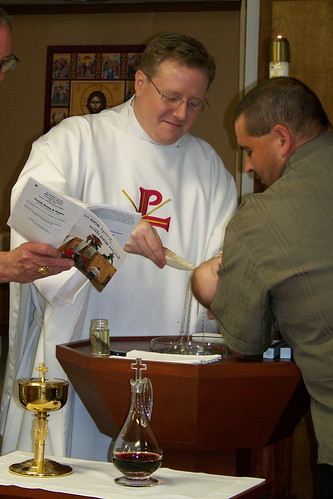
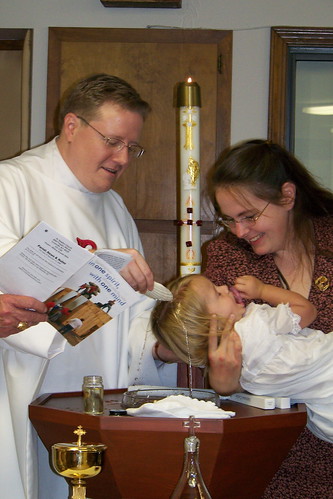
What is better than that is to bring your children into the household of faith by covenant baptism.
Presenting Lillianah Kathryn-Marie and Elias Zebulun Larimer - born anew of water and the word (John 3:5) on the Feast of St. Matthew the Apostle & Evangelist (Sept. 21, 2008).
"...here Christ is speaking of baptism, of real and natural water such as a cow may drink, the baptism about which you hear in the sermons on this subject. Therefore, the word water does not designate affliction here; it means real, natural water, which is connected with God's word and becomes a very spiritual bath through the Holy Spirit or through the entire Trinity. Here Christ also speaks of the Holy Spirit as present and active, in fact, the entire Holy Trinity is there. And thus the person who has been baptized is said to be born anew. In Titus 3:3 Paul terms baptism 'a washing of regeneration and renewal of the Holy Spirit.' In the last chapter of Mark we read that 'he who believes and is baptized will be saved.' (Mark 16:16.) And in this passage Christ declares that whoever is not born anew of the water and the Holy Spirit cannot come into the kingdom of God. Therefore, God's words dare not be tampered with."
(Martin Luther's Sermons on the Gospel of Saint John, Vol. 22, p. 283.)
He couldn't be more wrong.
What is better than that is to bring your children into the household of faith by covenant baptism.
Presenting Lillianah Kathryn-Marie and Elias Zebulun Larimer - born anew of water and the word (John 3:5) on the Feast of St. Matthew the Apostle & Evangelist (Sept. 21, 2008).
"...here Christ is speaking of baptism, of real and natural water such as a cow may drink, the baptism about which you hear in the sermons on this subject. Therefore, the word water does not designate affliction here; it means real, natural water, which is connected with God's word and becomes a very spiritual bath through the Holy Spirit or through the entire Trinity. Here Christ also speaks of the Holy Spirit as present and active, in fact, the entire Holy Trinity is there. And thus the person who has been baptized is said to be born anew. In Titus 3:3 Paul terms baptism 'a washing of regeneration and renewal of the Holy Spirit.' In the last chapter of Mark we read that 'he who believes and is baptized will be saved.' (Mark 16:16.) And in this passage Christ declares that whoever is not born anew of the water and the Holy Spirit cannot come into the kingdom of God. Therefore, God's words dare not be tampered with."
(Martin Luther's Sermons on the Gospel of Saint John, Vol. 22, p. 283.)
2008-06-24
Please Stand for the Processional
 I had no idea that the Imperial March could be so worship-inspiring. I don't know how I'll cope. Was anyone else aware that Chad Vader was now in orders?
BTW, these are some sort of Scandinavian Lutherans. They're the only ones who wear the chasuble with a surplice, and that distinctive neck ruffle.
2008-06-20
Offending against Love or Christ? What we can safely tolerate.
"Doctrine is heaven, life is earth. In life there is sin, error, uncleanness, and misery, mixed, as the saying goes, 'with vinegar.' Here love should condone, tolerate, be deceived, trust, hope, and endure all things (1 Cor. 13:7); here the forgiveness of sins should have complete sway, provided that sin and error are not defended. But just as there is no error in doctrine, so there is no need for any forgiveness of sins. Therefore there is no comparison at all between doctrine and life. 'One dot' of doctrine is worth more than 'heaven and earth' (Matt. 5:18); therefore we do not permit the slightest offense against it. But we can be lenient toward errors of life. For we, too, err daily in our life and conduct; so do all the saints, as they earnestly confess in the Lord's Prayer and the Creed. But by the grace of God our doctrine is pure; we have all the articles of faith solidly established in Sacred Scripture. The devil would dearly love to corrupt and overthrow these; that is why he attacks us so cleaverly with this specious argument about not offending against love and the harmony among the churches."
- Martin Luther, Luther’s Works 27: 41-42
2008-06-19
Reminder to those who allege reductionism
Since the California ruling on Same Sex Marriage, my inbox has been full of requests for money and activism to support traditional marriage. Some of the Christian organizations even ask me to pray. (Shame on the others!) There have been insightful commentaries and legal musings (can you say balkanization), along with the standard tripe. There's just a tremendous amount of energy going toward dealing with the issue.
Plenty of people on the other side say that the right is obsessed with homosex. Now that's like saying that during a flood, Iowans are obsessed with sandbags. But even if we do come off as a bit fixated, there's a reason beyond morbid obsession that the battles rage these days over sexuality:
Plenty of people on the other side say that the right is obsessed with homosex. Now that's like saying that during a flood, Iowans are obsessed with sandbags. But even if we do come off as a bit fixated, there's a reason beyond morbid obsession that the battles rage these days over sexuality:
If I profess with the loudest voice and clearest exposition every portion of the Word of God except precisely that little point which the world and the devil are at that moment attacking, I am not confessing Christ, however boldly I may be professing Him. Where the battle rages there the loyalty of the soldier is proved; and to be steady on all the battle front besides, is mere flight and disgrace if he flinches at that point.
(Luther's Works. Weimar Edition. Briefwechsel [Correspondence], vol. 3, pp. 81ƒ.)
In each age, we are asked to give allegiance to the powers of this world or to the Kingdom of God and His Christ. Everyday, we choose sides. The place where Christians must rush in to fill the gap is where the nay-sayers allege that Christ's Kingdom does not extend. If it is sexuality, we will speak of His Lordship there. If it is economics, we must contend for him there. If it is freedom of conscience, we will challenge those against it.
Right now, a tiny contingent of the population* is waging an enormous rhetorical (and now political) campaign against Christ's Lordship over human relationality & sexuality. It's a big deal, because Paul describes that sacred bond as a mystery illustrative of Christ and His Church. As stewards of the mysteries, our service to Christ cannot constitute an erosion of that union.
If nothing else, think of the children and the minorities.
*Less than 3% of men and 1.5% of women, according to Sex in America: A Definitive Survey, Robert T. Michael, John H. Gagnon, Edward O. Laumann, and Gina Kolata, Little, Brown and Company, Boston, 1994, p. 176.
Right now, a tiny contingent of the population* is waging an enormous rhetorical (and now political) campaign against Christ's Lordship over human relationality & sexuality. It's a big deal, because Paul describes that sacred bond as a mystery illustrative of Christ and His Church. As stewards of the mysteries, our service to Christ cannot constitute an erosion of that union.
If nothing else, think of the children and the minorities.
2007-07-18
Insufficient reflection on Sola Fide
Some people argue that while Christians are fussing over doctrine, they are ignoring the work that Christ left for us to do. I retort that that those who don't understand the work Christ did while he was on earth are hardly capable of continuing it in any meaningful way! So talk of Christianity that is separated from truth claims on the nature of Christ's work is not particularly defensible. Further, I think that history would show how Christianity is, historically, uniquely tied to its truth claims (both dogma and pragma) in a way that other faiths (often being more practice-driven) are not. This is merely a matter of history, not of theology. And secular thinkers have said as much in recent days.
A colleague's recent thoughts on justification and faith brought to mind Luther's famous statement, that "the doctrine of justification is the article by which the church stands or falls." He was referring to its articulation in the fourth article of the Augsburg Confession that justification is by faith alone in Christ alone (Melancthon's commentary on which may be found here). Similarly, Calvin said that justification by faith is "the principle hinge by which religion is supported." To be a Protestant means that you understand salvation, however you parse that (salvation from Hell and God's wrath, restoration to right relationship with God and others, etc.) is accomplished by Jesus Christ's work plus nothing! The recent Cambridge Declaration reiterated the belief, calling sola fide the "chief article" of Protestant Christianity.
I think that we lose perspective on this belief when we aren't anchored in understanding the history surrounding it. The Roman Catholic Church, for all its errors and excesses, was doing a decent job of urging charity and contributing to social cohesion. It had hospitals, schools, diplomats, amnesty workers, etc. And when the Reformers got off the ground, they had similar organizations. Their belief in this doctrine of justification by faith was obviously a matter of great intellectual and pietistic reflection, as is evidenced by the amount of ink spilled on the topic in the following four centuries. (Turretin's work on this is massive!) But it also had a very practical outworking in the building of schools, hospitals, charitable organizations, etc... all of which flourished in Reformed countries (despite the current mischaracterization that concern for doctrine diminishes "living out the kingdom of God").
What Protestants have always affirmed is that saving faith is God's work in us. It is an abandonment of faith in ourselves and a reliance upon the work of Christ as the sole means by which we have joyful fellowship with God and (ultimately) with ourselves and with others. If we look at any thing we do as somehow changing God's mind about communing with us, we fail to trust in Christ. If we think our good deeds make God like us more, we flubbed it. If we think God will love us less if we misbehave, we've fallen into error.
For legalists, this often takes the form of a "don't" list. Don't murder. Don't fornicate. Don't steal. Don't drink. Don't smoke. Don't XXXX. People that think God loves us or thinks better of us because we don't do these things are taking glory away from the sufficient righteousness that is ours in Jesus Christ.
For others - often (and inaccurately) labeled as "liberals" - this takes the form of a "do" list. Do feed the hungry. Do clothe the poor. Do justice for the orphan, widow, and alien. Do recycle. Do activism. Do XXXX. People that think God loves us or thinks better of us because we do these things are taking glory away from the sufficient righteousness that is ours in Jesus Christ.
Both of these forms of autosoterism are detestable and are unreformed. Reformed people eschew sin (some of which is found in the "don't list") and act righteously (some of which is found in the "do list") because God has revealed that his glory is manifested in us in those ways. Our life is one of thankful response whereby we "glorify God and enjoy him forever."
Every time we move away from the doctrine - the belief - that the work of reconciliation is complete in Christ and manifested in time by its application to us through the Holy Spirit, we err in one extreme or the other. We may say that we're just trying to live right (whether that's "good, clean livin'" or "ethical, green livin'"). But if we don't trust in Jesus for all of salvation (setting us right with the Godhead, each other, and the created order), then we'll fall into the trap of autosoterism (Pelagianism, Romanism, or whatever stripe it wears). Then, the God we worship is an idol who exists to rubber stamp our failures or successes in "doing justice" or "acting righteously."
Recommended reading:
One Faith: The Evangelical Consensus, by Alister McGrath and Thomas Oden. They've both written on the topic for academic audiences (vide infra). More importantly, they show how Protestants who identify themselves as Reformed and as Arminian have a common ground of belief. In terms of bang-for-your-buck, this is the tops!
Iustitia Dei, by Alister McGrath. This is a historical overview of the doctrine, solid and interesting but a little dry and very, very expensive.
Dr. Sproul does a better job at detailing this within the Reformed family, but his work has a more narrow appeal than the McGrath/Oden piece. Still, if you are Reformed, his book is a better representation of our mindset on the issue. (There's an interesting critique of Sproul's handling of Luther here.)
Faith Alone, by Martin Luther. Last but not least, this is the exposition of his stance from the Smalcald Articles. I also recommend this examination of his position on how living justification by grace through faith results in our sanctification and wholeness.
A colleague's recent thoughts on justification and faith brought to mind Luther's famous statement, that "the doctrine of justification is the article by which the church stands or falls." He was referring to its articulation in the fourth article of the Augsburg Confession that justification is by faith alone in Christ alone (Melancthon's commentary on which may be found here). Similarly, Calvin said that justification by faith is "the principle hinge by which religion is supported." To be a Protestant means that you understand salvation, however you parse that (salvation from Hell and God's wrath, restoration to right relationship with God and others, etc.) is accomplished by Jesus Christ's work plus nothing! The recent Cambridge Declaration reiterated the belief, calling sola fide the "chief article" of Protestant Christianity.
I think that we lose perspective on this belief when we aren't anchored in understanding the history surrounding it. The Roman Catholic Church, for all its errors and excesses, was doing a decent job of urging charity and contributing to social cohesion. It had hospitals, schools, diplomats, amnesty workers, etc. And when the Reformers got off the ground, they had similar organizations. Their belief in this doctrine of justification by faith was obviously a matter of great intellectual and pietistic reflection, as is evidenced by the amount of ink spilled on the topic in the following four centuries. (Turretin's work on this is massive!) But it also had a very practical outworking in the building of schools, hospitals, charitable organizations, etc... all of which flourished in Reformed countries (despite the current mischaracterization that concern for doctrine diminishes "living out the kingdom of God").
What Protestants have always affirmed is that saving faith is God's work in us. It is an abandonment of faith in ourselves and a reliance upon the work of Christ as the sole means by which we have joyful fellowship with God and (ultimately) with ourselves and with others. If we look at any thing we do as somehow changing God's mind about communing with us, we fail to trust in Christ. If we think our good deeds make God like us more, we flubbed it. If we think God will love us less if we misbehave, we've fallen into error.
For legalists, this often takes the form of a "don't" list. Don't murder. Don't fornicate. Don't steal. Don't drink. Don't smoke. Don't XXXX. People that think God loves us or thinks better of us because we don't do these things are taking glory away from the sufficient righteousness that is ours in Jesus Christ.
For others - often (and inaccurately) labeled as "liberals" - this takes the form of a "do" list. Do feed the hungry. Do clothe the poor. Do justice for the orphan, widow, and alien. Do recycle. Do activism. Do XXXX. People that think God loves us or thinks better of us because we do these things are taking glory away from the sufficient righteousness that is ours in Jesus Christ.
Both of these forms of autosoterism are detestable and are unreformed. Reformed people eschew sin (some of which is found in the "don't list") and act righteously (some of which is found in the "do list") because God has revealed that his glory is manifested in us in those ways. Our life is one of thankful response whereby we "glorify God and enjoy him forever."
Every time we move away from the doctrine - the belief - that the work of reconciliation is complete in Christ and manifested in time by its application to us through the Holy Spirit, we err in one extreme or the other. We may say that we're just trying to live right (whether that's "good, clean livin'" or "ethical, green livin'"). But if we don't trust in Jesus for all of salvation (setting us right with the Godhead, each other, and the created order), then we'll fall into the trap of autosoterism (Pelagianism, Romanism, or whatever stripe it wears). Then, the God we worship is an idol who exists to rubber stamp our failures or successes in "doing justice" or "acting righteously."
Recommended reading:
One Faith: The Evangelical Consensus, by Alister McGrath and Thomas Oden. They've both written on the topic for academic audiences (vide infra). More importantly, they show how Protestants who identify themselves as Reformed and as Arminian have a common ground of belief. In terms of bang-for-your-buck, this is the tops!
Iustitia Dei, by Alister McGrath. This is a historical overview of the doctrine, solid and interesting but a little dry and very, very expensive.
Dr. Sproul does a better job at detailing this within the Reformed family, but his work has a more narrow appeal than the McGrath/Oden piece. Still, if you are Reformed, his book is a better representation of our mindset on the issue. (There's an interesting critique of Sproul's handling of Luther here.)
Faith Alone, by Martin Luther. Last but not least, this is the exposition of his stance from the Smalcald Articles. I also recommend this examination of his position on how living justification by grace through faith results in our sanctification and wholeness.
Subscribe to:
Posts (Atom)